
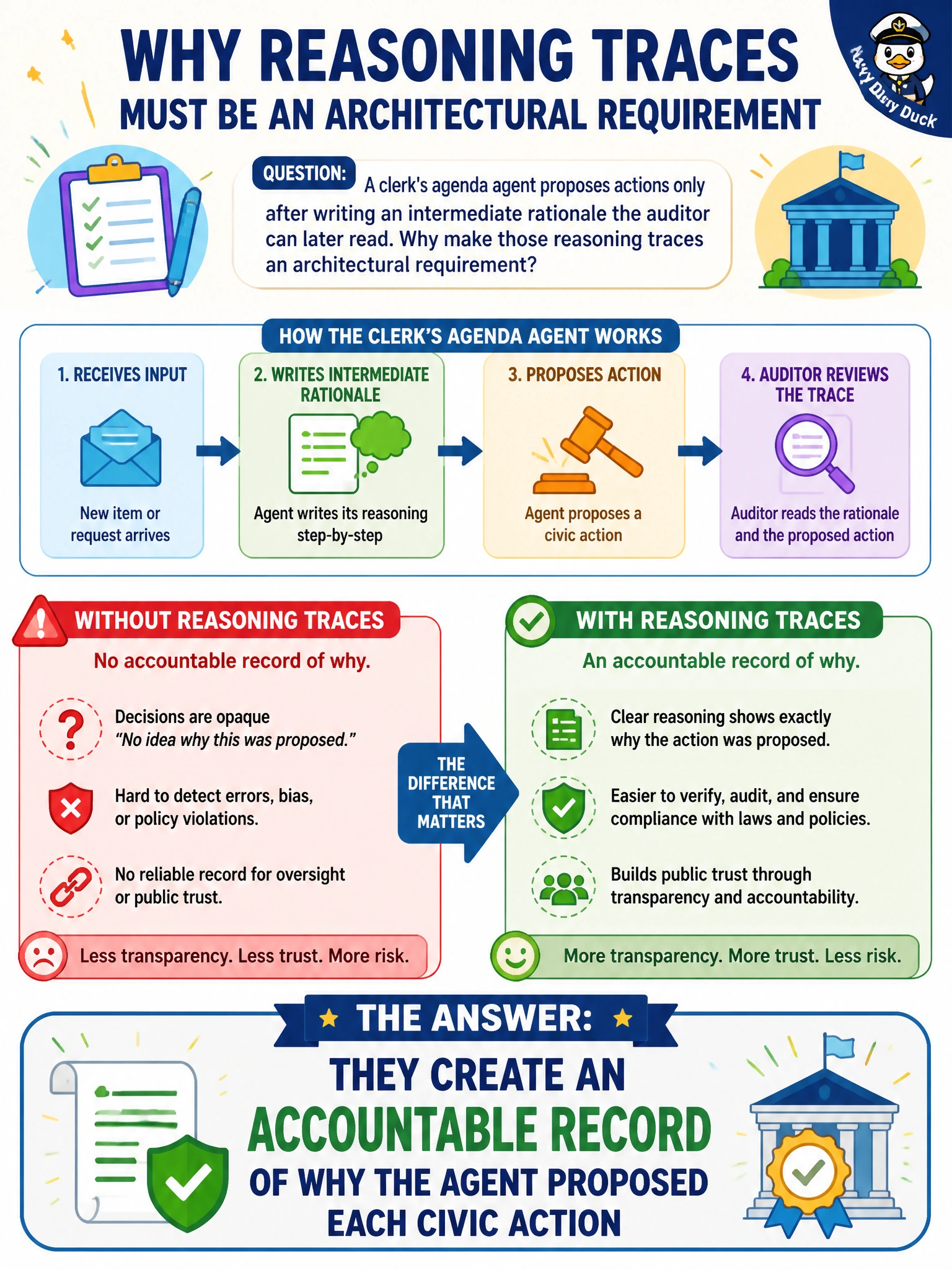
A clerk's agenda agent proposes actions only after writing an intermediate rationale the auditor can later read. Why make those reasoning traces an architectural requirement?
Select an answer to reveal the explanation.
Short Explanation
Auditors don't want a magic agenda fairy—they want the paper trail. Intermediate rationales are that trail: here's why the agent suggested the motion, written down before it acted.
Full Explanation
Requiring intermediate rationales before an agenda agent proposes actions creates an accountable record of why each civic action was suggested. Auditors and clerks can later reconstruct the decision path—policy citations, conflicting items, timing constraints—rather than accepting an opaque recommendation. Making those reasoning traces an architectural requirement therefore serves municipal accountability, not model aesthetics.
Claiming traces guarantee the agent never needs tools fails because rationales explain proposals; they do not replace external data or systems of record. Replacing open-records policies with model logits fails by concept: public-records obligations are legal processes; logits and hidden activations are not a disclosure program. Allowing the agent to hide actions from auditors after the meeting fails because that is the opposite of an accountability requirement.
Exam caveat: intermediate reasoning traces support auditability and review. They are not a substitute for records retention law, nor proof that tools are unnecessary.
Operational check: generate an agenda proposal in a test tenant, persist the intermediate rationale with the proposed action ID, retrieve it through the audit UI after session end, and verify the rationale references the same motions and constraints the agent proposed—without exposing raw chain-of-thought to the public agenda packet unless policy allows.