
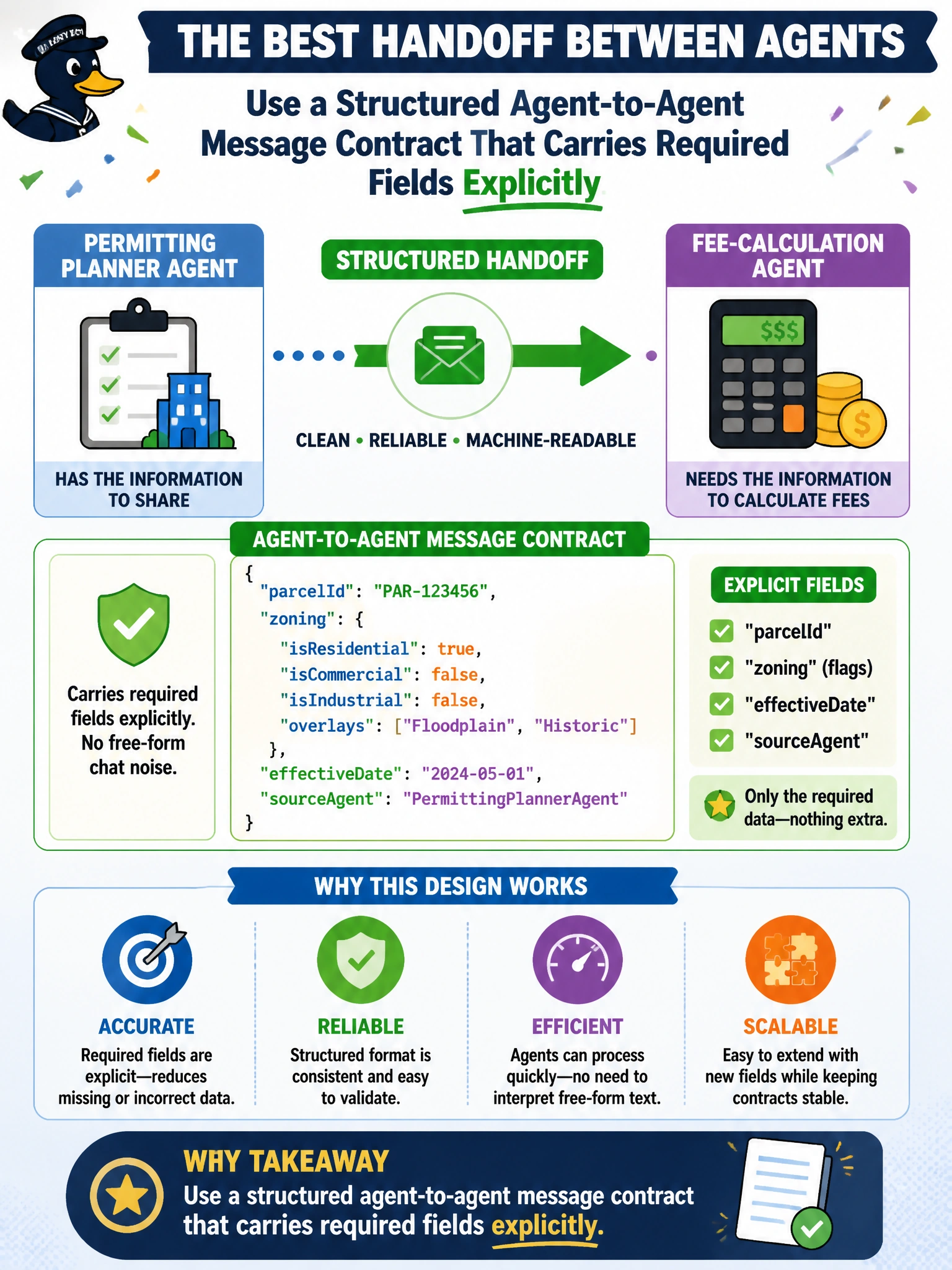
A permitting planner agent must hand a parcel ID and zoning flags to a fee-calculation agent without free-form chat noise. What communication design best supports that handoff?
Select an answer to reveal the explanation.
Short Explanation
Agents shouldn't gossip in essays when a parcel ID will do. A structured handoff is like a routing slip with labeled boxes—parcel, zoning flags, done—so the fee agent gets facts, not chat noise.
Full Explanation
Handoffs between a permitting planner agent and a fee-calculation agent should carry parcel ID and zoning flags through a structured agent-to-agent message contract. Explicit required fields reduce free-form chat noise, schema drift, and silent omission—critical when municipal fee engines depend on precise identifiers and flags rather than narrative paraphrase. That communication design best supports reliable machine-to-machine civic workflow.
Pasting both agents into one shared free-text transcript fails because conversational residue does not guarantee field survival or typed validation. Emailing a human clerk to retype the parcel ID fails by concept: it reintroduces manual latency and transcription error instead of fixing the inter-agent interface. Broadcasting the entire resident chat history to every city agent fails as oversharing: unrelated agents receive unnecessary content, increasing privacy and confusion risk without improving the fee handoff.
Exam caveat: structured contracts are about interoperability and required-field integrity between agents, not about replacing humans for policy exceptions or about pub/sub fan-out patterns.
Operational check: send a contract message with parcel ID and zoning flags omitted one at a time; verify schema validation rejects incomplete payloads; send a complete message and confirm the fee agent computes using exactly those fields without scraping chat text.