
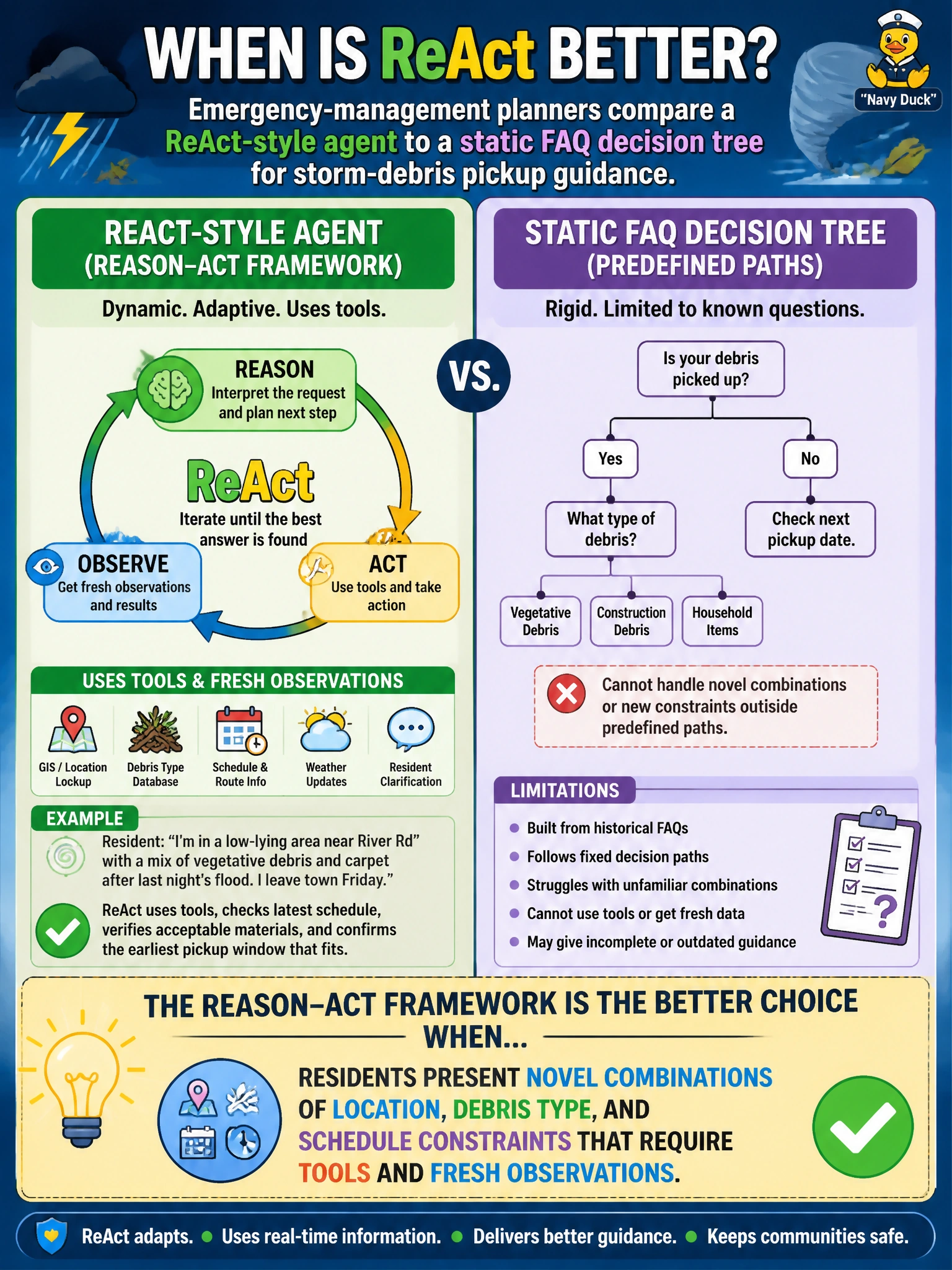
Emergency-management planners compare a ReAct-style agent to a static FAQ decision tree for storm-debris pickup guidance. When is the reason–act framework the better architectural choice?
Select an answer to reveal the explanation.
Short Explanation
Static FAQ trees shine when yesterday's storm looks like every other storm. Novel messes—weird debris, odd streets, shifting pickup windows—need an agent that can think, check live tools, and adapt. That's ReAct territory.
Full Explanation
ReAct-style reason–act architecture outperforms a static FAQ decision tree when residents present novel combinations of location, debris type, and schedule constraints that require tools and fresh observations. Emergency-management storm-debris guidance often includes edge cases that no preauthored FAQ leaf anticipated; the agent must reason, call live pickup or GIS tools, observe results, and adapt. That adaptability is the architectural reason to choose ReAct over a fixed tree.
Choosing ReAct when every scenario already maps to a single fixed FAQ leaf fails because that is precisely when a deterministic tree is sufficient and cheaper to operate. Removing all tool use and answering only from brochure text fails by concept: it denies the live-data loop ReAct exists to provide. Demanding deterministic scripts that never call live schedules likewise fails—those requirements describe the FAQ/script side of the trade-off, not ReAct’s strength.
Exam caveat: the exam contrast is adaptability with tools versus fully anticipated static paths. Do not pick ReAct merely because it sounds more “AI”; pick it when novelty and tool-grounded updates matter.
Operational check: script a novel debris/location/window combination absent from the FAQ, confirm the ReAct agent issues schedule/GIS tool calls and cites Observation data; run a fully covered FAQ case and confirm the tree still handles it without unnecessary tool chatter.