
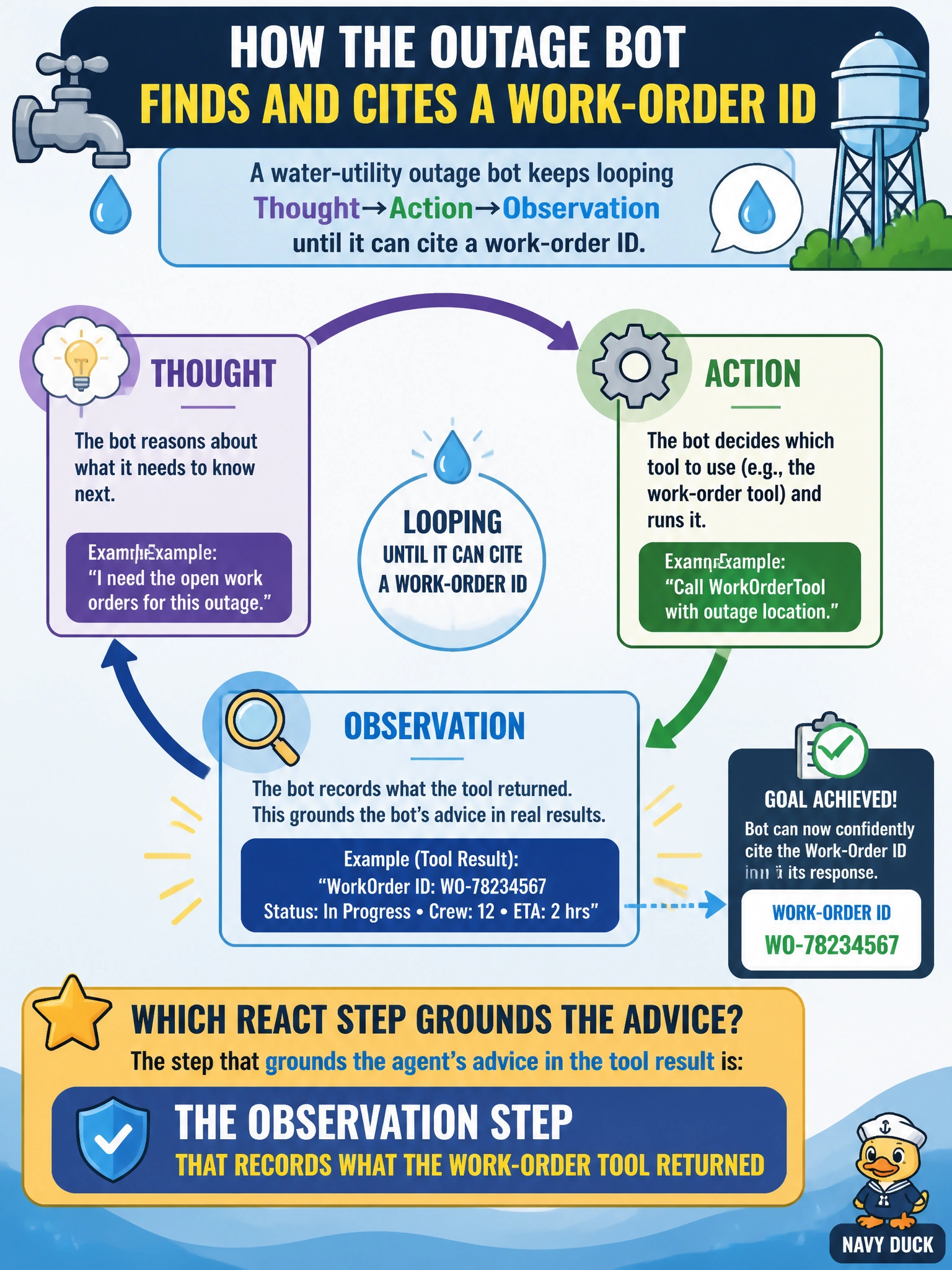
A water-utility outage bot keeps looping Thought→Action→Observation until it can cite a work-order ID. Which ReAct step is primarily responsible for grounding the agent's advice in the tool result?
Select an answer to reveal the explanation.
Short Explanation
Observation is where the wrench hits the pipe—the tool comes back with a work-order ID, and the agent finally has something real to cite. Without that step, Thought and Action are just hoping.
Full Explanation
In ReAct, grounding advice in tool results is the job of the Observation step. When a water-utility outage bot loops Thought → Action → Observation until it can cite a work-order ID, Observation is where the work-order tool’s return value is recorded and made available to subsequent thoughts. Without that binding step, later resident-facing guidance is not tethered to the live municipal system of record.
The initial system prompt’s jargon list fails because prompts supply vocabulary and policy priors; they do not record what a specific tool invocation returned for this outage. The final polite closing sentence fails by concept: courtesy text is presentation, not evidential grounding. A random temperature setting before the first Thought fails because sampling hyperparameters affect generation stochasticity, not the semantic binding of tool output into the agent’s working context.
Exam caveat: candidates often confuse “what makes the agent polite,” “what configures decoding,” or “what seeds domain language” with “what grounds the answer in the tool.” ReAct’s Observation is the grounding hinge.
Operational check: force the work-order tool to return a known ID, inspect the agent trace for an Observation containing that ID, then confirm the resident reply cites the same ID; fail the tool once and confirm the agent does not invent a work-order number in place of a missing Observation.