
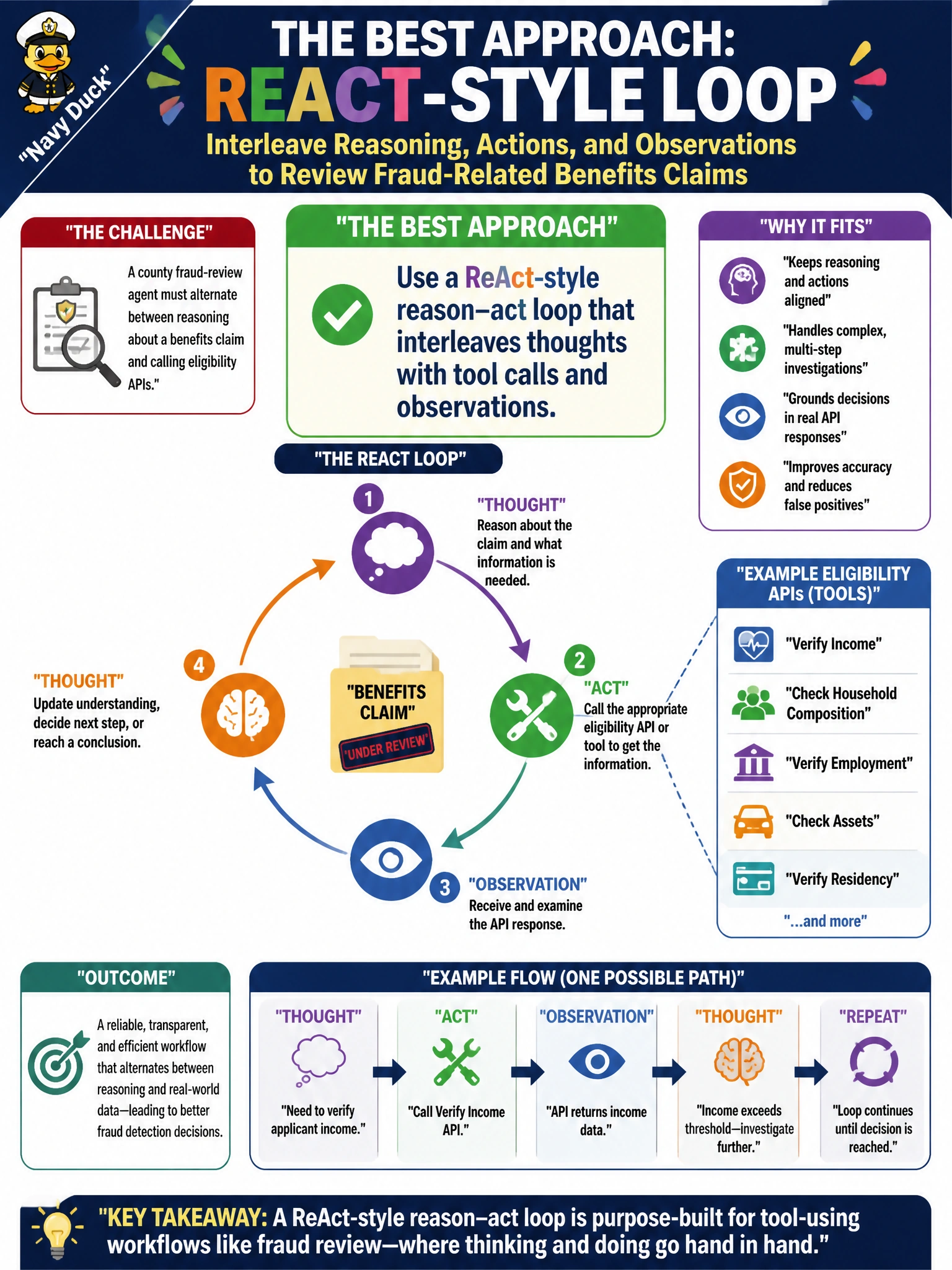
A county fraud-review agent must alternate between reasoning about a benefits claim and calling eligibility APIs. Which approach best fits that tool-using workflow?
Select an answer to reveal the explanation.
Short Explanation
You need an agent that reasons, checks eligibility APIs, and then uses what it learns to continue—like a caseworker moving between notes and an eligibility terminal. ReAct gives you that Thought → Action → Observation rhythm instead of a single unsupported guess.
Full Explanation
A county fraud-review agent that alternates between reasoning about a benefits claim and calling eligibility APIs needs an interleaved tool-using control loop. A ReAct-style reason–act pattern fits because it structures Thought → Action (tool call) → Observation → continued reasoning, allowing the agent to ground each eligibility judgment in live API evidence rather than a single unaudited guess. This matches investigative civic review, where facts arrive from systems of record across multiple steps. Relying on the system prompt’s policy summary without consulting eligibility APIs fails because prompt text cannot substitute for current claim and eligibility state in county systems. Returning a canned denial for every claim abandons individualized evidence gathering merely to avoid API latency, which is incompatible with fair fraud review. Disabling reasoning traces and emitting only a final eligibility boolean leaves reviewers with no intermediate rationale or tool observations for auditability, just a bare result. Exam caveat: ReAct is the best fit when the question emphasizes alternation between reasoning, tool calls, and observations; the other listed approaches omit API evidence, individualized review, or an inspectable reasoning path. Practical check: run a synthetic claim with mocked eligibility APIs, confirm the trace shows multiple thought/action/observation cycles, then inject a corrected API observation mid-loop and verify that the final determination changes rather than ignoring the tool result.