
A public hospital district throughput desk shares a municipal Conda forge mirror across teams. What collaborative practice reduces dependency chaos?
Select an answer to reveal the explanation.
Short Explanation
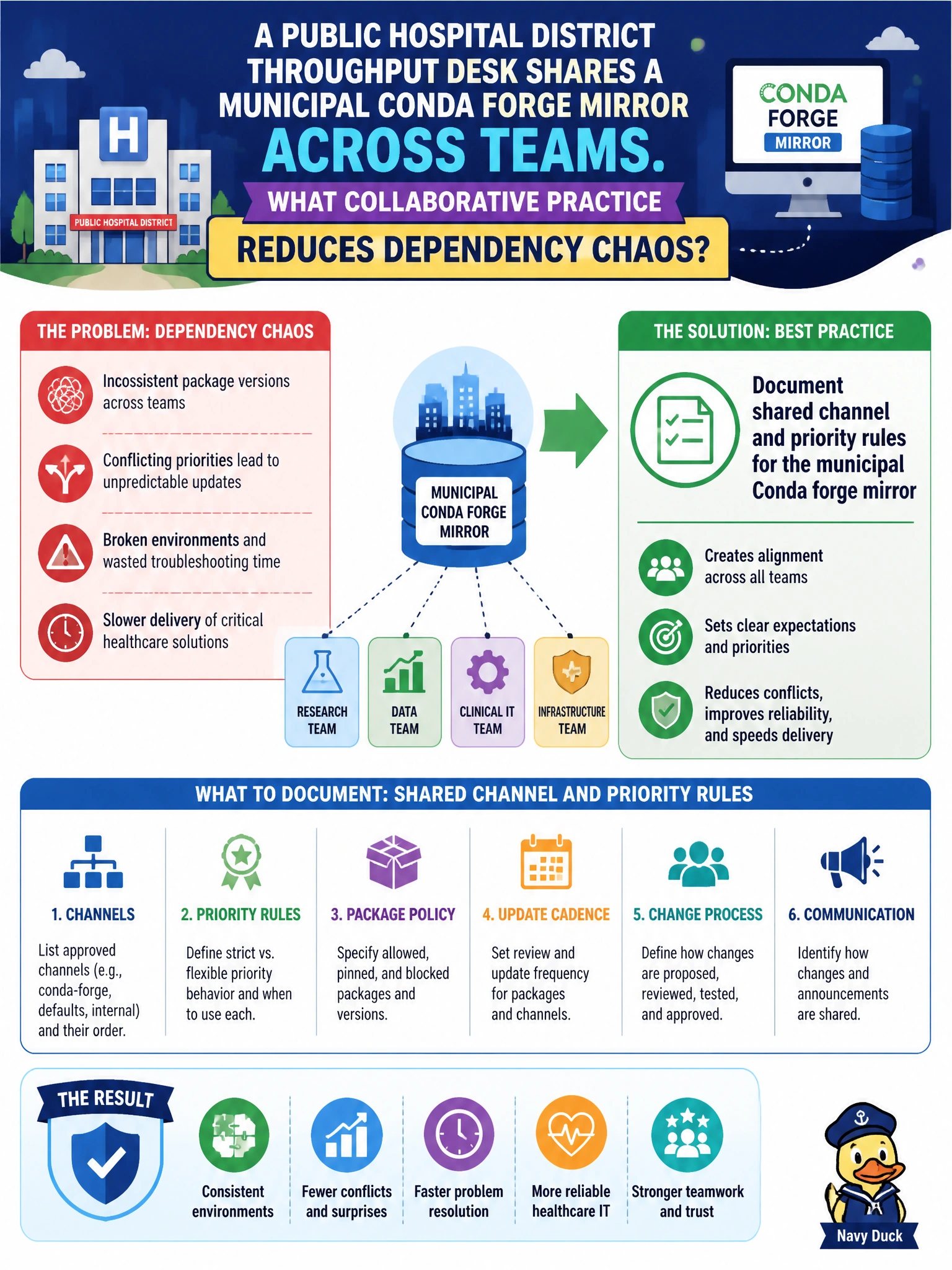
A shared Conda mirror is a shared pantry—post the channel and priority rules on the door so nobody restocks mystery spices.
Full Explanation
A public hospital district throughput desk sharing a municipal Conda forge mirror across teams reduces chaos only when channel membership and priority are shared knowledge. Solves depend on which channels are visible and in what order; undocumented differences produce conflicting package builds across teams. The collaborative practice that fits is to document shared channel and priority rules for the municipal Conda forge mirror so every team’s solve starts from the same policy.
Letting each team silently add channels in any order without documentation guarantees divergent solves and “it installed on our side” disputes. Prioritizing personal Anaconda Cloud tokens over the municipal mirror always undermines the point of a governed civic mirror and can pull unaudited builds. Disabling the mirror and downloading wheels from unvetted blogs abandons supply-chain hygiene for hospital analytics.
Exam caveat: documentation must include both channel list and priority—identical channels in different order can still yield different builds. Mirror outages need a written fallback that still preserves governance, not ad hoc blog downloads.
Operational check: publish the channel/priority standard next to the mirror URL, encode it in shared Condarc or CI configuration, periodically audit team environments for rogue channels, and require change review when someone proposes a new channel for throughput pipelines.