
A fire/EMS response-time lab shares GPU workstations among analysts. How should they manage dependencies so one upgrade does not break others?
Select an answer to reveal the explanation.
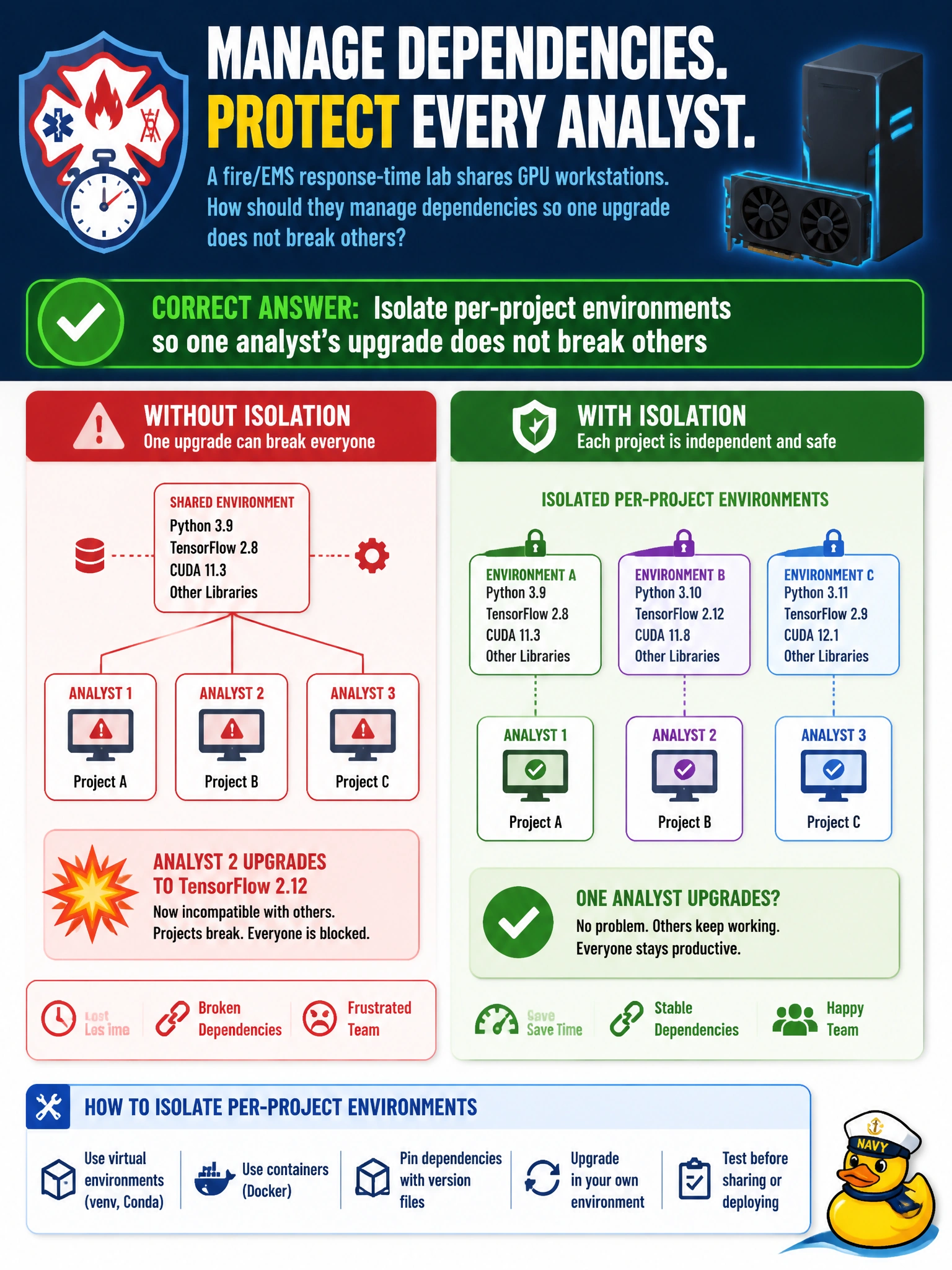
Short Explanation
On shared firehouse GPUs, give each project its own toolkit so one analyst’s upgrade doesn’t knock everyone else’s hose couplings loose. You’ll keep changes contained with isolation and let other workflows keep running.
Full Explanation
A fire/EMS response-time lab sharing GPU workstations must prevent one upgrade from breaking everyone else’s environment. Dependency isolation is the core control: each project or analyst workflow gets its own environment, keeping package changes scoped. Isolating per-project environments so one analyst’s upgrade does not break others is the correct multi-user practice on shared civic GPUs. Forcing everyone onto one mutable global site-packages tree creates a shared failure domain: an upgrade can break unrelated response-time notebooks. Allowing anyone to sudo-pip into the system Python mid-shift extends that risk to OS Python and can disrupt unrelated system tooling. Banning installs and pinning every analyst to library paths from an old laptop freezes the lab in an unmaintainable, unreproducible state. Exam caveat: isolation can use Conda environments, venvs, or containers; the point is the scope of mutation, not a particular tool. Shared base images or modules are fine if upgrades land in isolated overlays rather than a mutable global tree. Practical check: provision named per-project environments on shared fire/EMS GPU hosts, document activation commands, remove analysts’ write access to system site-packages, and test that upgrading project A’s pins leaves project B’s imports working.