
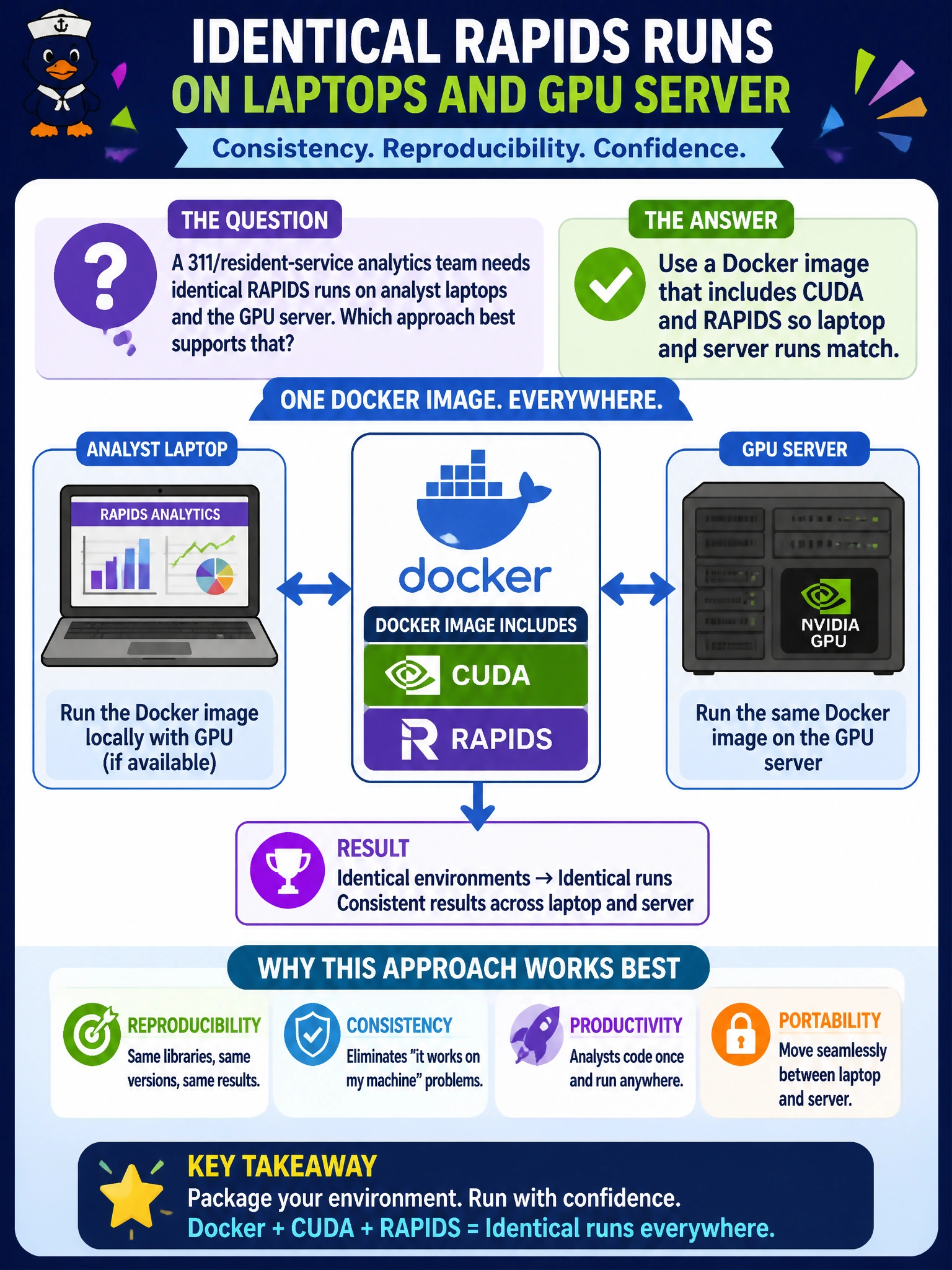
A 311/resident-service analytics team needs identical RAPIDS runs on analyst laptops and the GPU server. Which approach best supports that?
Select an answer to reveal the explanation.
Short Explanation
Docker with CUDA and RAPIDS is the same lunchbox on every desk—laptop or server, the sandwich comes out the same.
Full Explanation
A 311/resident-service analytics team that needs identical RAPIDS runs on analyst laptops and the GPU server must eliminate host-by-host install drift. Containerization packages the CUDA user-space libraries and RAPIDS stack into one image so both classes of machine execute the same environment. Using a Docker image that includes CUDA and RAPIDS so laptop and server runs match is therefore the best of the listed approaches for identical accelerated behavior.
Installing different package sets on each host and comparing results by eye invites silent numeric and API drift and makes “identical” unverifiable. Disabling containers and requiring manual GUI installs before every job maximizes human error and non-reproducibility. Shipping only CSV extracts and forbidding environment tooling may move data but does nothing to align the compute stack that transforms those extracts.
Exam caveat: containers share the host GPU via the NVIDIA Container Toolkit; the host driver still must be compatible. Docker equality also depends on pinning image digests—floating “latest” tags recreate the same drift problem inside a new abstraction.
Operational check: build or pull a pinned CUDA+RAPIDS image, run the 311 pipeline smoke test on a laptop and on the GPU server with the same image digest, compare checksums or key metrics, and document the image tag in the team runbook.