
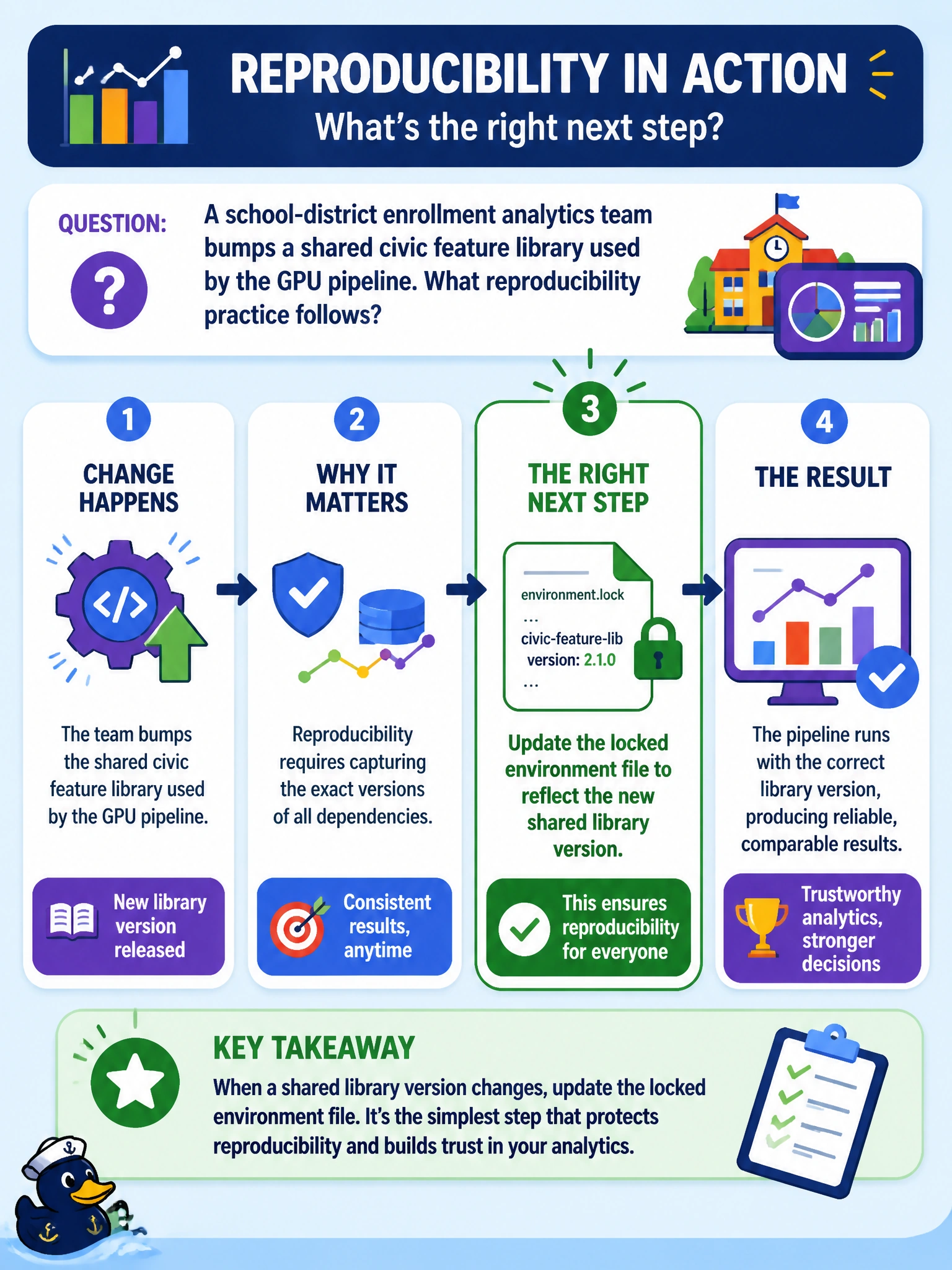
A school-district enrollment analytics team bumps a shared civic feature library used by the GPU pipeline. What reproducibility practice follows?
Select an answer to reveal the explanation.
Short Explanation
When the shared library gets a new coat of paint, refresh the locked env file—otherwise the recipe still lists yesterday's ingredients.
Full Explanation
When a school-district enrollment analytics team bumps a shared civic feature library used by the GPU pipeline, reproducibility artifacts must track that change. Locked environment files exist so recreations match what production actually runs. The correct follow-through is to update the locked environment file to reflect the new shared library version so subsequent solves and peer recreations install the intended dependency.
Leaving the locked environment file unchanged so old pins forever win freezes documentation in a lie: new code imports a new library while the lockfile still describes yesterday’s stack, causing “works on my machine” drift. Deleting the environment file to force each analyst to improvise destroys the shared contract entirely. Storing the new library only on one laptop and never documenting it creates a hidden single point of failure and unreproducible GPU pipeline behavior.
Exam caveat: updating the lockfile should be coupled with a tested solve—bumping a pin without resolving CUDA/RAPIDS constraints can break the environment. Treat shared library upgrades as intentional changes that go through the same review path as code.
Operational check: bump the shared feature library pin, regenerate or edit the lock/constraints file, recreate the env from scratch on a clean GPU host, run enrollment pipeline smoke tests, and commit lockfile and code changes together with a clear message.