
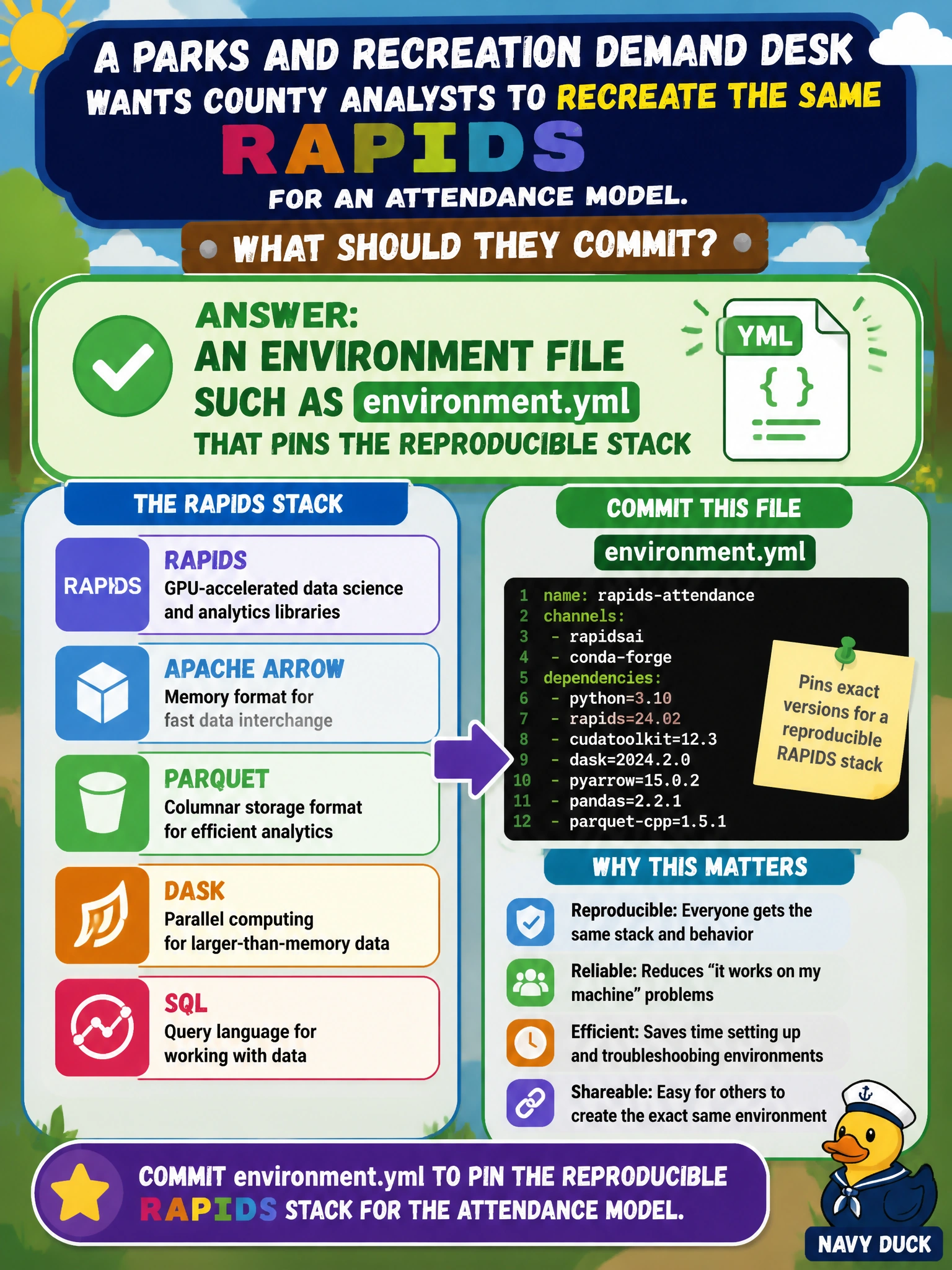
A parks and recreation demand desk wants county analysts to recreate the same RAPIDS stack for an attendance model. What should they commit?
Select an answer to reveal the explanation.
Short Explanation
If you want teammates to bake the same cake, leave the recipe—commit an environment.yml, not a blurry notebook selfie.
Full Explanation
A parks and recreation demand desk that wants county analysts to recreate the same RAPIDS stack for an attendance model must ship an environment definition, not folklore. Reproducible accelerated analytics depends on declaring packages, versions, and CUDA-compatible builds in a maintained file. Committing an environment file such as environment.yml that pins the reproducible stack is the correct practice so another analyst can recreate the Conda/RAPIDS environment on their host.
Only a screenshot of a working notebook cell with package versions cropped out is incomplete, non-executable documentation and often omits transitive pins. A verbal note in chat that someone used “whatever Conda had last Tuesday” is ephemeral and non-auditable. Shipping trained model weights alone with no environment declaration may allow inference in some setups but does not recreate the training or feature pipeline stack county analysts need.
Exam caveat: an environment file is necessary but not always sufficient—CUDA driver versions on the host, channel order, and platform tags can still break solves. Pair environment.yml with a short README of host prerequisites (driver, OS) for civic shared workstations.
Operational check: export the working parks environment with pinned versions, commit it beside the attendance pipeline, create a fresh env from that file on a clean machine, and confirm RAPIDS imports and a smoke-test training job before calling the stack reproducible.