
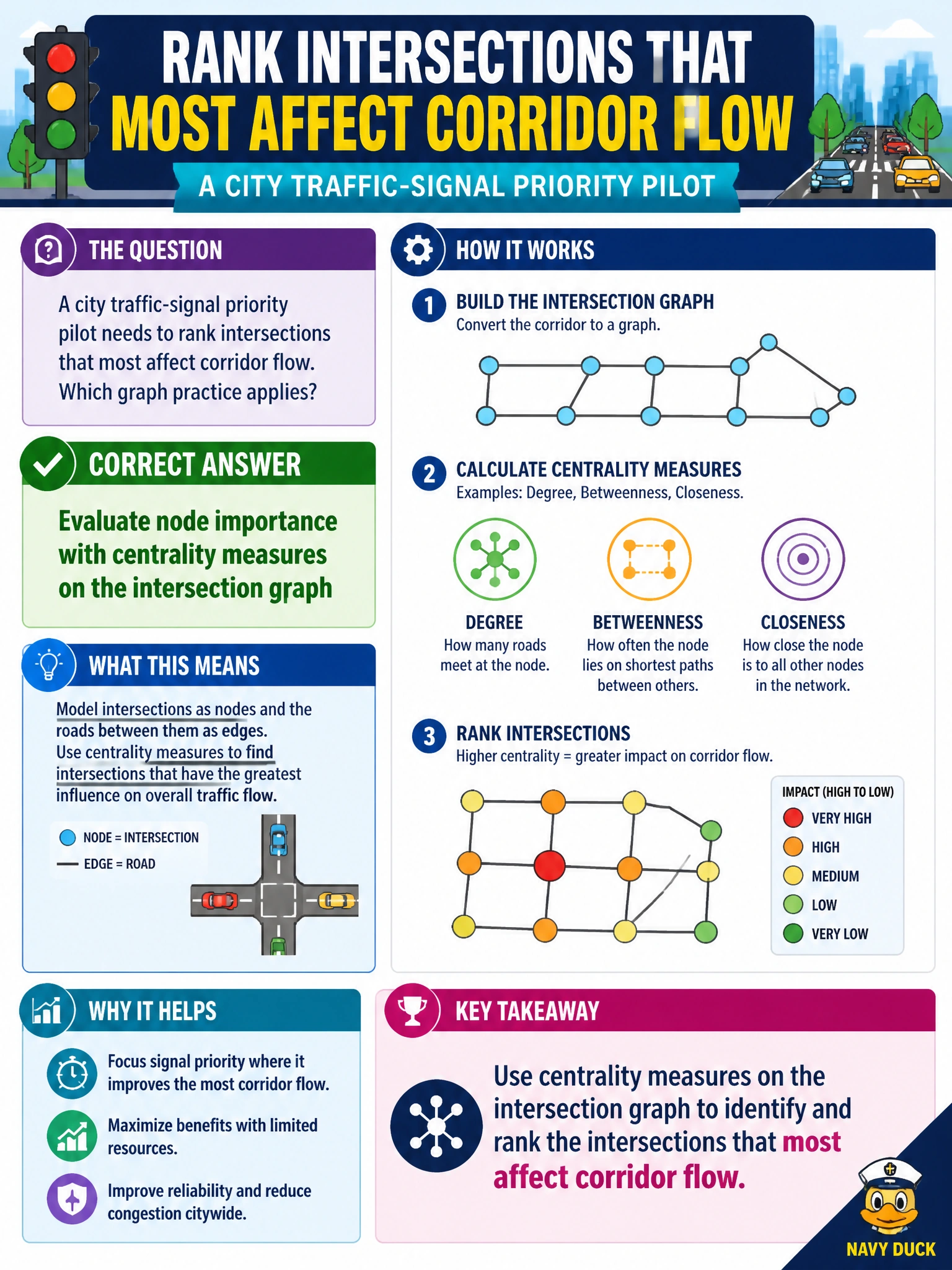
A city traffic-signal priority pilot needs to rank intersections that most affect corridor flow. Which graph practice applies?
Select an answer to reveal the explanation.
Short Explanation
The busiest crossroads aren't always the ones with the prettiest names—centrality scores tell you which nodes really hold the network together.
Full Explanation
A city traffic-signal priority pilot that must rank intersections by their effect on corridor flow is asking a node-importance question on a network. Intersections are nodes; approaches and corridor links are edges. Centrality measures (and related structural scores) quantify how much each intersection bridges or concentrates flow opportunity in that graph. Evaluating node importance with centrality on the intersection graph therefore aligns the analytic with the operational ranking need.
Ranking intersections by street-name alphabetical order ignores traffic structure entirely and produces an administratively tidy list with no flow meaning. Dropping node scores and reporting only total citywide vehicle counts answers a volume question, not which intersections matter most inside the corridor graph. Sampling one random intersection per ZIP code without network metrics adds geographic spread but still omits structural influence along the corridor.
Exam caveat: different centrality flavors answer different questions—betweenness emphasizes bridges, degree emphasizes local connectivity, PageRank-style scores emphasize recursive importance. Pick the measure that matches “affects corridor flow,” and consider weighted or directed graphs when approach volumes or one-way links matter. Centrality is structural; it should be combined with observed delay data for final priority decisions.
Operational check: build the corridor intersection graph from the signal network, compute the chosen centrality with documented parameters, overlay empirical delay or volume, and review the top-ranked nodes with traffic engineers before programming priority changes.