
A transit authority ridership desk finds a short weekday series slower on GPU than on CPU for simple rolling means. What explanation fits?
Select an answer to reveal the explanation.
Short Explanation
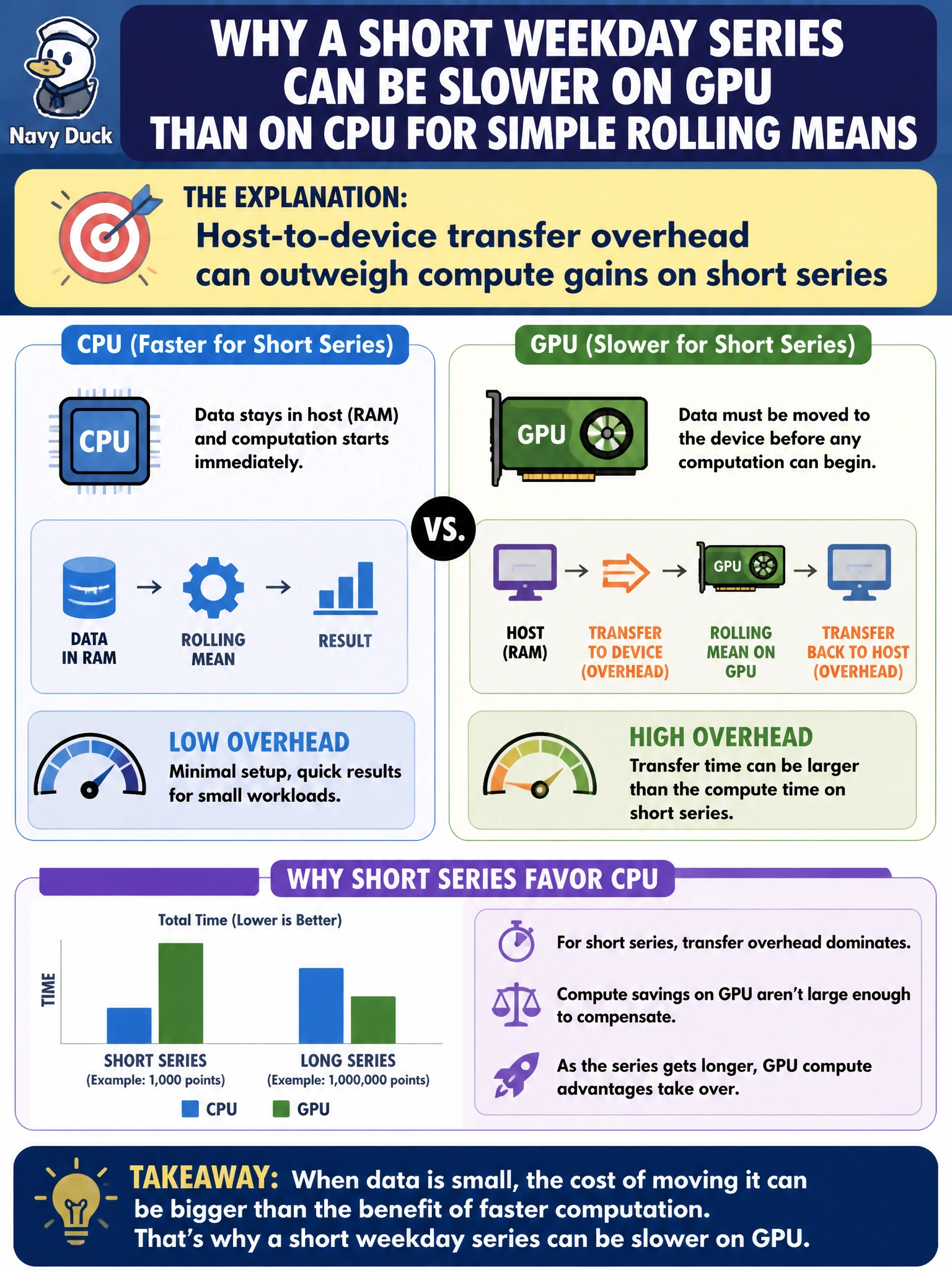
For a tiny ridership table, sending the data to the GPU can be like driving across town to use a stadium kitchen for one sandwich—the trip may take longer than the cooking. Transfer overhead can outweigh the compute savings, so you may find the CPU is faster on a short series.
Full Explanation
When a transit authority ridership desk finds a short weekday series slower on GPU than on CPU for simple rolling means, the likely explanation is overhead, not impossibility. Moving a small table to device memory, launching kernels, and copying results back can take more wall time than the arithmetic itself. Host-to-device transfer overhead can therefore outweigh compute gains on short series, making CPU the faster choice for that specific ridership window. The claim that GPUs cannot compute rolling means on any numeric series is false: GPUs can perform these calculations, with benefits more likely when data volume amortizes the movement costs. The suggestion that RAPIDS may require a minimum row count before it can calculate rolling means on weekday data mistakes a possible performance limitation for a computation restriction; a short series may be inefficient without being forbidden. The claim that the CPU result must be wrong whenever GPU wall time is higher confuses performance with correctness: both backends should produce numerically comparable results, and a slower path is not proof of an error. Exam caveat: “short” is relative to PCIe bandwidth, kernel complexity, and whether the series is already on the device from a prior step. A one-off rolling mean may not benefit, while repeated windows or downstream RAPIDS stages that reuse device-resident data may. Practical check: time CPU and GPU on the actual short weekday extract, keep CPU as the default when GPU is slower, and revisit acceleration if the desk expands to multi-route, multi-month series that justify device transfer.