
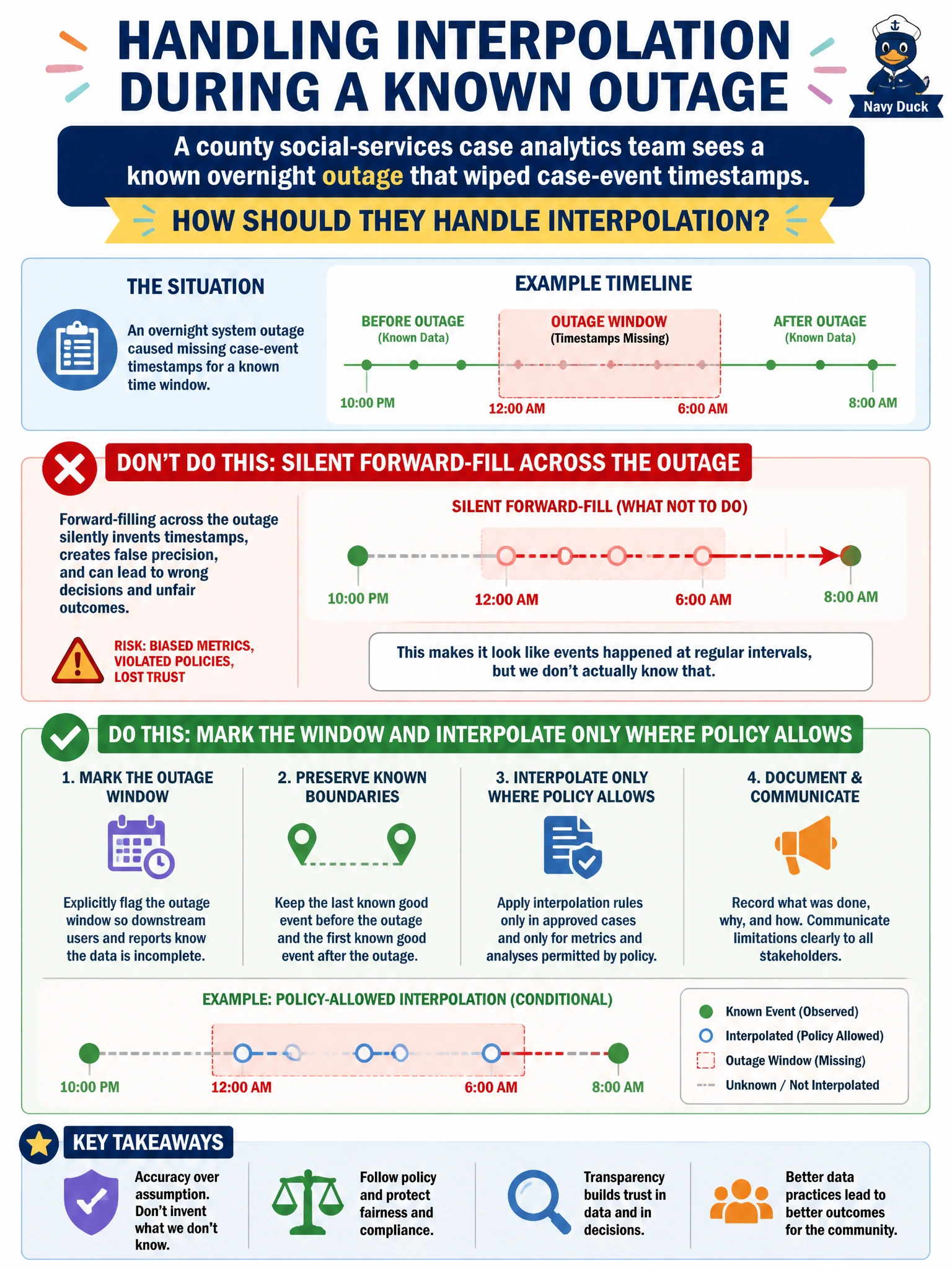
A county social-services case analytics team sees a known overnight outage that wiped case-event timestamps. How should they handle interpolation?
Select an answer to reveal the explanation.
Short Explanation
A known outage is a closed bridge—don't pretend cars still crossed by secretly forward-filling; flag the gap and only interpolate where the policy says it's okay.
Full Explanation
When a county social-services case analytics team knows an overnight outage wiped case-event timestamps, interpolation must preserve operational truth rather than cosmetic continuity. The correct approach is to avoid silent forward-fill across the outage, mark the outage window explicitly, and interpolate only where policy allows—often not at all for administrative systems where absence of events means the system was down, not that casework continued unchanged.
Forward-filling the last pre-outage values across the outage with no flags invents activity and caseload continuity that never occurred, biasing workload forecasts and audit trails. Back-filling from the first post-outage value similarly fabricates a smooth recovery path and can mis-time backlog arrival. Imputing outage hours with the monthly mean while hiding the outage in features conceals a known data-quality incident and teaches the model that average volumes occurred during downtime.
Exam caveat: techniques that are fine for brief sensor dropouts (linear interpolation, limited forward-fill) become harmful when the gap is a documented infrastructure failure in case-management systems. Governance and explainability requirements for social services often demand outage flags over seamless charts.
Operational check: write the outage start/end into a quality log, add a binary outage feature to downstream models, exclude or specially weight those hours in accuracy reports, and confirm dashboards label the window so program managers do not treat imputed continuity as real case throughput.