
A city planning zoning analytics team ingests multi-sensor environmental feeds with skewed clocks for a land-use pilot. What accelerated approach fits irregular timestamps?
Select an answer to reveal the explanation.
Short Explanation
Skewed sensor clocks are like musicians playing in different time signatures—sync them to one grid, then let cuDF fill the beats on the GPU.
Full Explanation
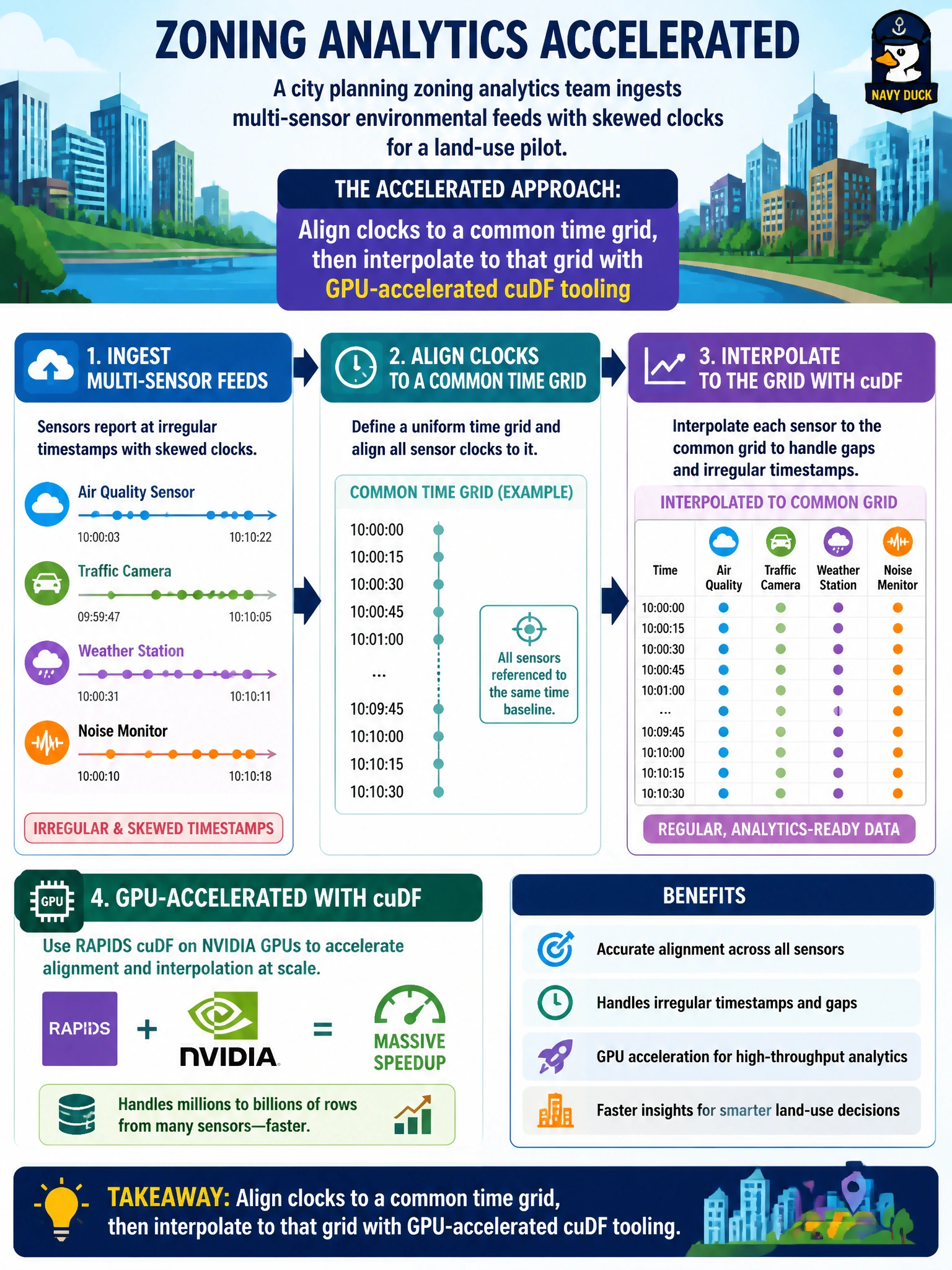
A city planning zoning analytics team ingesting multi-sensor environmental feeds with skewed clocks must first make timestamps comparable. Irregular and drifted clocks prevent valid joins, lag alignment, and multivariate feature construction for land-use pilots. The accelerated approach that fits is to align clocks to a common time grid, then interpolate onto that grid with GPU-accelerated cuDF tooling so heterogeneous sensors share one temporal index at municipal scale.
Keeping each sensor on its native clock and joining only on sensor IDs while ignoring time produces non-contemporaneous feature vectors—temperature from noon paired with particulate readings from another hour—corrupting any land-use or exposure model. Downsampling everything to monthly medians before alignment may hide clock skew but destroys the temporal resolution zoning pilots usually need for diurnal and event-driven effects. Converting timestamps to row indexes and sorting alphabetically by sensor name abandons time entirely and cannot recover temporal relationships.
Exam caveat: clock alignment (time-zone normalization, drift correction, shared grid) precedes interpolation; interpolating before alignment simply invents values on incompatible clocks. GPU acceleration speeds the transform but does not replace validation of sensor clocks against a trusted civic time source.
Operational check: pick an authoritative grid (for example UTC hourly), measure per-sensor offset and missingness, align then interpolate within approved gap limits, and verify that post-alignment correlations between co-located sensors behave physically before training the zoning pilot models.