
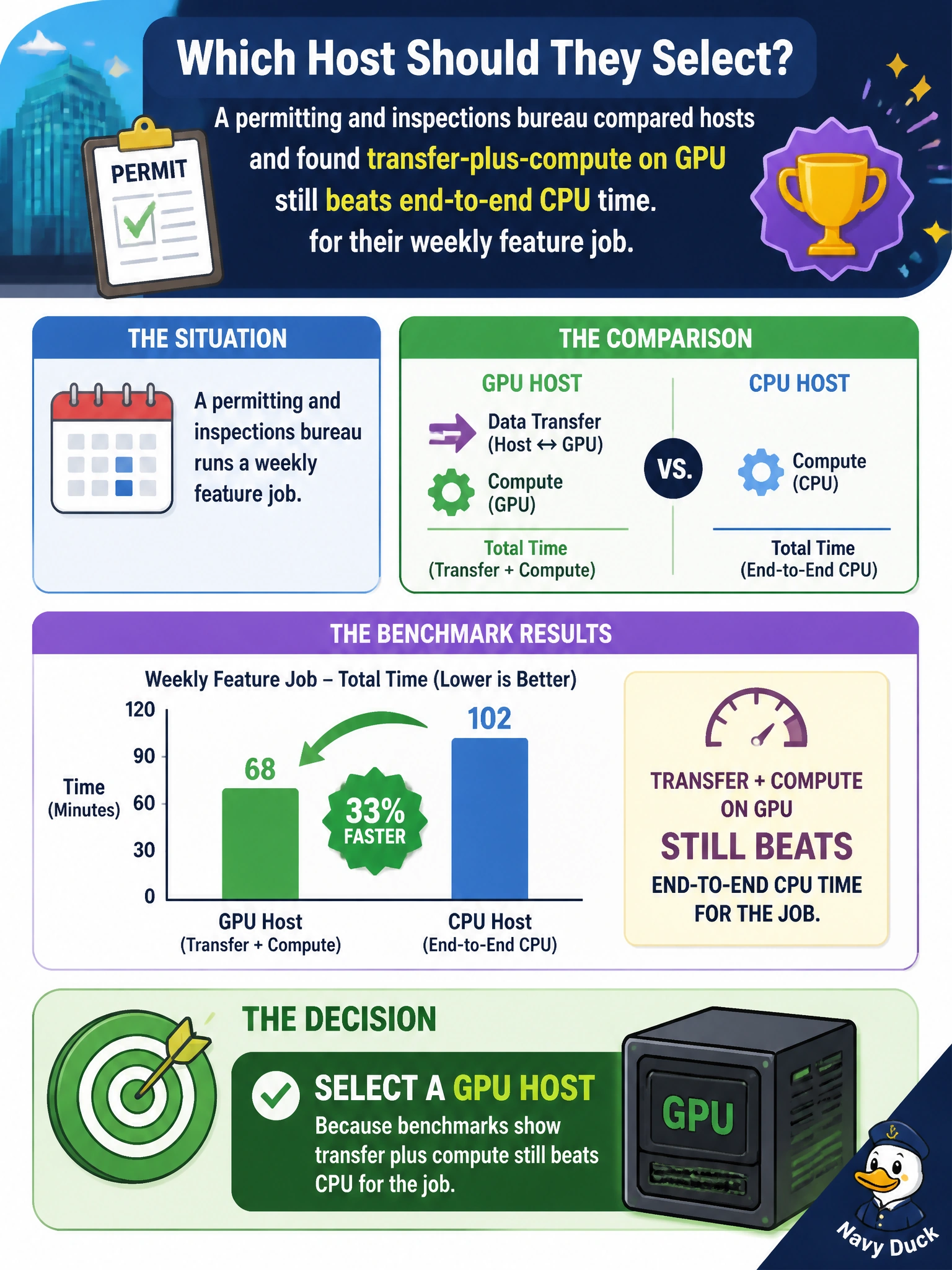
A permitting and inspections bureau compared hosts and found transfer-plus-compute on GPU still beats end-to-end CPU time for their weekly feature job. What should they select?
Select an answer to reveal the explanation.
Short Explanation
If the stopwatch still favors GPU after counting transfers, pick the GPU host—measurements beat folklore.
Full Explanation
A permitting and inspections bureau that compared hosts and found transfer-plus-compute on GPU still beats end-to-end CPU time for their weekly feature job should select a GPU host. Optimal hardware selection follows measured results: if GPU remains faster after including data transfer costs, choosing GPU is the evidence-based introductory MLOps decision for that permitting feature pipeline. Folklore about transfers always killing GPU value does not override a concrete benchmark.
Selecting a CPU-only host despite worse measured end-to-end time fails by concept: it ignores the bureau's own evidence and accepts a slower weekly feature job. Choosing no compute host and manual spreadsheet entry only fails because manual entry cannot meet automated weekly feature SLAs at scale. Picking the oldest laptop in surplus storage regardless of benchmarks fails by substituting inventory convenience for measured performance.
Exam caveat: when a question states that GPU transfer-plus-compute still wins, the answer is to choose GPU—do not invent a transfer veto the measurements already refuted.
Operational check: archive the host comparison report showing GPU end-to-end advantage for the permitting feature job, provision the GPU host accordingly, and re-time the weekly job after cutover to confirm the SLA still holds.