
A 311/resident-service analytics team must decide whether CPU pandas or GPU cuDF better meets the weekly county extract SLA. What should guide the choice?
Select an answer to reveal the explanation.
Short Explanation
Race the weekly extract on CPU pandas and GPU cuDF—let the stopwatch, not a coin flip, pick the hardware.
Full Explanation
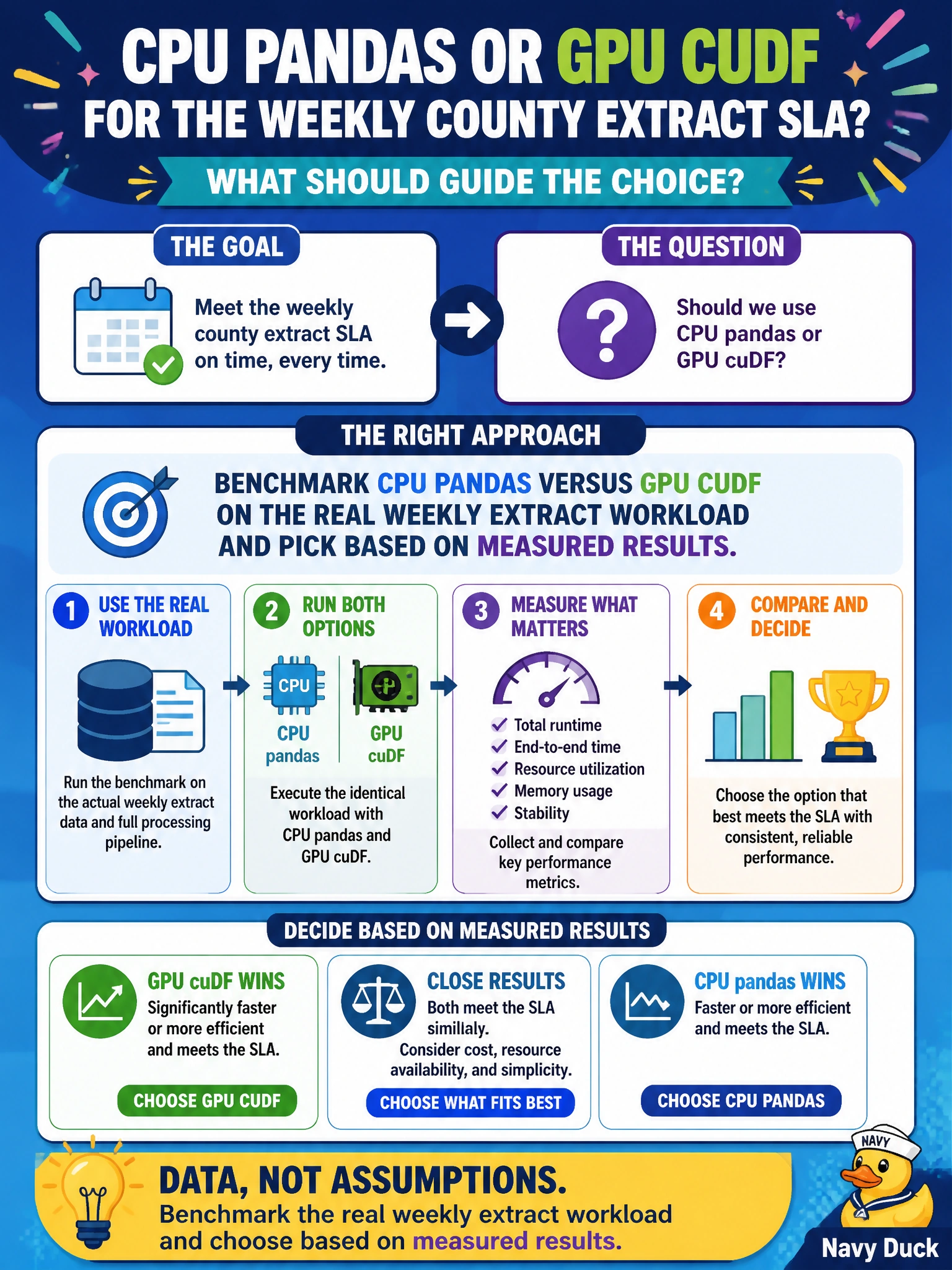
A 311/resident-service analytics team deciding between CPU pandas and GPU cuDF for the weekly county extract SLA should benchmark both on the real weekly extract workload and pick based on measured results. Hardware and library choice at associate level is evidence-driven: end-to-end timings on the actual civic extract (including I/O and transfers) show whether GPU acceleration meets the SLA better than CPU pandas. Dogma without a stopwatch is not MLOps.
Always choosing GPU with no timing evidence fails by concept: GPUs are not automatically faster once transfer and orchestration overheads are counted for every workload. Always choosing CPU because GPUs cannot process tabular data fails because RAPIDS cuDF exists specifically to accelerate tabular workflows on GPU. Flipping a coin in the service desk lobby fails because chance is not an SLA decision method.
Exam caveat: correct answers emphasize benchmarking the real workload—not brand loyalty to CPU or GPU.
Operational check: run timed pandas and cuDF versions of the weekly 311/county extract on representative data volumes, record wall-clock and resource use, compare against the SLA, and document the winning path before locking the production schedule.