
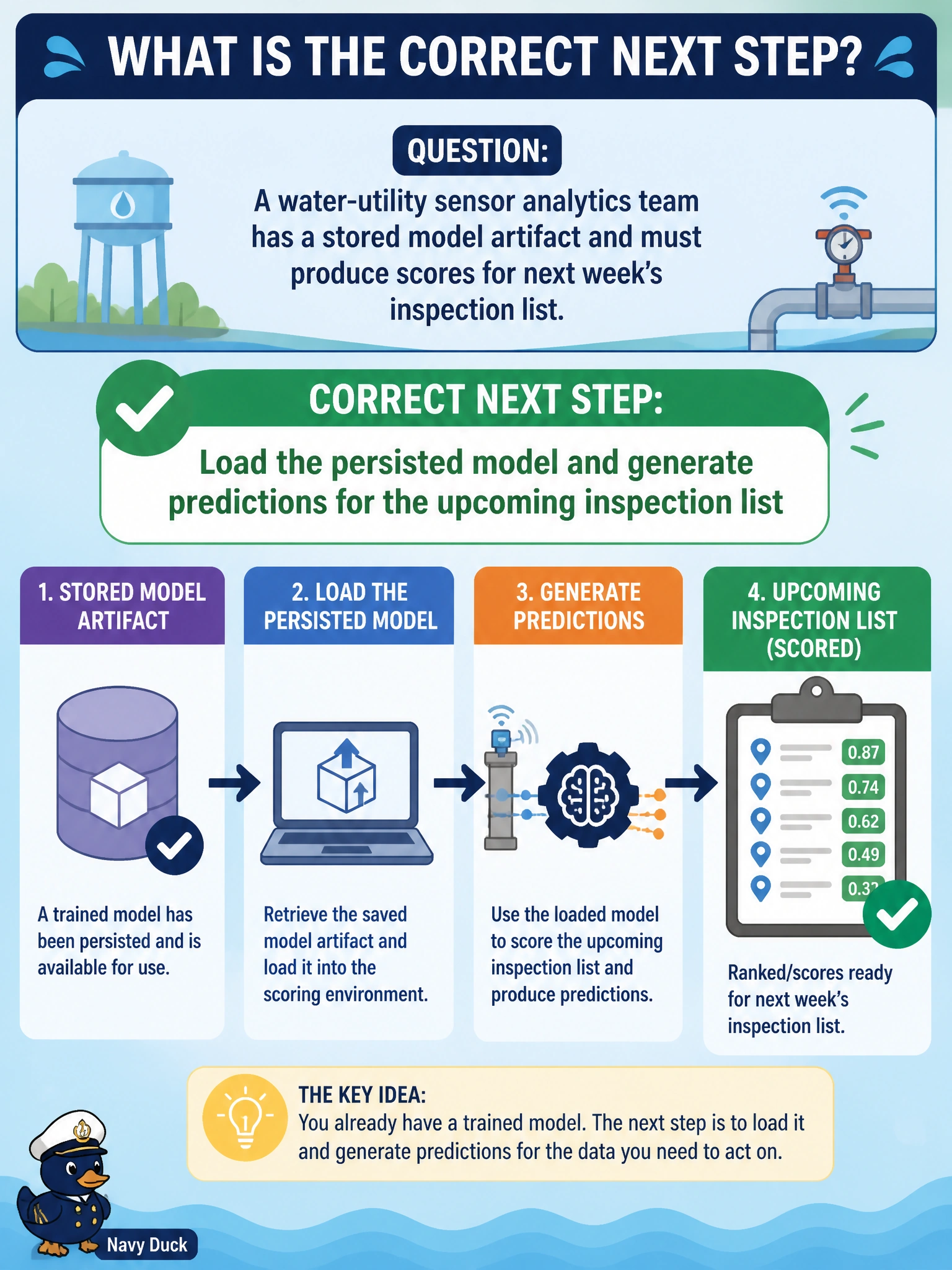
A water-utility sensor analytics team has a stored model artifact and must produce scores for next week's inspection list. What is the correct next step?
Select an answer to reveal the explanation.
Short Explanation
The stored artifact is the wrench in the toolbox—load it and score next week's inspection list.
Full Explanation
A water-utility sensor analytics team that already has a stored model artifact and must score next week's inspection list should load the persisted model and generate predictions for that list. Once an artifact exists, the operational next step is inference: present the upcoming inspections in the expected feature schema and emit scores or ranks for field planning. Reloading the champion preserves continuity with the validated training run.
Throwing away the artifact and guessing inspection priorities manually fails by concept: it abandons the trained signal the utility already paid to produce. Retraining a new model for every single inspection row independently fails because per-row retraining is computationally absurd and destroys a stable scoring policy. Exporting the model as an unreadable screenshot only fails because a screenshot is not a loadable inference artifact and cannot score sensor features.
Exam caveat: distinguish training, persistence, and scoring stages—when the artifact already exists, the next step is load-and-predict, not retrain or discard.
Operational check: load the stored water-utility model in the scoring environment, confirm feature columns for next week's inspection extract match training, write predictions to the inspection work queue, and spot-check a handful of high-priority assets before crews roll.