
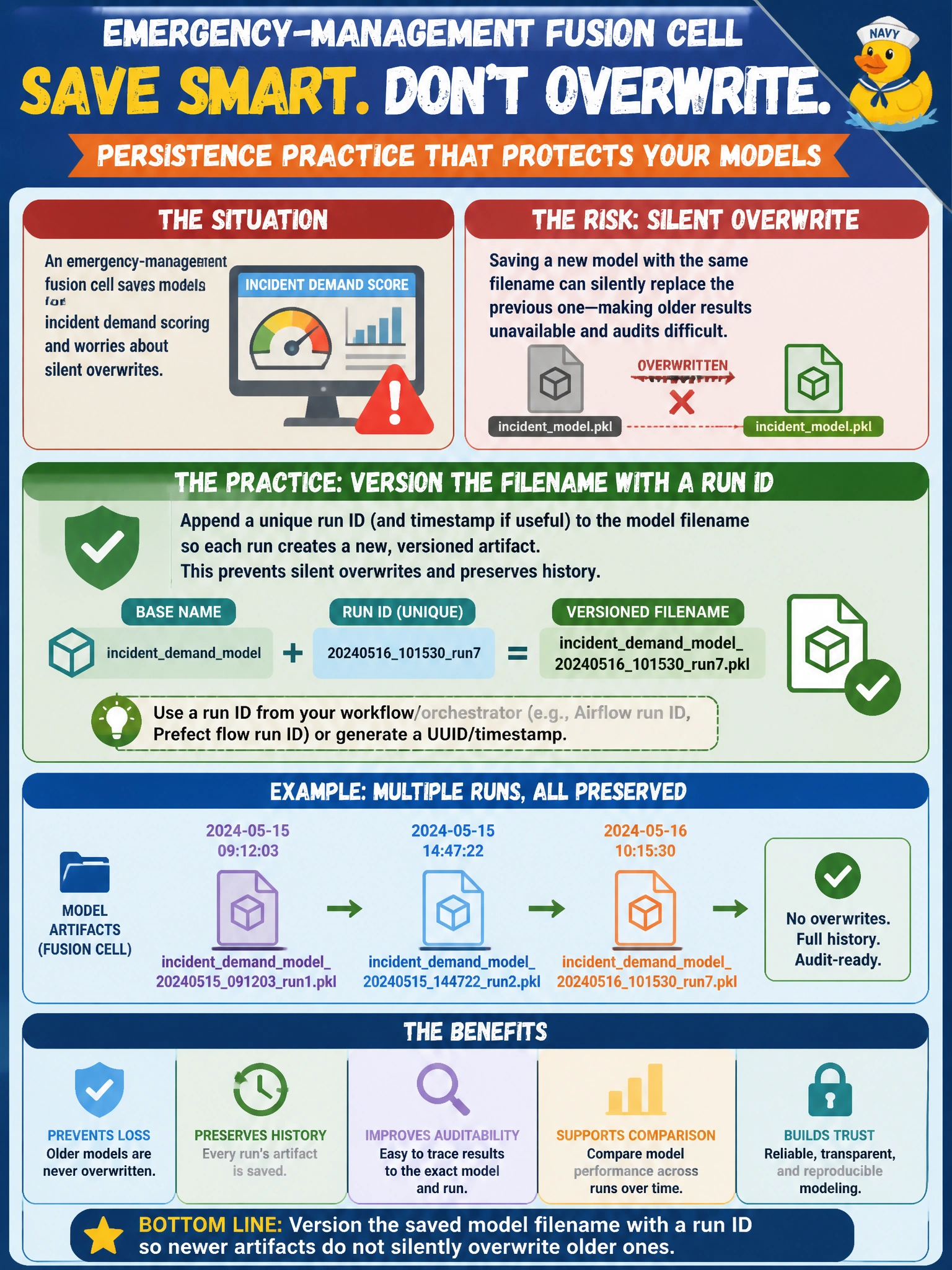
An emergency-management fusion cell saves models for incident demand scoring and worries about silent overwrites. What persistence practice should they adopt?
Select an answer to reveal the explanation.
Short Explanation
Put the run ID in the filename like a badge number—then yesterday's model doesn't get quietly overwritten.
Full Explanation
An emergency-management fusion cell that saves models for incident demand scoring and worries about silent overwrites should version the saved model filename with a run ID so newer artifacts do not quietly replace older ones. Versioned persistence preserves rollback and audit: yesterday's champion remains available if today's promotion misbehaves during an incident surge. Run IDs (or equivalent unique version markers) make each file addressable in promotion logs and playbooks.
Always saving to the same filename model.pkl with no version marker fails by concept: each write silently destroys the prior champion needed for emergency continuity. Storing models only in chat message attachments fails because chat is not durable artifact storage with access control and lineage. Disabling write access after the first save forever without a promotion path fails by freezing the cell on a single artifact with no governed way to update models as incident patterns evolve.
Exam caveat: safe model persistence emphasizes versioning and non-destructive writes, not a single overwrite path.
Operational check: configure save paths to include run ID or semantic version, verify an old incident-demand artifact remains readable after a new save, and document which version is live in the fusion cell's promotion record.