
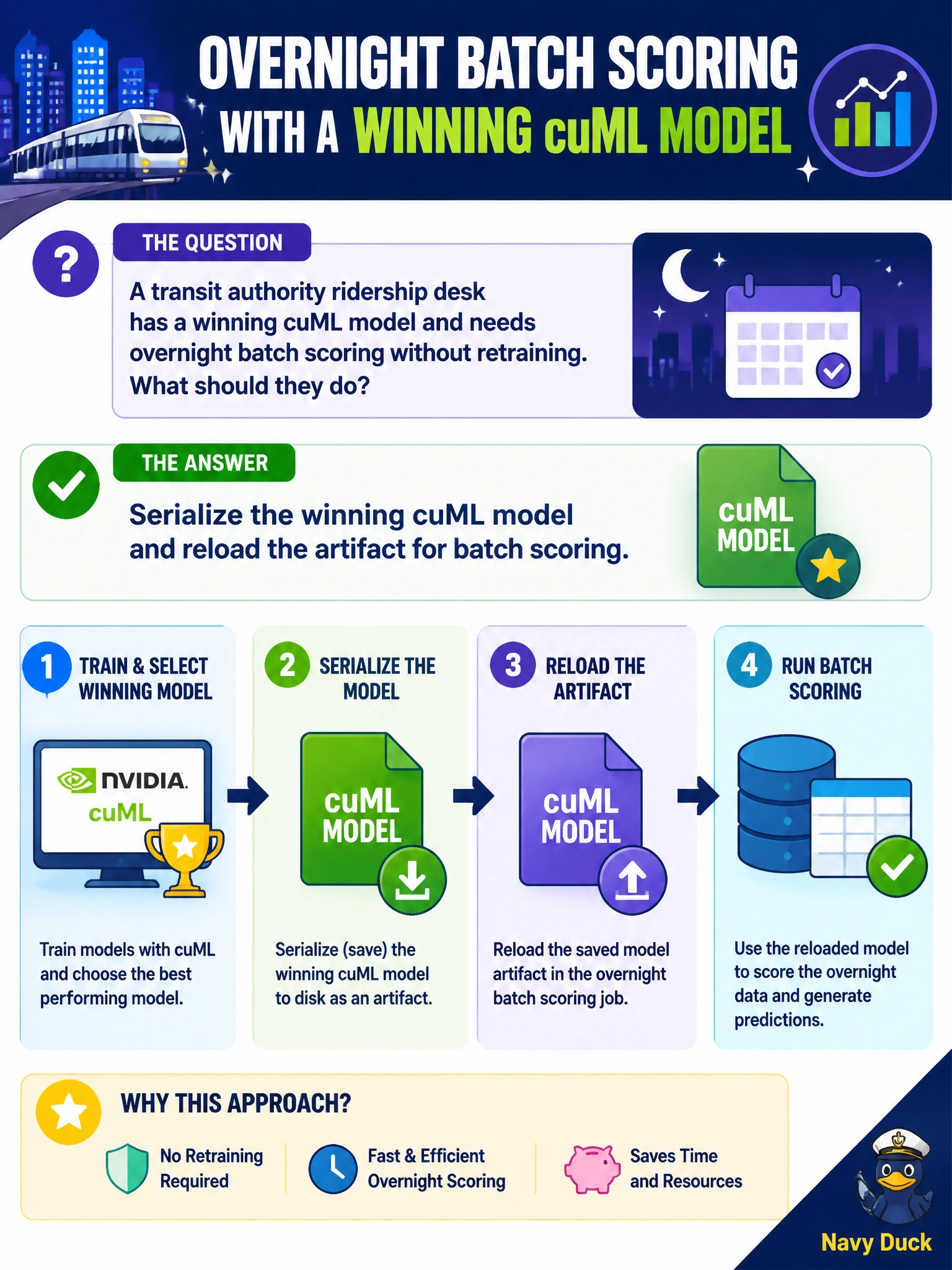
A transit authority ridership desk has a winning cuML model and needs overnight batch scoring without retraining. What should they do?
Select an answer to reveal the explanation.
Short Explanation
Save the trophy model to disk and reload it for batch scoring—don't rebuild the whole team every night.
Full Explanation
A transit authority ridership desk with a winning cuML model that must score overnight without retraining should serialize the winning model and reload that artifact for batch scoring. Persistence separates training from inference: save once after validation wins, then load the same bytes each night to score ridership features. That pattern avoids wasting GPU and wall-clock time rebuilding an already-selected champion and keeps overnight batches stable.
Retraining from scratch in every scoring job with no saved artifact fails by concept: repeated full training is unnecessary for batch scoring, burns resources, and can change the model silently night to night. Pasting coefficients into an email and retyping them at score time fails because manual transcription is error-prone and not a serialization workflow. Keeping the model only in volatile GPU memory overnight fails because process or host restarts lose the champion before batch scoring runs.
Exam caveat: serialize-and-reload is the standard path from a winning cuML (or similar) training run to batch inference without retraining.
Operational check: after champion selection, write a versioned artifact, reload it in a dry-run batch job, compare a sample of scores to the training-time predict call, and only then schedule overnight ridership scoring against that file.