
A county social-services case analytics team runs many district model trials and needs comparable history. What should they log in MLflow for each trial?
Select an answer to reveal the explanation.
Short Explanation
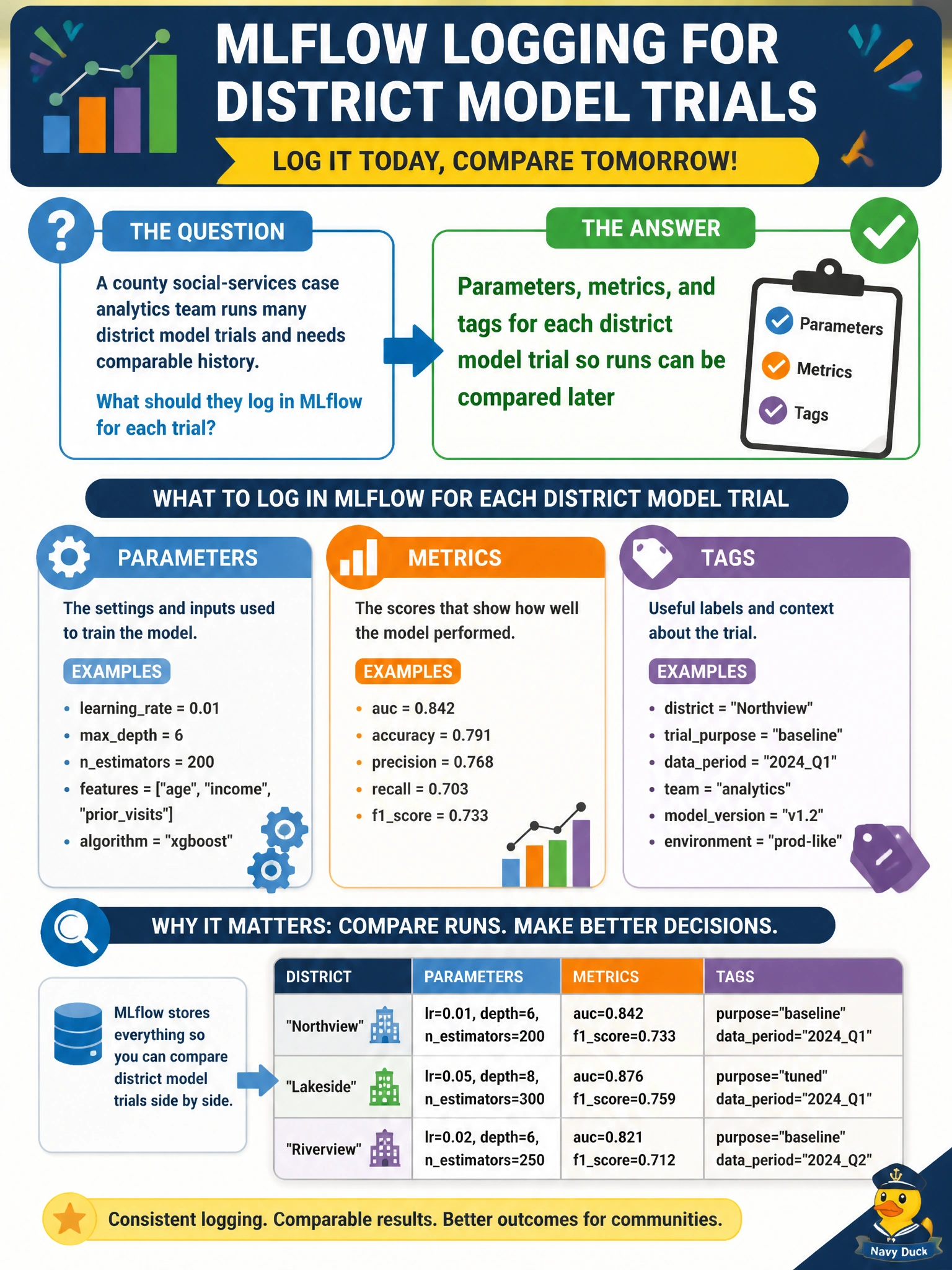
MLflow is the lab notebook for trials—log params, metrics, and tags so every district run can be compared later.
Full Explanation
A county social-services case analytics team running many district model trials should log parameters, metrics, and tags in MLflow for each trial so runs remain comparable later. Experiment tracking is the structured lab notebook of associate MLOps: parameters capture what was tried, metrics capture how it performed, and tags capture district, data snapshot, or policy context. That history enables apples-to-apples comparison, reproduction, and champion selection across districts.
Logging only the analyst's preferred lunch order fails by concept: food preferences are not experiment metadata and cannot reconstruct a trial. Logging only a screenshot of the laptop wallpaper fails because informal images do not encode hyperparameters or metrics in a queryable form. Logging only the meeting room number used that day fails for the same reason—room booking data is unrelated to model comparison.
Exam caveat: tools such as MLflow are tested for what to record (params, metrics, tags), not for storing incidental workplace trivia.
Operational check: for each district trial, require a logged hyperparameter dict, primary validation metrics, and tags for district ID and data version; refuse to discuss best model in review unless those fields exist in the tracking UI.