
A city planning zoning analytics team must pick a champion model before a public-health adjacent pilot. How should they compare candidates?
Select an answer to reveal the explanation.
Short Explanation
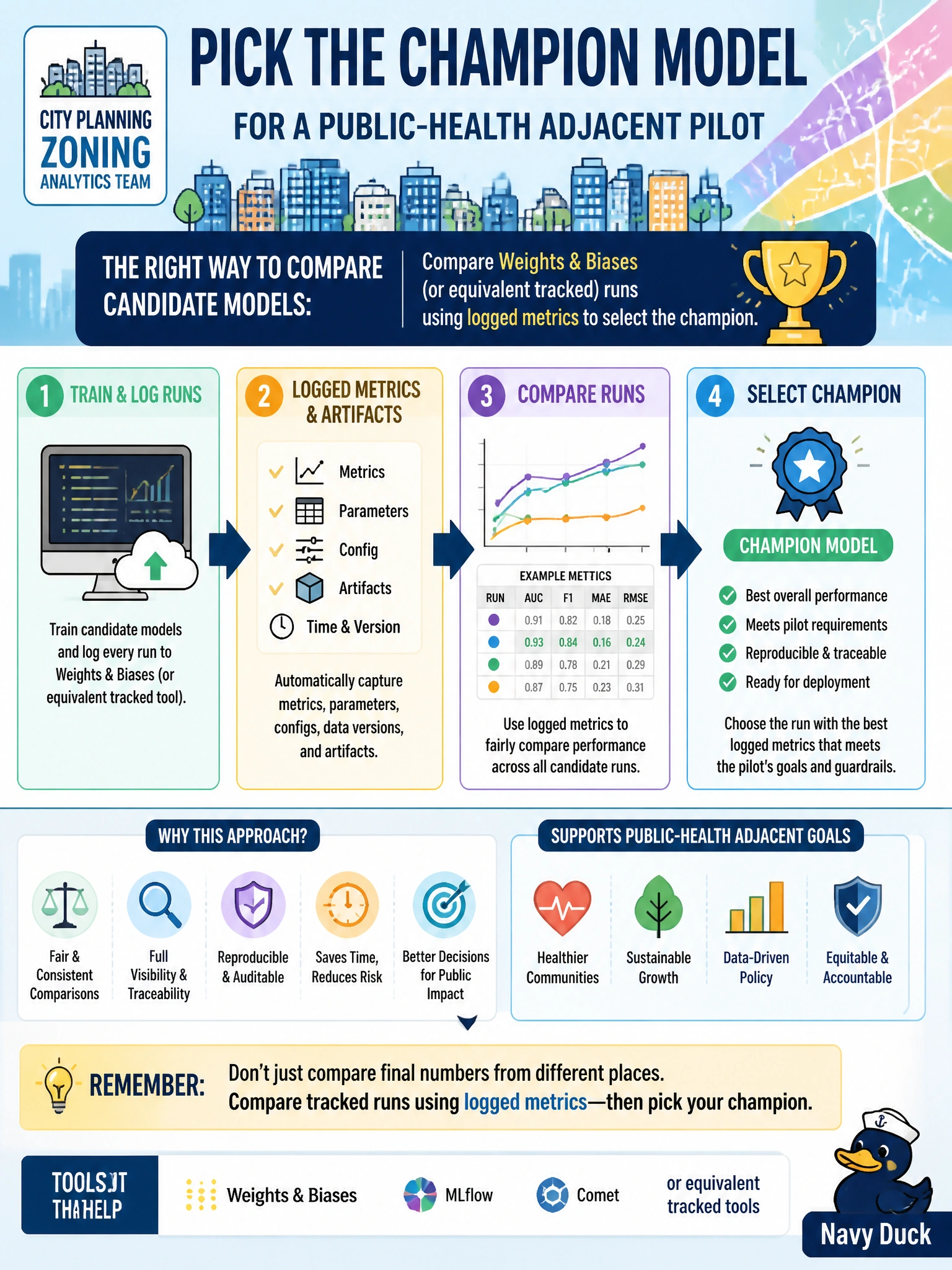
Tracked W&B runs are the scoreboard—compare logged metrics to crown the champion before the pilot.
Full Explanation
A city planning zoning analytics team selecting a champion before a public-health-adjacent pilot should compare Weights & Biases (or equivalent tracked) runs using logged metrics. Evidence-based selection means lining up candidate runs on the same evaluation criteria—validation loss, precision/recall, calibration, or civic SLA proxies—and promoting the run that wins on the agreed metric with complete tracking history. Trackers exist so champion choice is auditable rather than anecdotal.
Picking the model whose filename sorts first alphabetically fails by concept: lexical order of artifacts has no relationship to predictive quality. Choosing whichever notebook was left open overnight fails because incidental desktop state is not an evaluation protocol. Selecting the run with the fewest logged metrics to save storage fails because sparse logging reduces comparability; storage thrift is not a model-quality criterion for a civic pilot gate.
Exam caveat: brand names (W&B, MLflow) may appear, but the underlying idea is compare tracked runs on logged metrics—not informal heuristics.
Operational check: open the tracker comparison view for the zoning candidates, confirm shared metric definitions and data tags, document the winning run ID, and only then package that champion for the public-health-adjacent pilot.