
A municipal fleet telematics desk has a flaky open-data pull that sometimes fails mid-run and risks corrupting nightly outputs. Which reliability pattern belongs in the monitored pipeline?
Select an answer to reveal the explanation.
Short Explanation
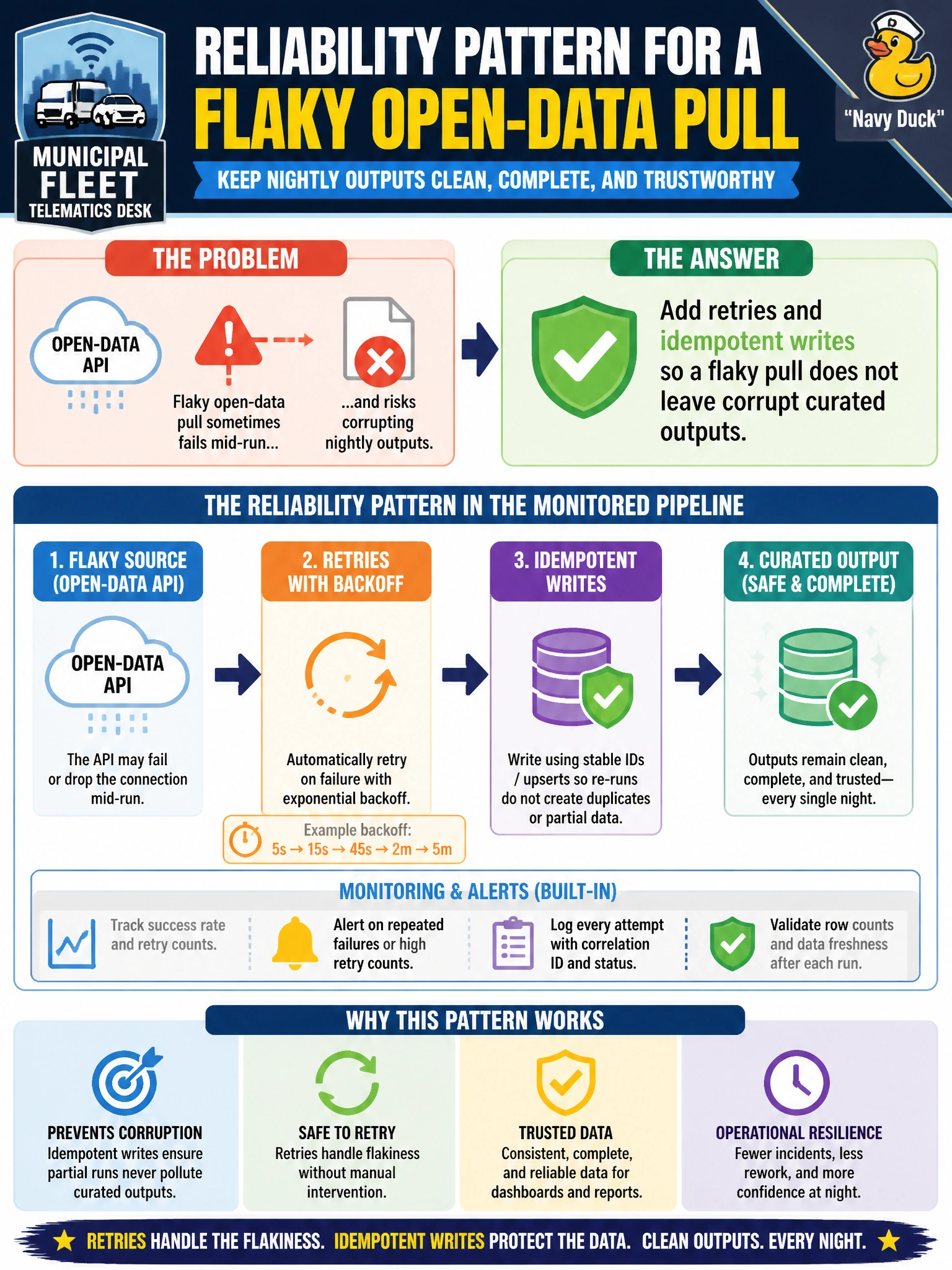
Retries plus idempotent writes are seat belts for flaky feeds—failed pulls should not leave half-baked telematics tables.
Full Explanation
A municipal fleet telematics desk with a flaky open-data pull that sometimes fails mid-run should add retries and idempotent writes so a failed pull does not leave corrupt curated outputs. Reliability patterns belong in monitored pipelines: transient network or source failures are expected, and civic curated Parquet (or equivalent) must not be replaced by half-written files. Retries absorb blips; idempotent materialization (write-temp-then-swap, partition replace with checksums, or equivalent) ensures a failed attempt leaves yesterday's good artifact intact.
Always overwriting yesterday's curated Parquet with a half-written file on failure fails by concept: it turns a transient pull error into lasting data corruption for fleet analytics consumers. Disabling checksums and schema validation to speed recovery fails because those checks are what detect partial or malformed writes during recovery. Running the pull once with no retry and accepting silent corruption fails by abandoning both resilience and data integrity for municipal telematics.
Exam caveat: retries alone are incomplete without safe write semantics; associate answers usually pair retries with idempotent or atomic publish patterns.
Operational check: simulate a mid-pull failure in staging, verify retries engage, confirm the curated telematics table still matches the last good checksum and schema, and only then promote the reliability change to the nightly monitored pipeline.