
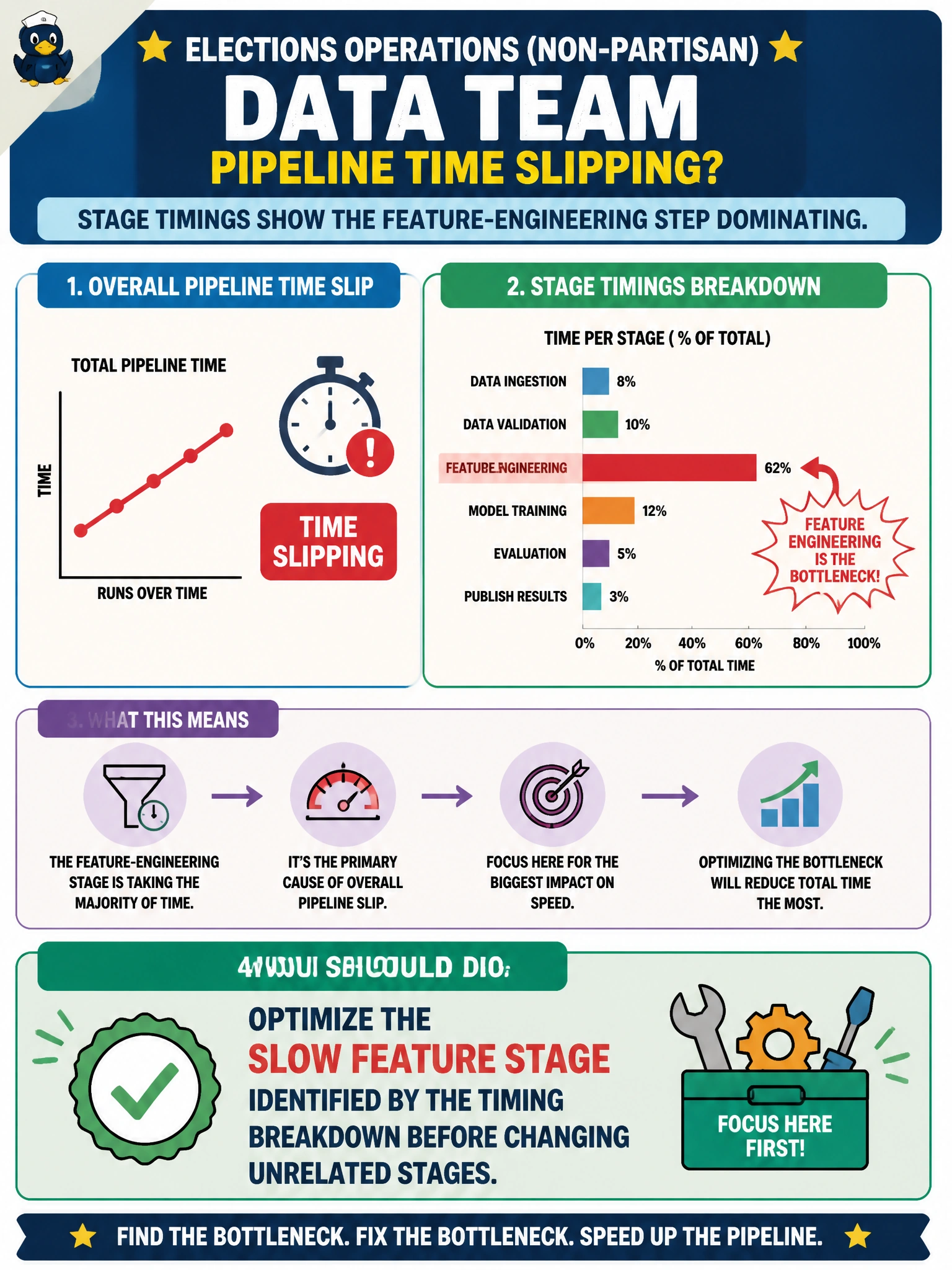
An elections operations (non-partisan) data team sees overall pipeline time slip and stage timings show the feature-engineering step dominating. What should they do?
Select an answer to reveal the explanation.
Short Explanation
Stage timings are the pit crew radio—fix the slow feature lap first instead of rebuilding the whole car blind.
Full Explanation
An elections operations (non-partisan) data team whose overall pipeline time slips, with stage timings showing feature engineering dominating, should optimize that slow feature stage before changing unrelated stages. Pipeline monitoring is valuable when it localizes the bottleneck. Associate MLOps practice is to use stage-level timings to focus engineering effort where wall-clock cost actually lives—here, feature engineering—rather than rewriting the entire stack blindly.
Rewriting the entire stack in a new language without measuring anything fails by concept: a broad rewrite without profiling may miss the true bottleneck and introduce new SLA risk during election operations windows. Optimizing only the final PowerPoint export fails when timings show feature engineering dominates; polishing an export step does not recover the lost minutes. Deleting timing metrics so the dashboard looks green fails because hiding telemetry removes the evidence needed for reliable optimization and audit.
Exam caveat: overall pipeline latency without a stage breakdown is insufficient; examiners expect candidates to act on the dominant stage identified by monitoring.
Operational check: keep stage timers enabled for the elections extract, confirm feature engineering remains the top contributor, profile that stage (I/O, joins, GPU kernels), apply a measured fix, and re-run the timing report before touching unrelated stages.