
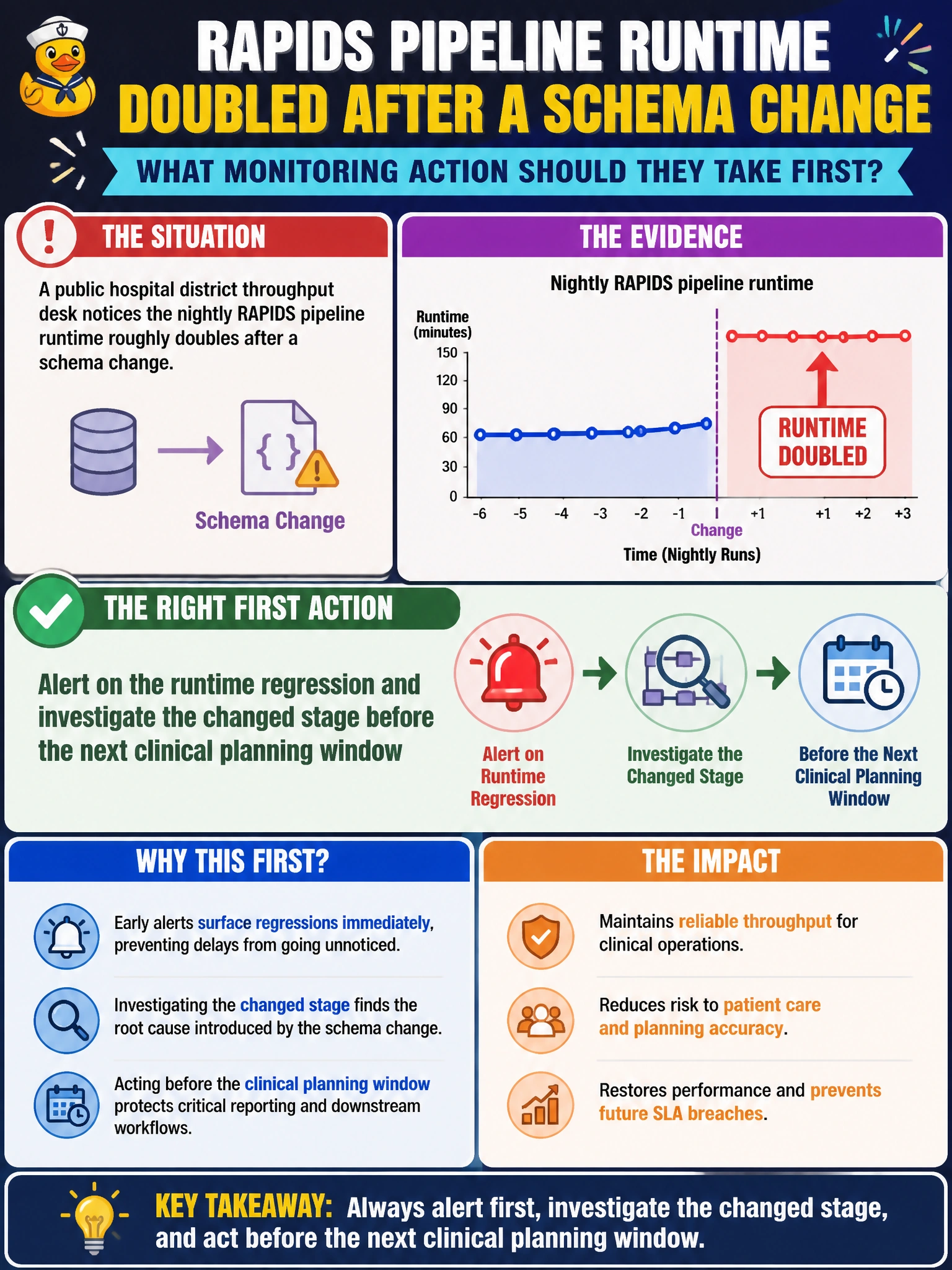
A public hospital district throughput desk notices the nightly RAPIDS pipeline runtime roughly doubles after a schema change. What monitoring action should they take first?
Select an answer to reveal the explanation.
Short Explanation
Doubled runtime is the smoke alarm—alert and dig into the stage that changed before morning planners walk into a mess.
Full Explanation
A public hospital district throughput desk whose nightly RAPIDS pipeline roughly doubles in runtime after a schema change should first alert on the runtime regression and investigate the changed stage before the next clinical planning window. Introductory MLOps treats pipeline duration and stage health as first-class telemetry: a large regression after a schema edit is a reliability signal that can miss bed-planning or throughput refresh SLAs if ignored. Investigating the changed stage (join explosion, wider columns, unintended full scans, or GPU transfer blow-ups) is the targeted response.
Ignoring runtime and only watching dashboard colors fails by concept: cosmetic dashboard state does not detect SLA risk when the RAPIDS job itself slowed. Disabling all logging so the job finishes faster on paper fails because silencing telemetry hides the regression and blocks root-cause analysis. Assuming the schema change is irrelevant and closing the ticket fails because the timing coincidence with a schema change is exactly the investigative lead hospital data teams should follow.
Exam caveat: monitoring is not only accuracy metrics—runtime and reliability regressions after schema changes are in-scope associate MLOps concerns.
Operational check: page or ticket on a runtime threshold breach, diff the schema change against the slow stage's profile (row counts, shuffle, GPU memory), and confirm the nightly job returns inside the clinical planning window before marking the incident closed.