
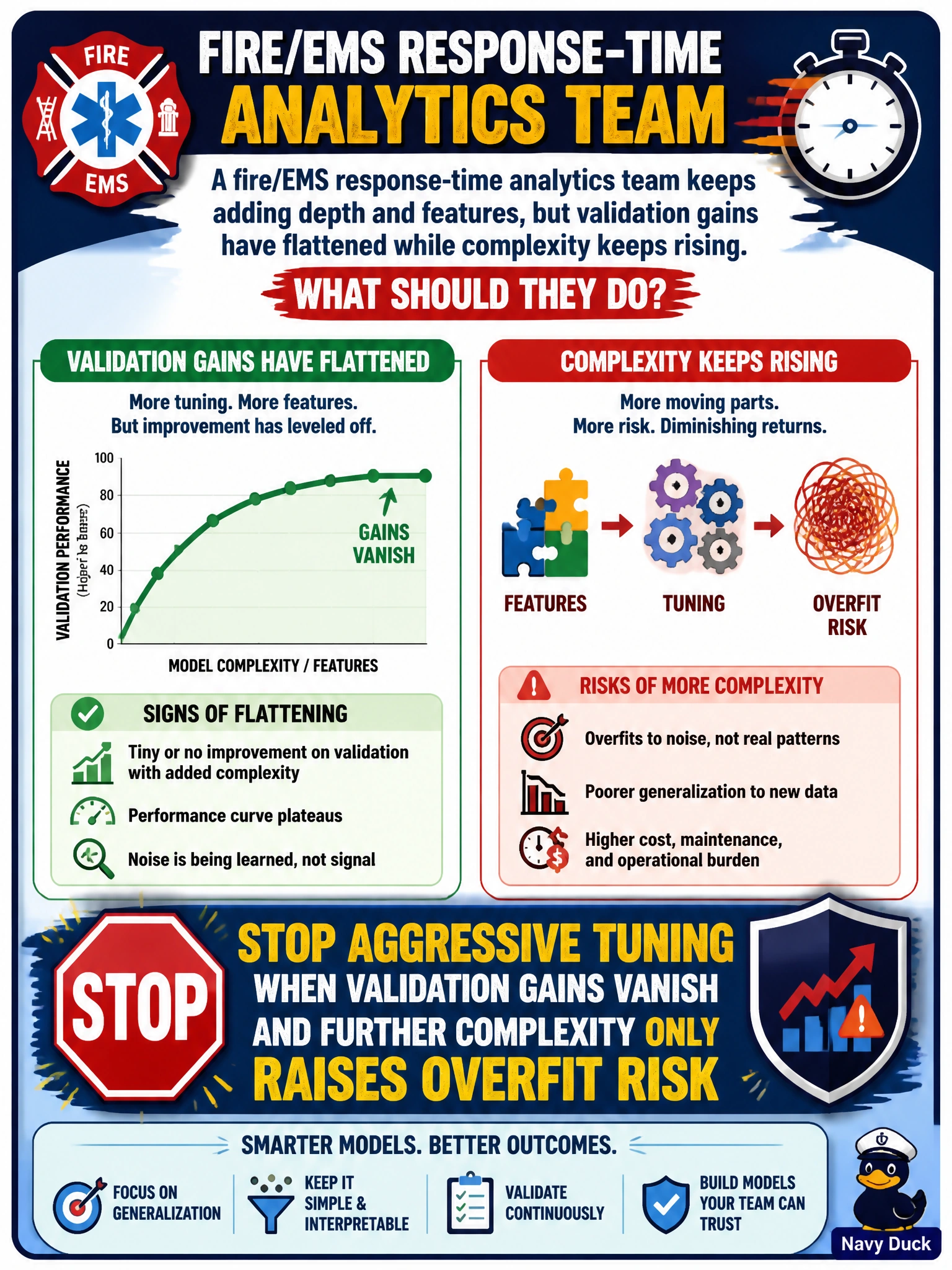
A fire/EMS response-time analytics team keeps adding depth and features, but validation gains have flattened while complexity keeps rising. What should they do?
Select an answer to reveal the explanation.
Short Explanation
When the validation curve flatlines, stop spinning the dials—extra complexity just invites overfitting without civic payoff.
Full Explanation
A fire/EMS response-time analytics team that keeps adding depth and features after validation gains have flattened should stop aggressive tuning: further complexity mainly raises overfit risk without operational payoff. Parameter and capacity search should be gated by validation improvement. Once the validation curve plateaus, freezing a simpler champion preserves generalization for dispatch and turnout analytics and avoids chasing training loss that no longer translates to better holdout performance.
Deepening trees indefinitely because more complexity always helps fails by concept: after the validation plateau, extra depth often memorizes noise in historical response logs rather than improving real ETA quality. Discarding the validation set so training metrics look better fails because it removes the only honest early-warning signal for overfit. Replacing numeric features with random noise to force a restart fails because it destroys signal and invents a chaotic reset instead of disciplined early stopping on validation.
Exam caveat: more features or deeper trees is not automatically better; associate MLOps expects diminishing-returns discipline on validation, not endless capacity growth.
Operational check: track validation metric versus model complexity for the EMS pilot; when successive depth or feature additions yield negligible validation lift, lock the champion, document the stop rule, and move to operational monitoring rather than further tuning spirals.