
A permitting and inspections bureau sees high error on both the training set and the validation set for a risk-scoring model. What diagnosis and remedy fit best?
Select an answer to reveal the explanation.
Short Explanation
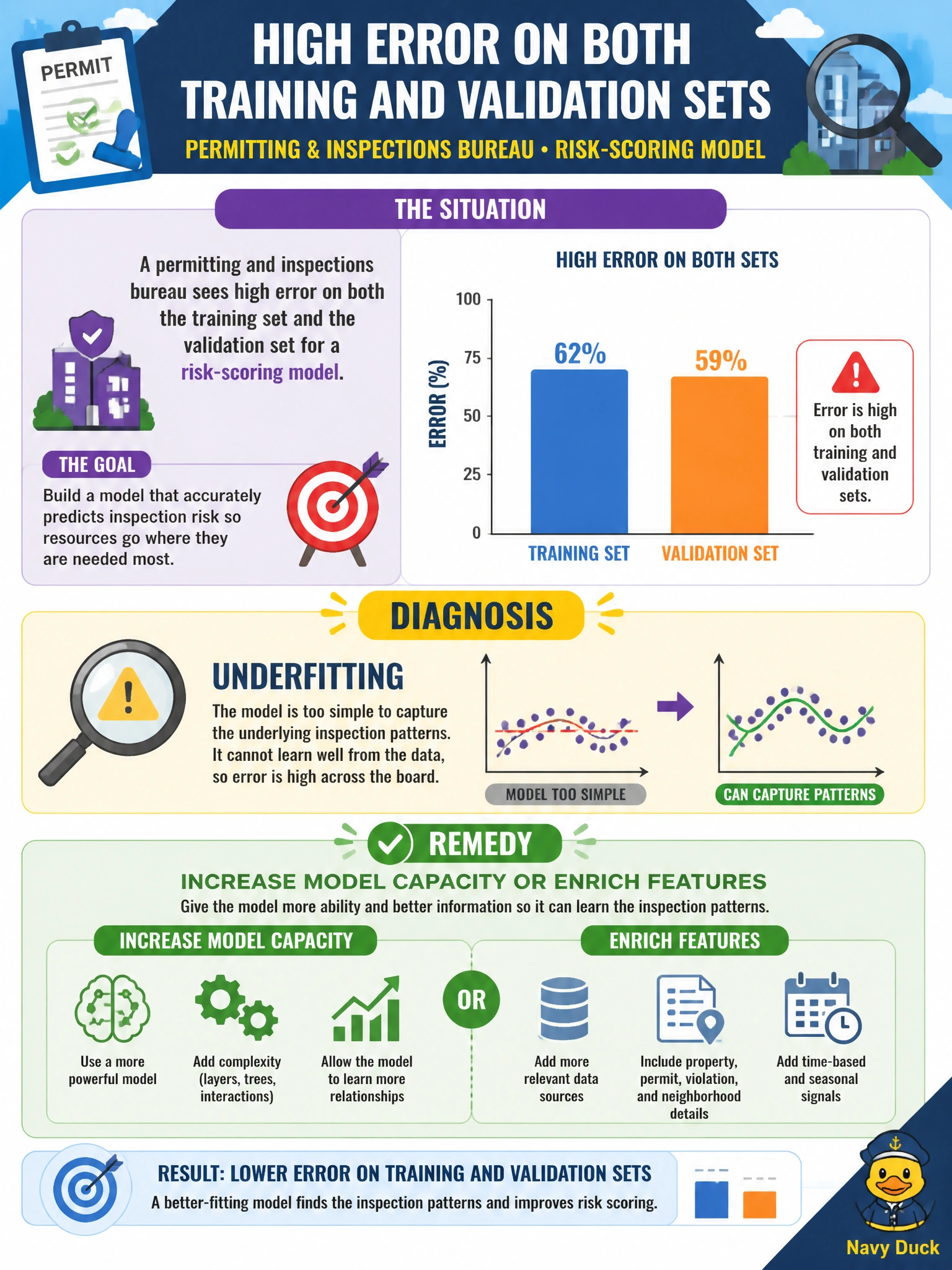
High error everywhere means the model never learned the beat—underfitting—so give it more capacity or better features, not a victory lap.
Full Explanation
When a permitting and inspections bureau sees high error on both the training set and the validation set for a risk-scoring model, the correct diagnosis is underfitting: the model lacks capacity or informative features to learn inspection patterns. Remedies at associate level include enriching features (permit type interactions, inspection history, inspector workload signals), reducing excessive regularization, or increasing model flexibility so both train and validation error can fall together. Promoting a model that cannot fit the training sample will not magically generalize in the field.
Diagnosing overfitting and then shrinking capacity until training error rises further fails by concept: overfitting is low train error with high validation error; shrinking capacity when both errors are already high worsens underfit. Calling the result ideal generalization and promoting immediately fails because dual high error is the opposite of healthy generalization. Deleting all categorical permit types as if they were leakage fails because useful categorical structure is often the signal for inspection risk; removing it without a leakage analysis deepens underfit rather than fixing it.
Exam caveat: both overfitting and underfitting can produce bad validation metrics, but the train side distinguishes them. High–high means underfit; low–high means overfit.
Operational check: before changing production risk scores, verify that training metrics are also poor; if so, expand feature quality or model capacity and re-measure both splits—do not promote or randomly discard permit categories without a leakage review.