
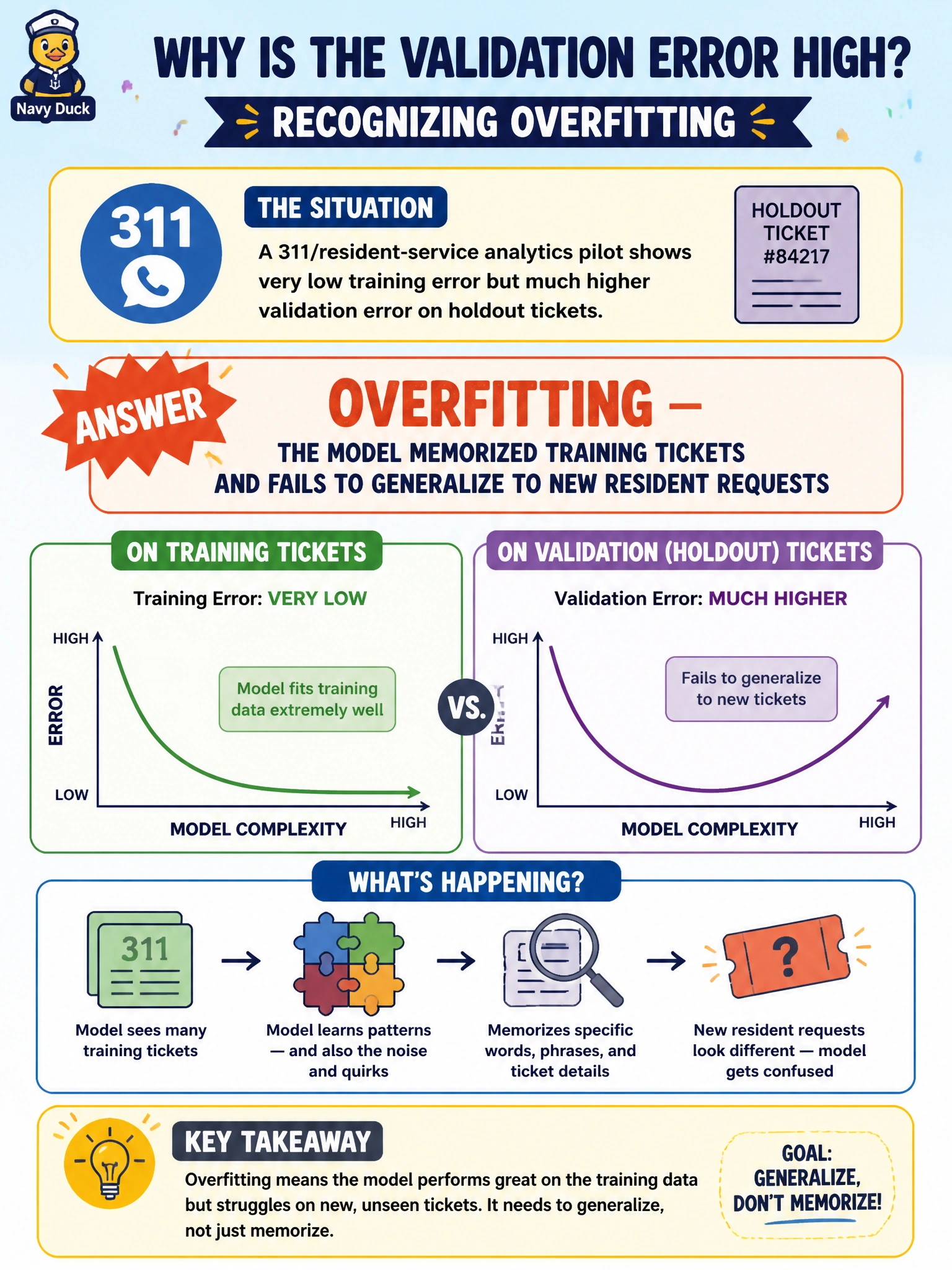
A 311/resident-service analytics pilot shows very low training error but much higher validation error on holdout tickets. How should the team label this pattern?
Select an answer to reveal the explanation.
Short Explanation
Low train error with high val error is like acing yesterday's worksheet and bombing a fresh quiz—classic overfitting on the 311 pilot.
Full Explanation
A 311/resident-service analytics pilot that shows very low training error but much higher validation error on holdout tickets exhibits overfitting: the model memorized idiosyncrasies of the training tickets and fails to generalize to new resident requests. At associate level, the diagnostic signature is a large train–validation gap with strong in-sample fit and weak out-of-sample performance. Civic teams should respond with regularization, capacity reduction, more representative training data, or early stopping—not with claims that the model is deployment-ready.
Labeling the pattern as perfect deployment readiness with no further review fails by concept: a validation collapse is a stop signal for promotion, not evidence of readiness for resident-facing service. Calling it underfitting fails because underfitting shows poor performance on both train and validation; here training error is very low, which is the opposite signature. Treating the gap as proof that validation data should be ignored fails because validation exists precisely to expose generalization failure before 311 workflows trust the scores.
Exam caveat: do not confuse low training loss with a good model. Examiners often plant a train–val asymmetry to test whether candidates recognize overfitting versus underfitting.
Operational check: compare training versus validation metrics for the 311 pilot; if train is excellent and holdout tickets degrade sharply, freeze further capacity increases, apply regularization or simplify features, and re-evaluate on a fresh resident-request sample before any production cutover.