
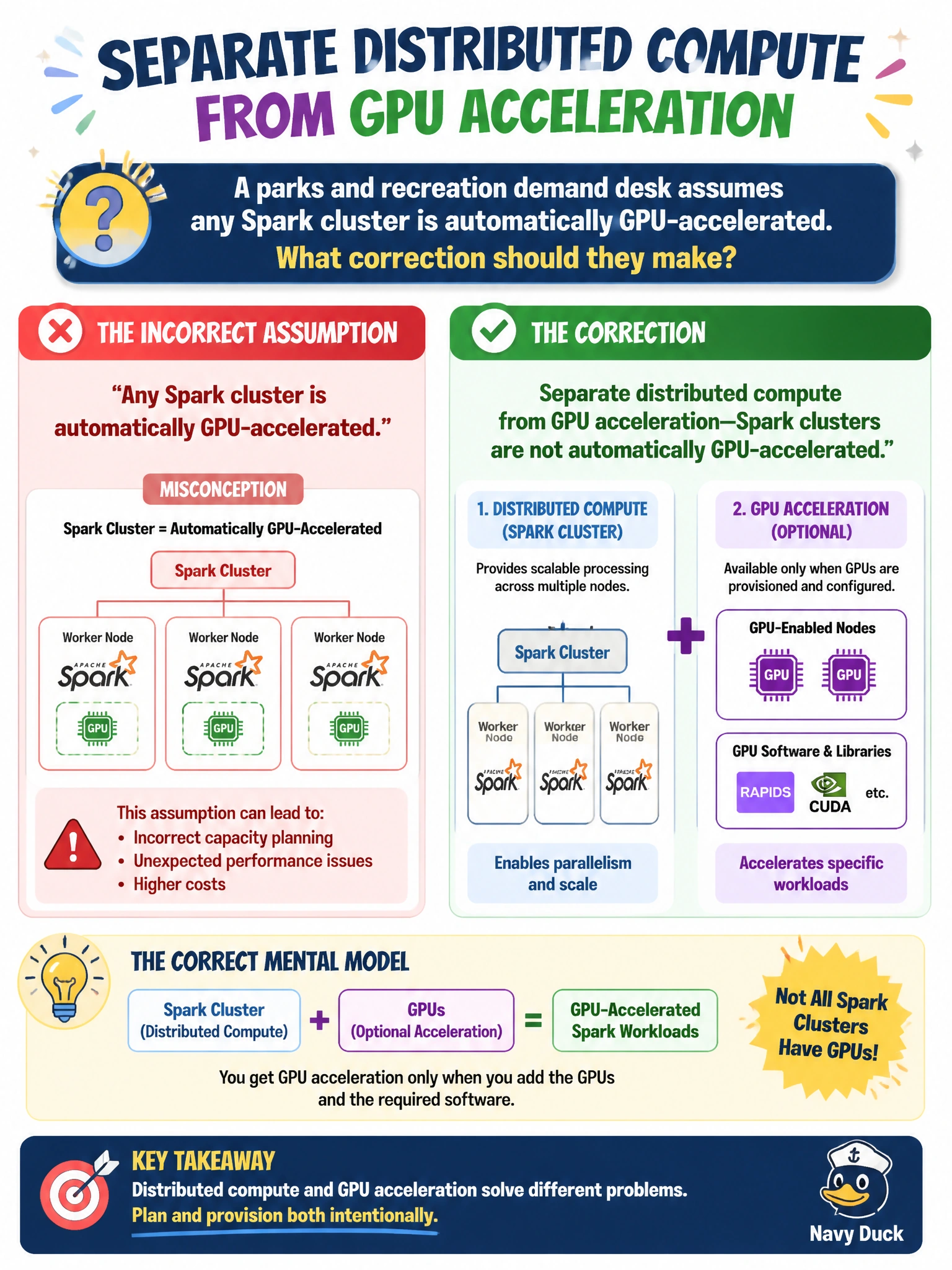
A parks and recreation demand desk assumes any Spark cluster is automatically GPU-accelerated. What correction should they make?
Select an answer to reveal the explanation.
Short Explanation
Spark means 'many workers,' not 'GPU magic auto-on.' Distribution and acceleration are different dials—check whether GPU libraries and executors are actually configured. Renaming docs won't flip the hardware.
Full Explanation
Parks and recreation teams must separate distributed compute from GPU acceleration: a Spark cluster is not automatically GPU-accelerated. Distribution spreads work across executors; GPU acceleration requires appropriate libraries, device-aware runtimes, and configuration. Domain 5 explicitly tests that conceptual split so municipal staff do not assume 'Spark' means 'GPU on' when capacity planning or reading vendor slideware.
Treating every Spark job as GPU-accelerated by definition with no further checks invents hardware that may not be present or configured. Assuming GPUs cannot participate in any distributed framework ever is the opposite overgeneralization—GPUs can participate when properly integrated. Replacing the word Spark with RAPIDS in all docs without changing runtime settings is cosmetic renaming that does not enable devices.
Exam caveat: Spark ≠ automatic GPU. Check executor GPU configs and accelerated libraries; renaming documentation changes nothing.
Operational check: Inventory whether the parks Spark jobs request GPUs, which accelerated packages are installed, and profile device utilization; if CPUs only, either accept CPU Spark or configure a true GPU-accelerated stack.