
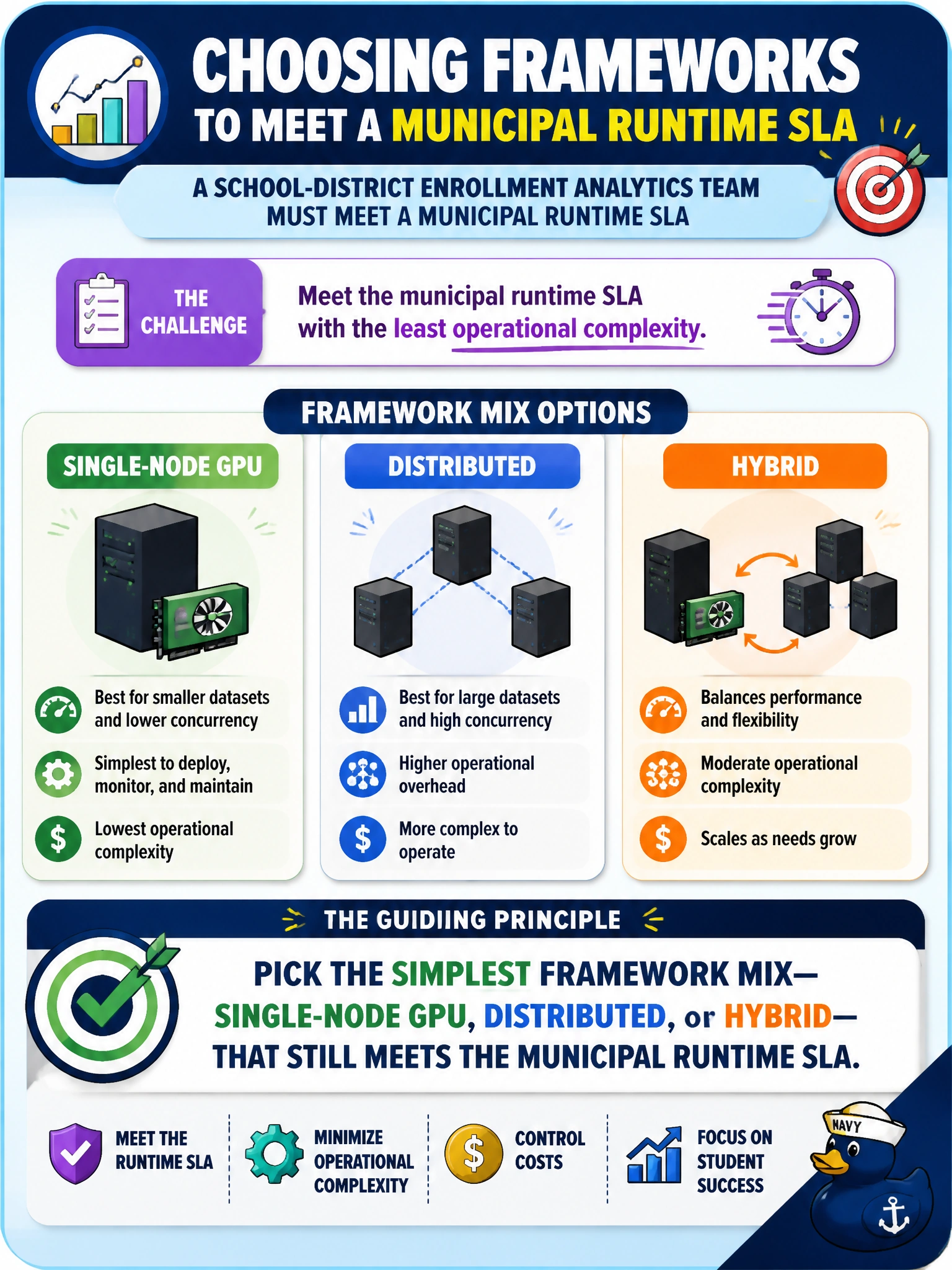
A school-district enrollment analytics team must meet a municipal runtime SLA with the least operational complexity. How should they choose frameworks?
Select an answer to reveal the explanation.
Short Explanation
Meet the bus schedule with the smallest bus that still arrives on time. Choose the simplest GPU or distributed mix that hits the enrollment SLA—don't buy a fleet for a neighborhood route. Paper cluster counts aren't the goal.
Full Explanation
School-district enrollment analytics should pick the simplest framework mix—single-node GPU, distributed, or hybrid—that still meets the municipal runtime SLA. Pragmatic Domain 5 selection minimizes operational complexity while clearing service levels: do not maximize cluster count for its own sake when a smaller accelerated setup suffices. Least complexity that still hits the SLA keeps support burden and failure modes within what a district team can operate.
Always picking the largest multi-cloud mesh regardless of SLA and data size overbuilds cost and failure modes without proven need. Preferring handwritten bit-level kernels on every analyst laptop before any RAPIDS trial skips proven accelerated libraries in favor of fragile custom code. Ignoring SLAs and optimizing only for maximum cluster count on paper optimizes a vanity metric instead of enrollment service performance.
Exam caveat: Simplest mix that meets the municipal SLA wins. Maximal mesh, laptop bit-kernels-first, and paper cluster counts are classic distractors.
Operational check: Benchmark single-node RAPIDS against the enrollment SLA; add distribution only if memory or runtime fails; document the chosen mix and reject proposals that grow clusters without SLA evidence.