
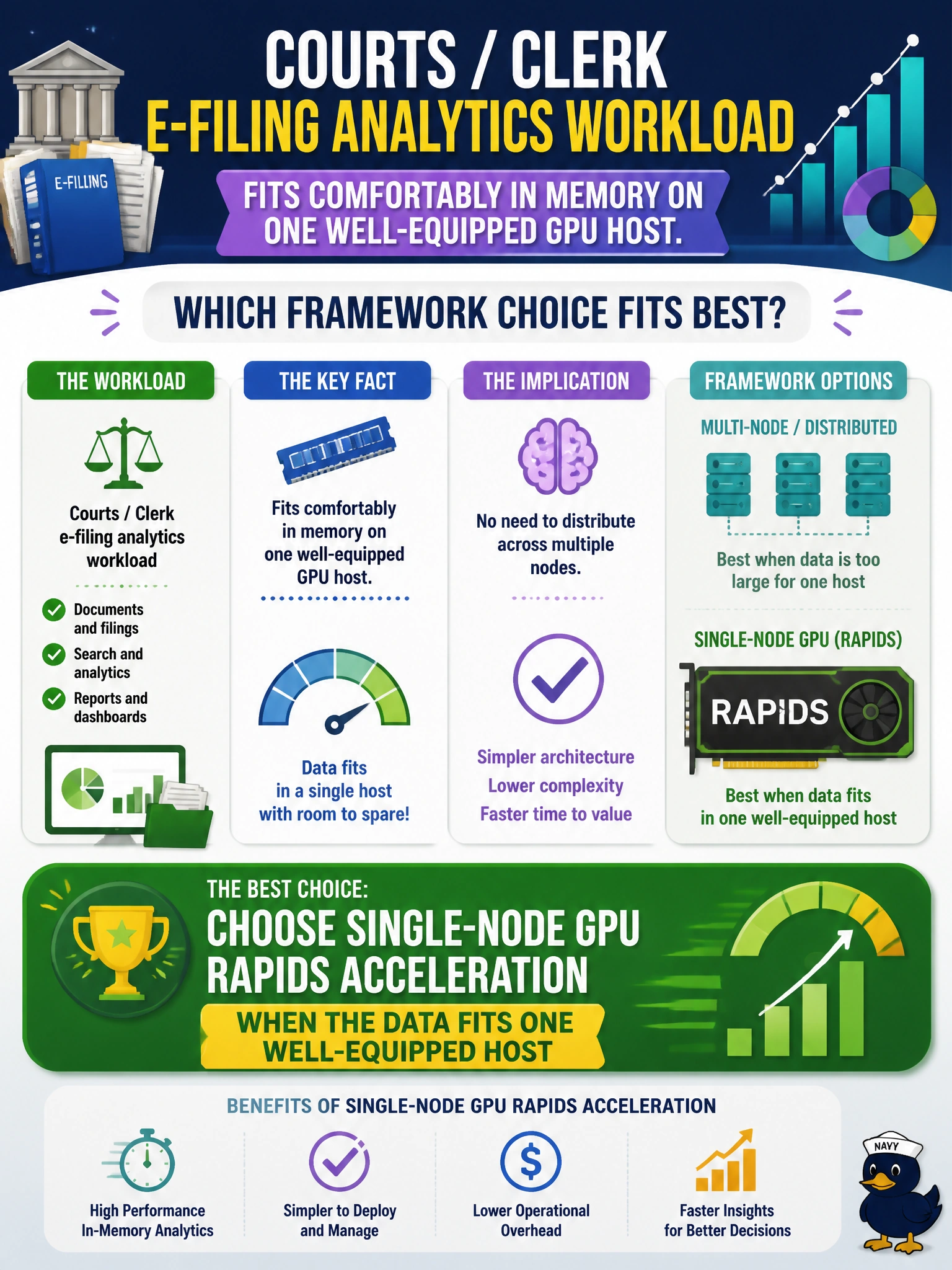
A courts / clerk e-filing analytics workload fits comfortably in memory on one well-equipped GPU host. Which framework choice fits best?
Select an answer to reveal the explanation.
Short Explanation
If the e-filing table fits one strong GPU box, you don't need a county-sized cluster on day one. Single-node RAPIDS is still real acceleration—distribution is a different lever. Skipping RAPIDS just because it's one host misses the point.
Full Explanation
When courts/clerk e-filing workloads fit comfortably in memory on one well-equipped GPU host, choose single-node GPU RAPIDS acceleration. GPU acceleration and multi-node distribution are related but distinct levers: fitting on one strong host means you can accelerate without standing up a distributed mesh. Domain 5 tests that distinction—single-node RAPIDS remains valid acceleration for municipal data that fits and often clears SLAs with far less operational overhead than a cluster.
Mandating a large multi-rack CPU-only cluster with no GPU acceleration ignores the available device path and adds needless ops cost. Requiring a global distributed mesh before any single-host RAPIDS trial forces distribution complexity the stem's data size does not need. Abandoning RAPIDS because single-node GPU work is 'never valid' is false doctrine; single-node GPU is a first-class option.
Exam caveat: Data fits one GPU host → single-node RAPIDS. Do not equate 'real' acceleration only with huge CPU clusters or mandatory meshes.
Operational check: Confirm e-filing fact size versus host GPU memory with headroom, run RAPIDS on that host against the SLA, and defer distribution until memory or runtime proves single-node insufficient.