
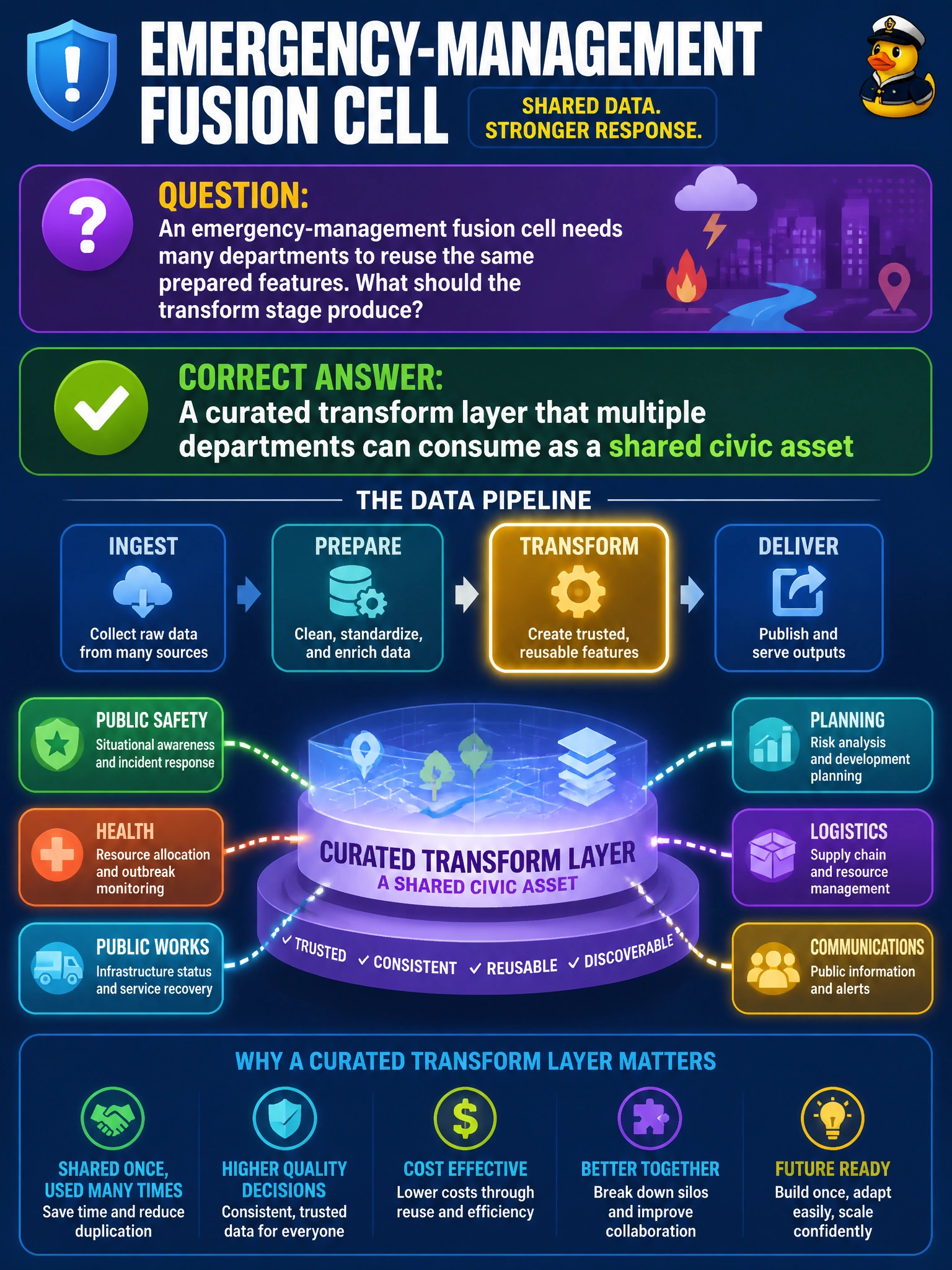
An emergency-management fusion cell needs many departments to reuse the same prepared features. What should the transform stage produce?
Select an answer to reveal the explanation.
Short Explanation
Think pantry, not takeout: land a curated transform layer so every department can grab the same prepared features. Session-only laptop CSVs and weekly reinvented extracts starve cross-agency reuse. Screenshots aren't a data product.
Full Explanation
For an emergency-management fusion cell, the transform stage should produce a curated transform layer that multiple departments can consume as a shared civic asset. Durable, documented feature tables enable police, fire, public health, and EOC analysts to reuse the same prepared inputs instead of reinventing extracts during an incident. Domain 5 frames transforms as lasting workflow products for cross-agency reuse, which is how fusion cells stay consistent under time pressure.
One-off laptop CSVs that vanish after each analyst session cannot support multi-department continuity or audit. Only screenshots of notebook cells with no reusable tables are not data products. Separate undocumented extracts reinvented per department each week create inconsistency, duplicated effort, and conflicting incident features during emergencies.
Exam caveat: Shared curated transform layers beat ephemeral laptop files, screenshots, and weekly reinvented extracts when stems stress multi-department reuse.
Operational check: Publish versioned transform tables to a governed store with schemas and owners, grant department read access, and retire session-only CSV handoffs for fusion-cell features during activations.