
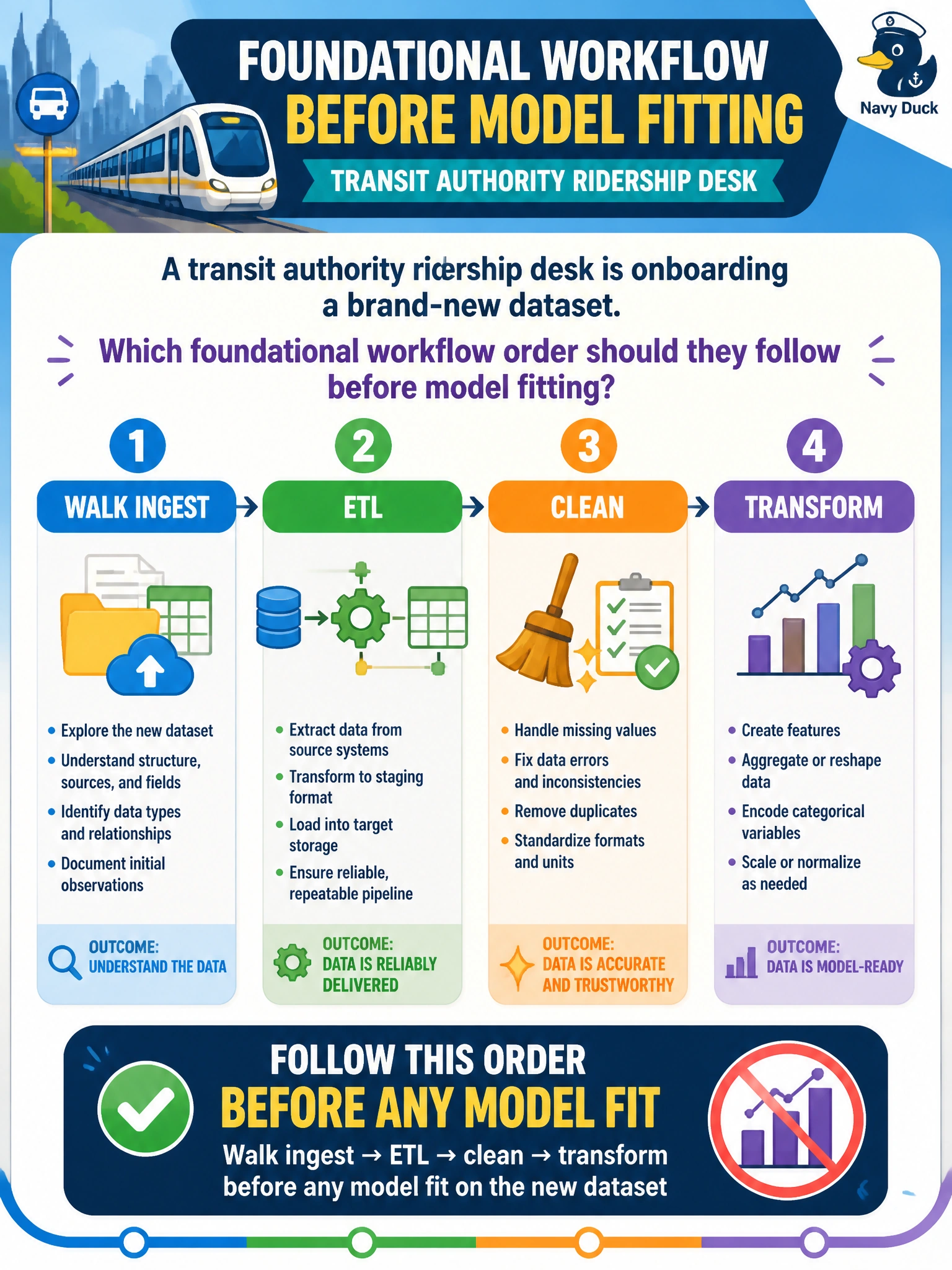
A transit authority ridership desk is onboarding a brand-new dataset. Which foundational workflow order should they follow before model fitting?
Select an answer to reveal the explanation.
Short Explanation
New ridership files still need the assembly line: ingest, ETL, clean, then transform—models wait their turn. Skipping the front of the line cooks garbage scores. Hyperparameter hunting before ingest docs is backwards.
Full Explanation
Onboarding a brand-new transit ridership dataset requires the foundational order ingest → ETL → clean → transform before any model fit. That sequence ensures schemas are understood, pipes are reliable, quality gates pass, and features are trustworthy before estimators see the data. Domain 5 end-to-end workflow discipline exists precisely so municipal models are not fit on raw chaos and so published ridership scores remain defensible to leadership.
Fitting models first and only later deciding whether ingest or cleaning mattered inverts the pipeline and bakes garbage into scores. Transforming raw dumps into published scores with no ETL or cleaning stages skips the stages that make civic metrics defensible. Skipping ingest documentation and jumping straight to hyperparameter search prioritizes tuning theater over data readiness.
Exam caveat: New dataset stems almost always want ingest → ETL → clean → transform before modeling. Hyperparameter search is not a substitute for front-of-pipeline work.
Operational check: Document ridership ingest sources, land ETL outputs, pass cleaning rules, materialize transforms, then—and only then—fit models and compare against held-out operational KPIs.