
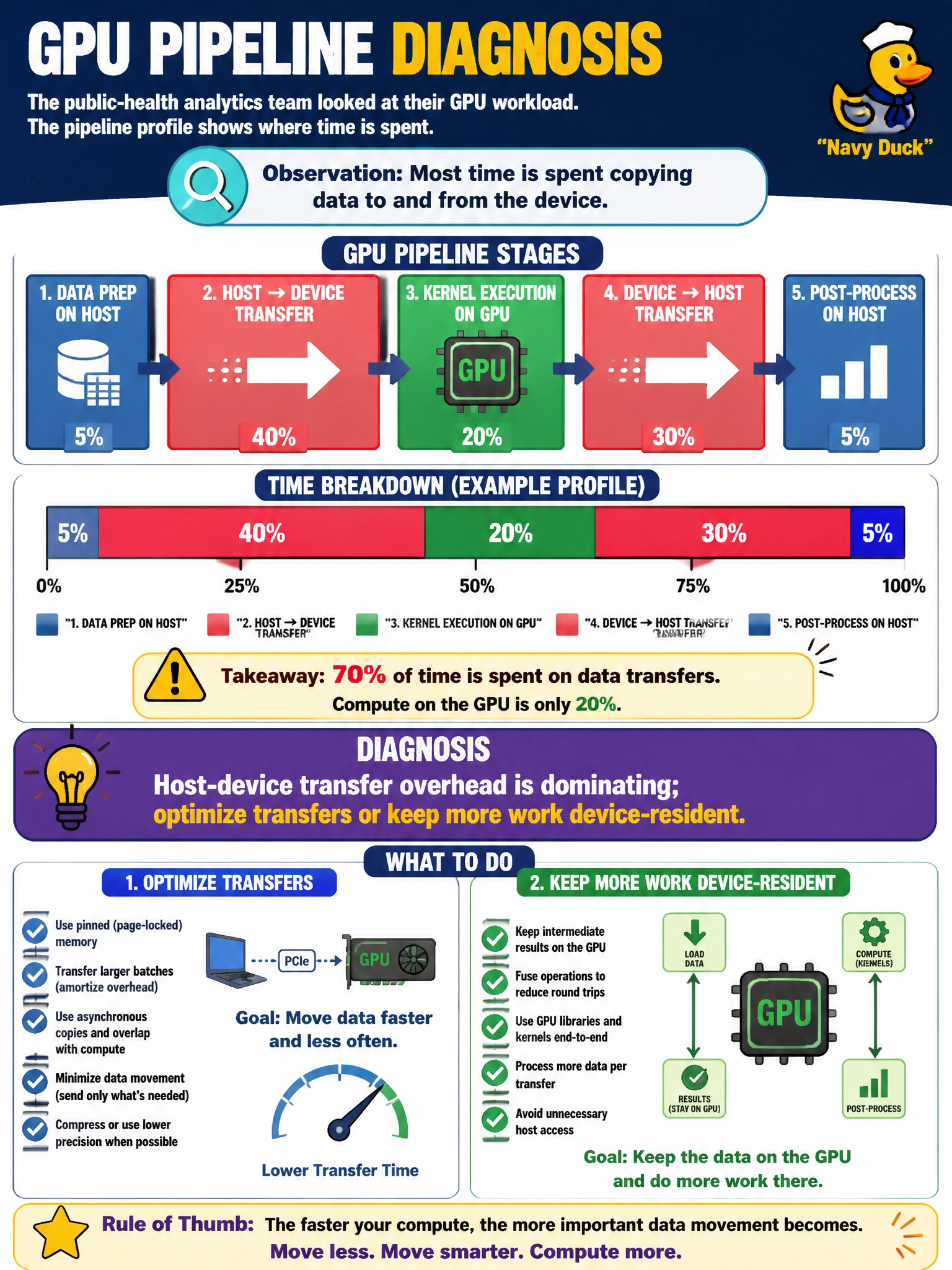
A county public-health analytics team profiles a 'GPU' pipeline and finds most time is spent copying data to and from the device. What diagnosis fits?
Select an answer to reveal the explanation.
Short Explanation
If the stopwatch says 'copying,' you don't have a compute problem—you have a ferry problem. Cut the host-device shuttling or keep work on the GPU. Importing RAPIDS alone doesn't make transfers free.
Full Explanation
If profiling a 'GPU' public-health pipeline shows most time spent copying to and from the device, the diagnosis is transfer overhead dominating—not kernel compute. Teams should optimize transfers or keep more work device-resident so acceleration actually appears in wall-clock time. Domain 5 fundamentals require reading profiles instead of assuming any GPU import equals speedup; otherwise the county pays for devices while still waiting on the PCIe ferry.
Asserting GPU kernels are definitely the only bottleneck and transfers are free contradicts the profile evidence in the stem. Claiming profiling is unnecessary once any GPU library is imported skips the diagnostic step that revealed the real bottleneck. Saying public-health data cannot use GPUs for legal reasons in all jurisdictions by default is an overbroad legal myth unrelated to the performance diagnosis.
Exam caveat: When profiles show copy time dominating, answer transfer optimization / device residency. Do not invent legal bans or assume kernels must be the issue.
Operational check: Break down H2D, kernel, and D2H percentages; reduce intermediate host round-trips; batch stages on device; re-profile until compute—not ferrying—dominates the public-health job.