
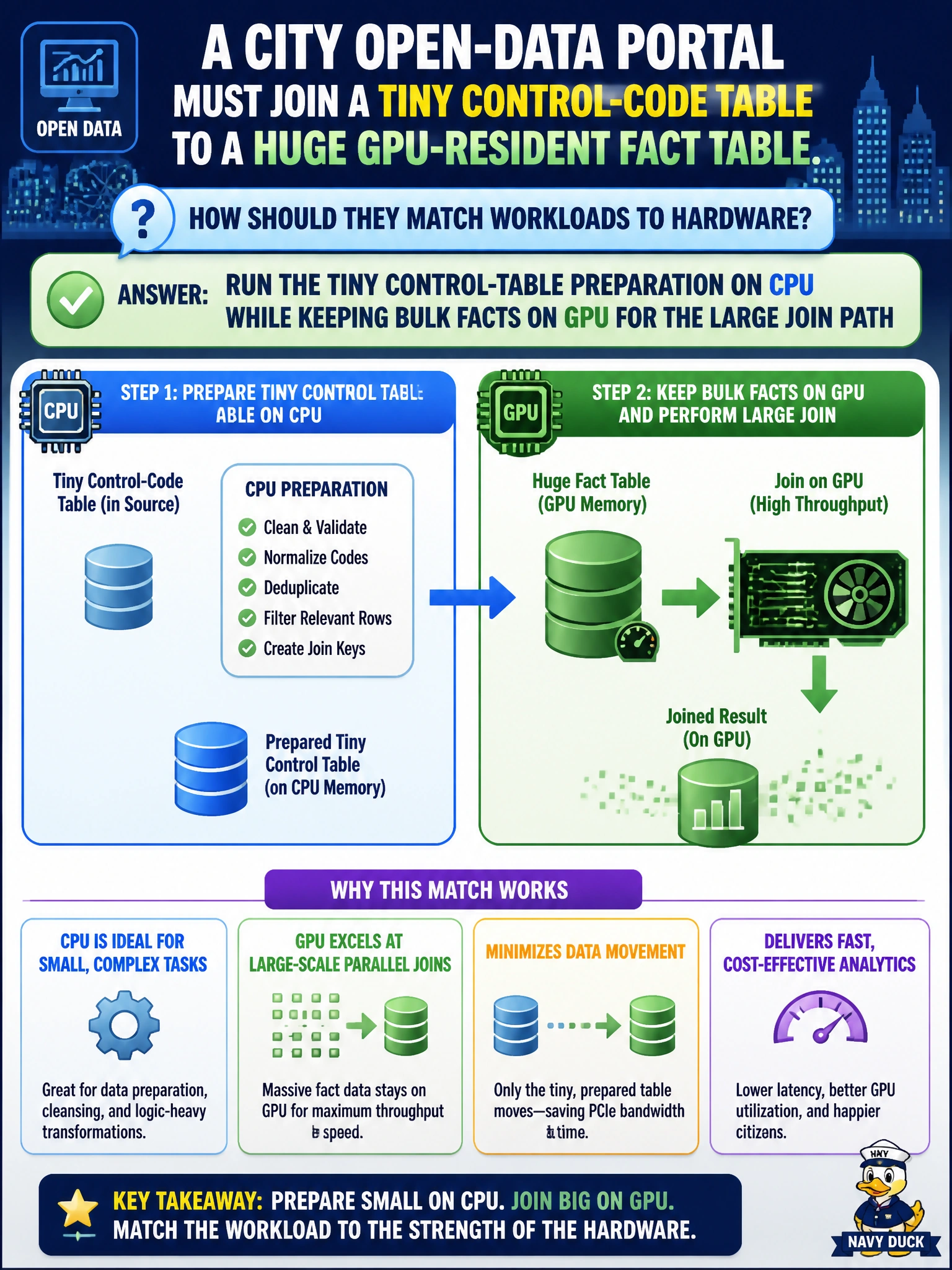
A city open-data portal must join a tiny control-code table to a huge GPU-resident fact table. How should they match workloads to hardware?
Select an answer to reveal the explanation.
Short Explanation
You can keep the small control-code preparation simple and reserve GPU power for the large fact-table join. Prepare the control table on CPU, then join it with the bulk facts on GPU—the right-sized match for each workload.
Full Explanation
The best match is to prepare the tiny control-code table on CPU while keeping the bulk fact table on GPU for the large join. CPU preparation avoids spending multi-node GPU resources on a small task, while GPU-resident facts can use device parallelism where the volume of work is substantial. Forcing the tiny control table through a multi-node GPU cluster by itself over-provisions hardware for its preparation and does not address the large join’s main workload. Uploading only the control table to GPU while leaving all fact rows in cold storage fails when the join needs those facts at scale: accelerating the small input cannot replace access to the large one. Duplicating the entire fact table to laptops just to run a tiny join locally creates unnecessary copies and moves bulk data away from the centralized GPU-resident path. Exam caveat: the tiny table’s size does not determine where the large join should run; match hardware to each stage, and keep the facts available on GPU for the intended scale. Practical check: prepare and validate the control codes on CPU, confirm the bulk facts remain GPU-resident, run the large join, and measure its completion time and data movement before publishing the open-data product.