
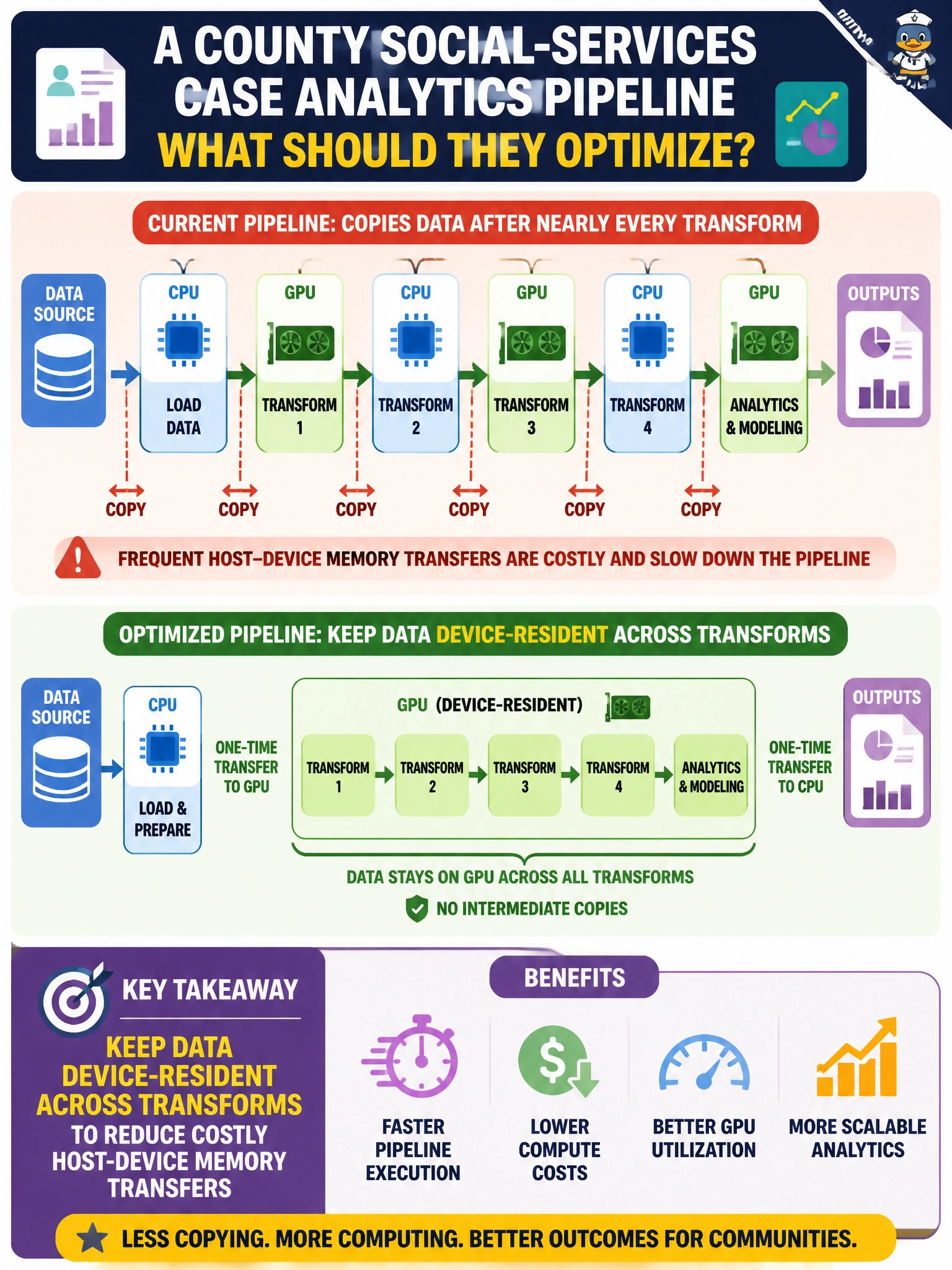
A county social-services case analytics pipeline copies frames between CPU and GPU after nearly every transform. What should they optimize?
Select an answer to reveal the explanation.
Short Explanation
Shipping the same table back and forth to the GPU is like moving couches between houses each chore. Park the data on device and do the transforms there. Extra ping-pong copies just burn the night window.
Full Explanation
County social-services case pipelines that copy frames between CPU and GPU after nearly every transform should keep data device-resident across stages. Host–device memory transfers are expensive relative to on-device compute; ping-ponging after each step often dominates runtime. Domain 5 optimization fundamentals prioritize reducing transfer chatter so RAPIDS-style transforms stay on the GPU until a deliberate gather is needed.
Increasing ping-pong copies so every step touches host and device twice worsens the bottleneck the stem describes. Moving all tiny lookups exclusively to remote tape archives mid-pipeline adds latency unrelated to fixing transfer overhead. Disabling GPU compute while keeping only host–device copies as the workload removes the acceleration benefit and leaves the costly shuttle pattern in place.
Exam caveat: Device-resident pipelines beat frequent H2D/D2H copies. If a stem stresses copying after nearly every transform, optimize residency—not more copies or abandoning the GPU.
Operational check: Profile transfer vs kernel time, fuse transforms into a device-resident chain, stage small reference tables thoughtfully, and copy back to host only for final export or CPU-only sinks.