
A solid-waste route optimization analytics team finished overnight ETL on GPU and must explain why to public works. Which reason best fits?
Select an answer to reveal the explanation.
Short Explanation
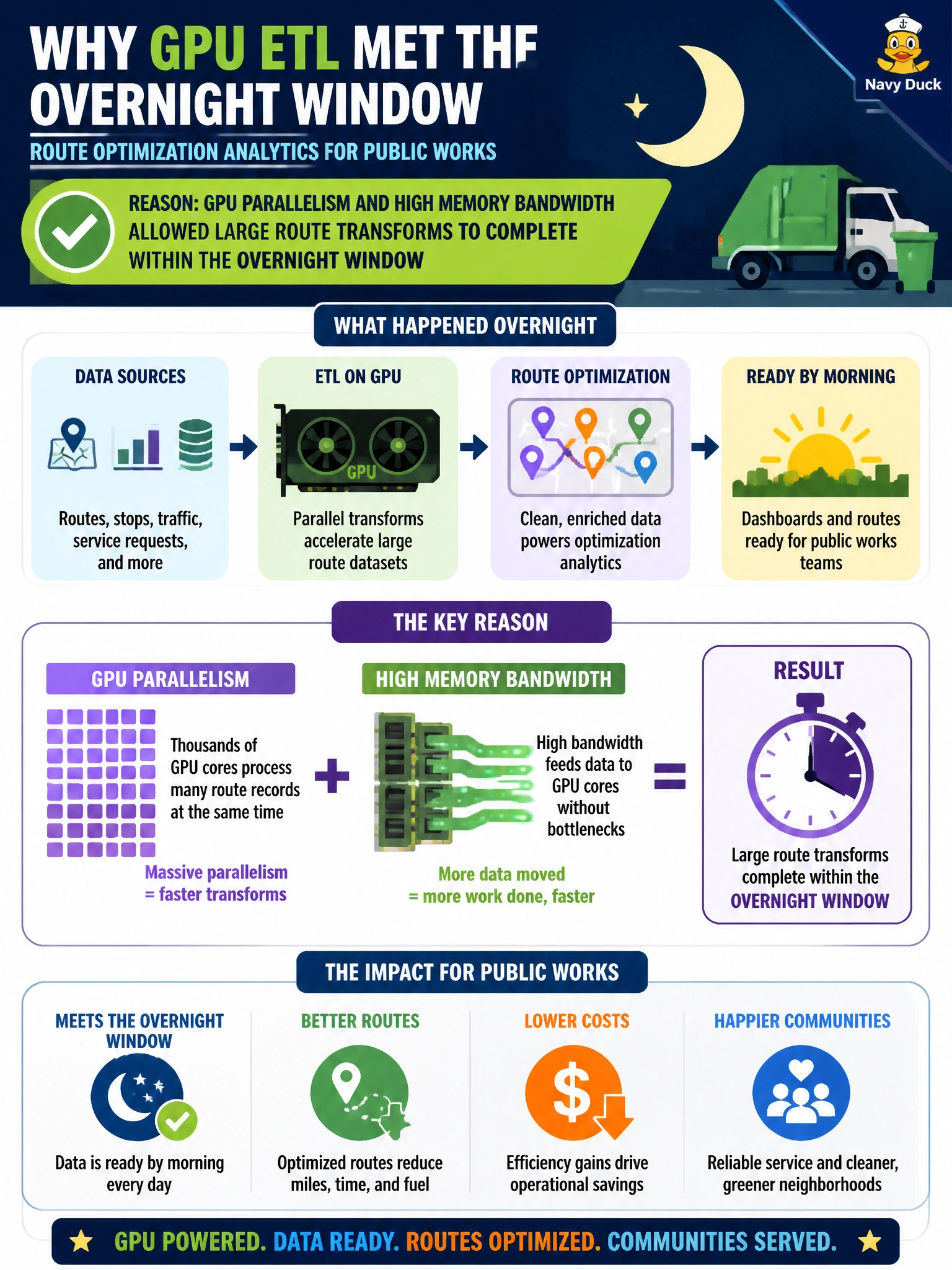
Think of the GPU as a wide highway: lots of lanes (parallelism) and a fast on-ramp (memory bandwidth) moved the route tables overnight. That's the hardware story—not magic policy changes or turning off quality checks. Paper manifests didn't finish the ETL.
Full Explanation
Overnight ETL finishing on GPU for solid-waste route optimization is best explained by GPU parallelism and high memory bandwidth completing large route transforms inside the batch window. Public works leadership needs that operational reason: the same columnar joins, aggregations, and feature builds that were too slow on CPU completed because the device processed wide tables concurrently with fast memory access.
Claiming GPUs finished faster because they disabled all logging and quality checks confuses speed with unsafe process shortcuts; acceleration does not require dropping controls. Crediting overnight success only to printing more paper manifests ignores the compute path entirely. Saying the GPU rewrote municipal policy so fewer routes were legally required invents a governance outcome hardware cannot produce.
Exam caveat: When stems ask why GPU ETL met an overnight civic window, answer with parallelism and bandwidth—not disabled QA, paper printouts, or policy rewriting.
Operational check: Compare overnight route-ETL wall times CPU vs GPU under identical quality checks, keep logging enabled, and brief public works on throughput gains tied to device parallelism rather than process shortcuts.