
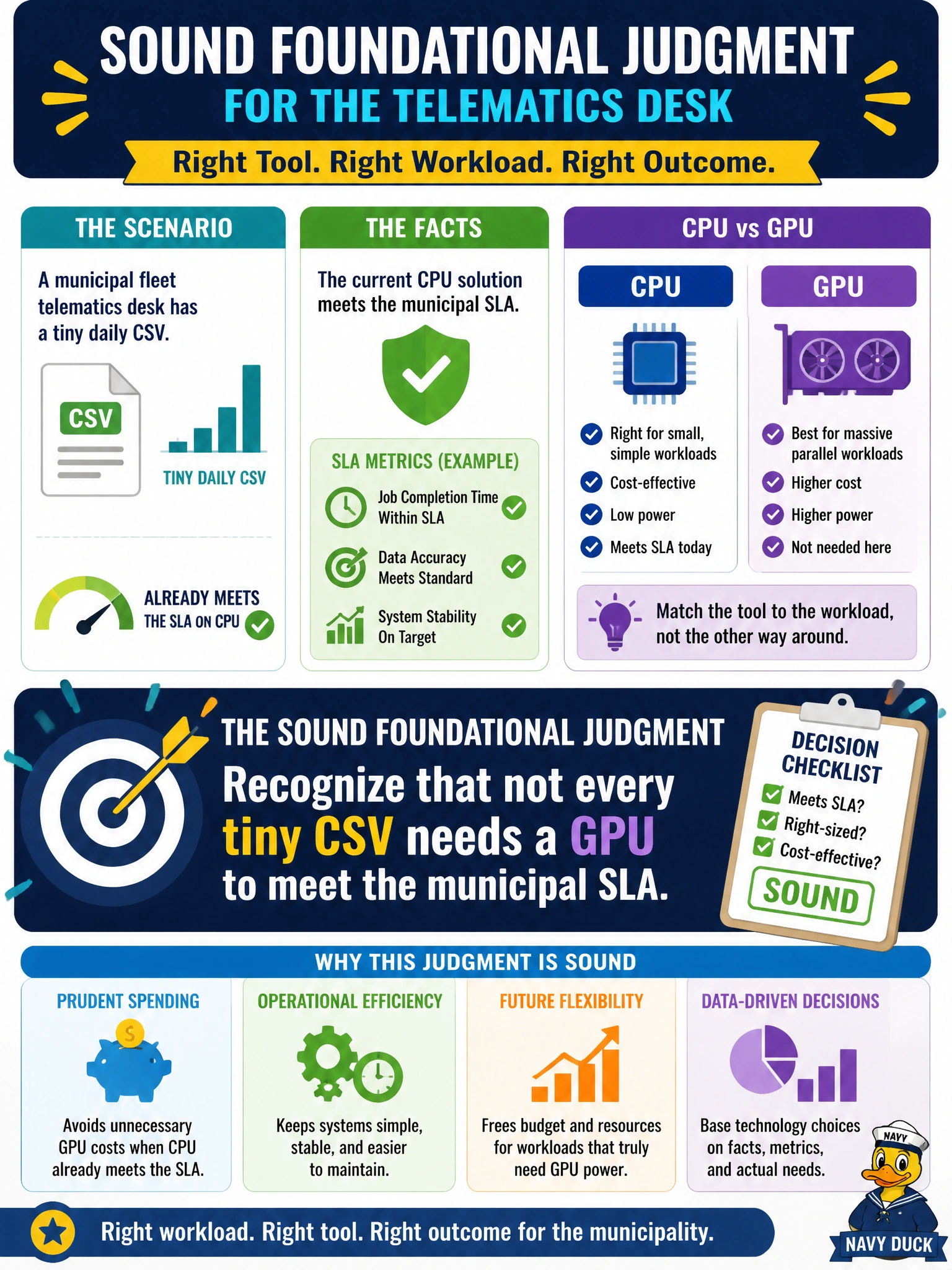
A municipal fleet telematics desk has a tiny daily CSV that already meets the SLA on CPU. What is the sound foundational judgment?
Select an answer to reveal the explanation.
Short Explanation
A postage-stamp CSV doesn't need a supercomputer—if CPU already hits the SLA, save the GPU for the heavy lifts. Acceleration is a tool, not a religion. Forcing multi-GPU on tiny files is overkill.
Full Explanation
Foundational judgment for municipal fleet telematics is proportional: a tiny daily CSV that already meets the SLA on CPU does not require a multi-GPU cluster. Domain 5 emphasizes matching hardware to data size and service levels—acceleration is a tool, not a mandate for every file. Sound engineering leaves small, SLA-compliant jobs on CPU and reserves GPUs for workloads that need them, which also protects scarce device capacity for heavier civic jobs.
Always forcing every file onto a multi-GPU cluster regardless of size wastes capacity, adds operational complexity, and can even slow tiny jobs via transfer overhead. Refusing to open CSVs under one megabyte for 'security theater' invents a non-requirement and blocks legitimate descriptive checks. Rewriting the tiny CSV as a deep neural net before any descriptive check over-models a simple fleet extract and skips basic EDA.
Exam caveat: 'Not every tiny CSV needs a GPU' is a frequent correct theme. Size and SLA drive the choice; maximal GPU theater is a distractor.
Operational check: Time the daily telematics CSV on CPU against the municipal SLA; if it clears comfortably, keep it on CPU and document GPU criteria (row count, join width, runtime breach) for when escalation is justified.