
An elections operations (non-partisan) data team needs the GPU counterparts to familiar pandas and scikit-learn stacks. What should they identify?
Select an answer to reveal the explanation.
Short Explanation
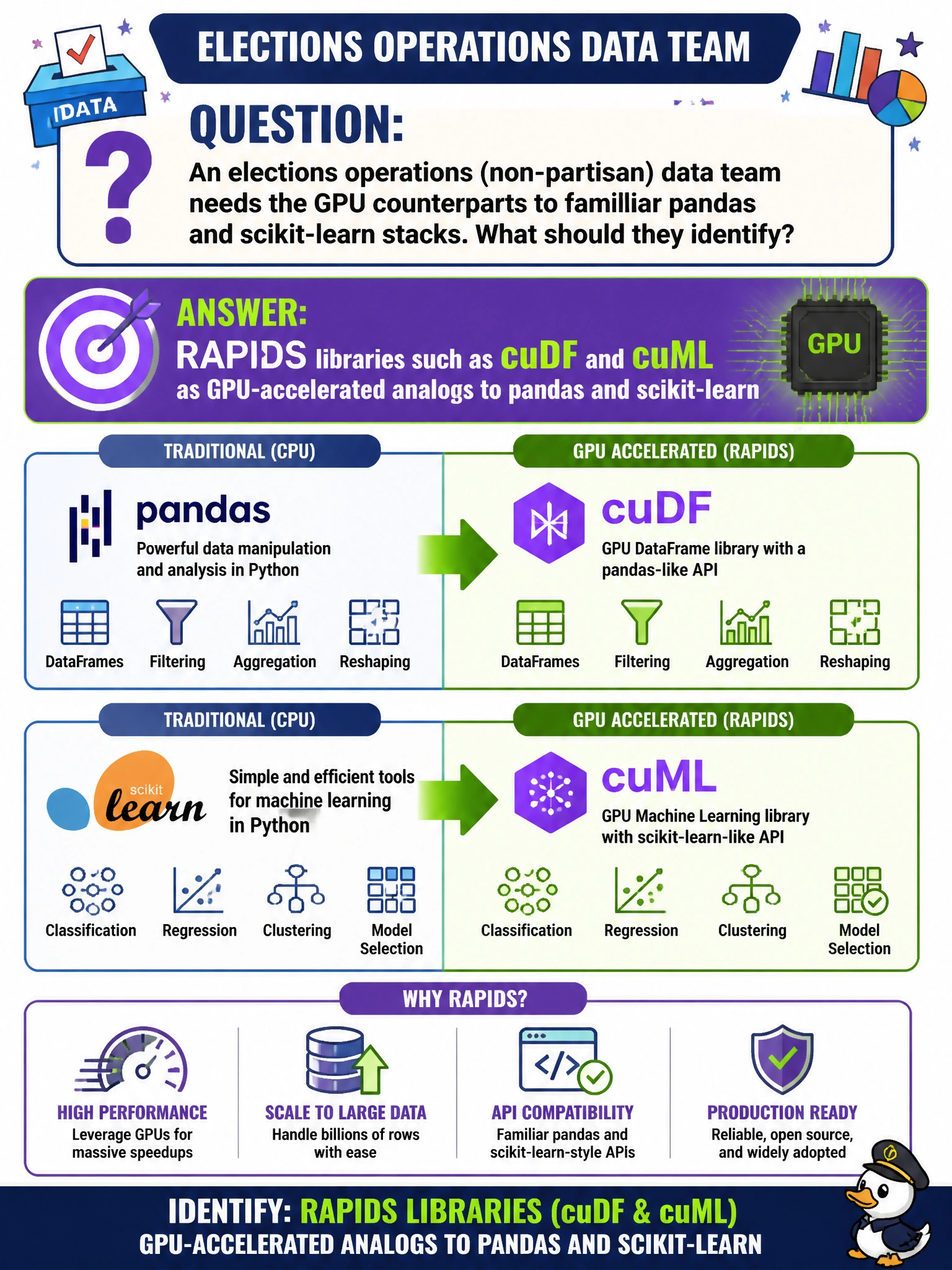
Know the map: pandas → cuDF, scikit-learn → cuML under the RAPIDS umbrella. Elections ops can keep familiar APIs while the work runs on GPU. Spreadsheets and photo editors aren't that map.
Full Explanation
Elections operations (non-partisan) teams moving from familiar CPU stacks should identify RAPIDS libraries such as cuDF and cuML as the GPU-accelerated analogs to pandas and scikit-learn. That mapping lets analysts reuse DataFrame and ML mental models while gaining device speed on large civic tables—core Domain 5 library literacy for accelerated data science. Naming the correct GPU counterparts is how municipal teams plan migrations without abandoning known APIs.
Relying only on CPU-only spreadsheet macros with no accelerated libraries ignores the GPU pathway the question asks for and will not scale election-night or countywide extracts. Treating consumer photo editors as the primary civic ML toolkit confuses image apps with tabular and classical ML libraries. Using word processors with mail merge as a RAPIDS replacement provides document assembly, not GPU DataFrames or accelerated estimators.
Exam caveat: pandas ↔ cuDF and scikit-learn ↔ cuML are the standard RAPIDS analogies. When stems ask for GPU counterparts to those stacks, name the RAPIDS libraries explicitly.
Operational check: Inventory current pandas/sklearn notebook steps for election datasets, map each to cuDF/cuML equivalents, and validate parity on a non-partisan sample before scaling to full extracts on GPU.