
A public hospital district throughput desk must explain to leadership why GPUs help on large tabular transforms. Which explanation is most accurate?
Select an answer to reveal the explanation.
Short Explanation
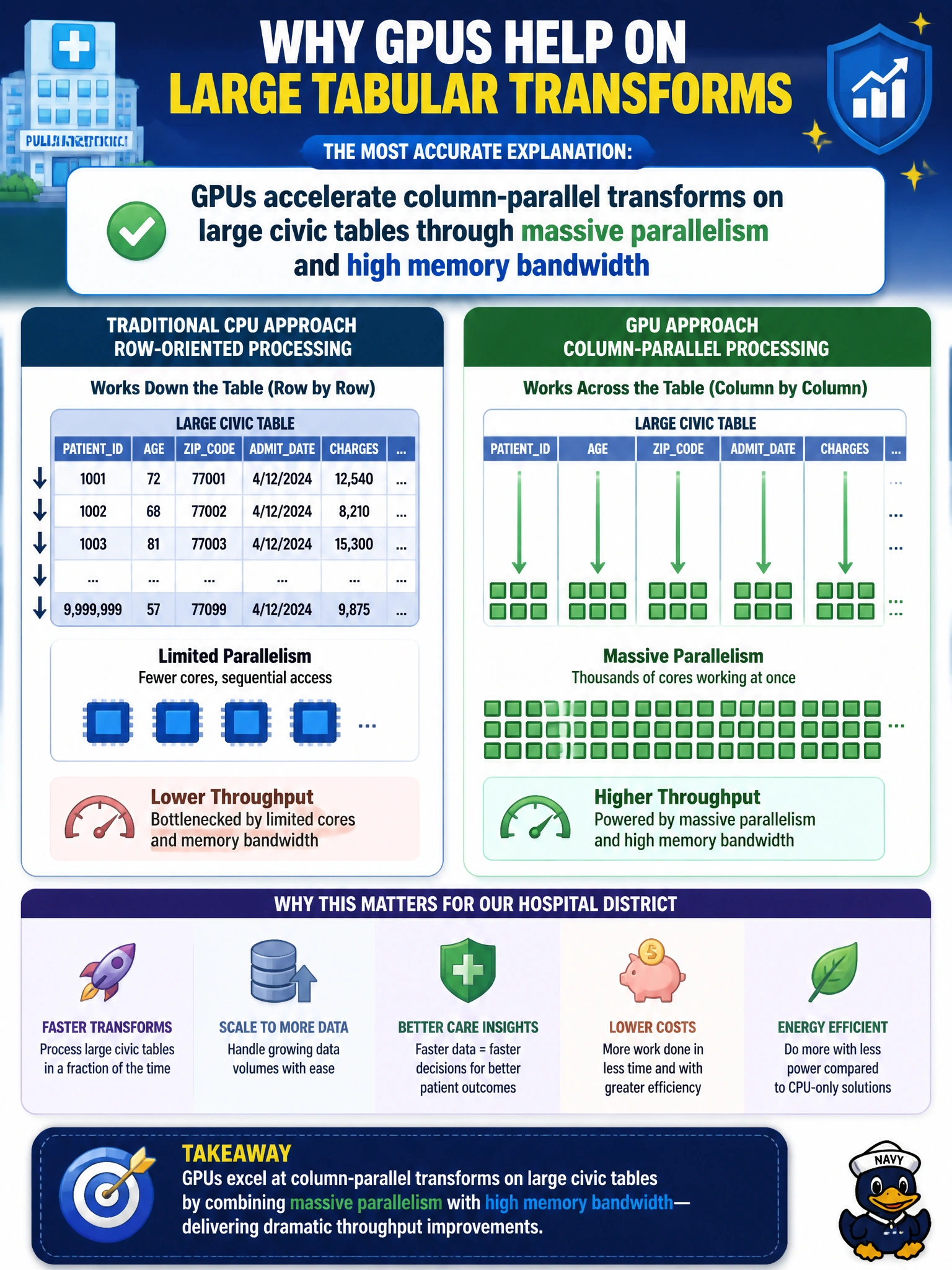
Big hospital tables are a parade of columns—GPUs march many of them at once with fat memory bandwidth. That's why large transforms finish faster, not because cleaning vanishes or slides get prettier. Single-row Python loops still aren't the hero.
Full Explanation
GPUs help large hospital-district tabular transforms because they apply massive parallelism and high memory bandwidth across columns—many rows and features processed concurrently rather than in slow serial CPU loops. That is the accurate leadership explanation for throughput desks: large civic tables benefit when transforms are column-parallel and memory-bound work moves faster on device. Domain 5 expects this hardware rationale, not marketing about slides or magically skipped cleaning.
Claiming GPUs only accelerate slide rendering and never help tabular data science is false; RAPIDS-style stacks target DataFrame and ML workloads. Saying GPUs replace the need for any data cleaning confuses acceleration with data quality—dirty inputs remain dirty, just processed faster. Claiming GPUs always make single-row Python loops faster than vectorized CPU code is wrong: interpreter-bound row loops stay poor; the win is vectorized/columnar work mapped to the GPU.
Exam caveat: Correct GPU value props emphasize parallelism and bandwidth on large tables. Distractors often invent 'slides only,' 'cleaning optional,' or 'slow Python loops magically win.'
Operational check: Profile a large tabular transform on CPU versus GPU with vectorized APIs, report wall-clock and throughput to leadership, and keep cleaning gates in the pipeline regardless of device.