
A fire/EMS response-time analytics team is stuck looping over a Python list of dicts for every calculation. What should they do early?
Select an answer to reveal the explanation.
Short Explanation
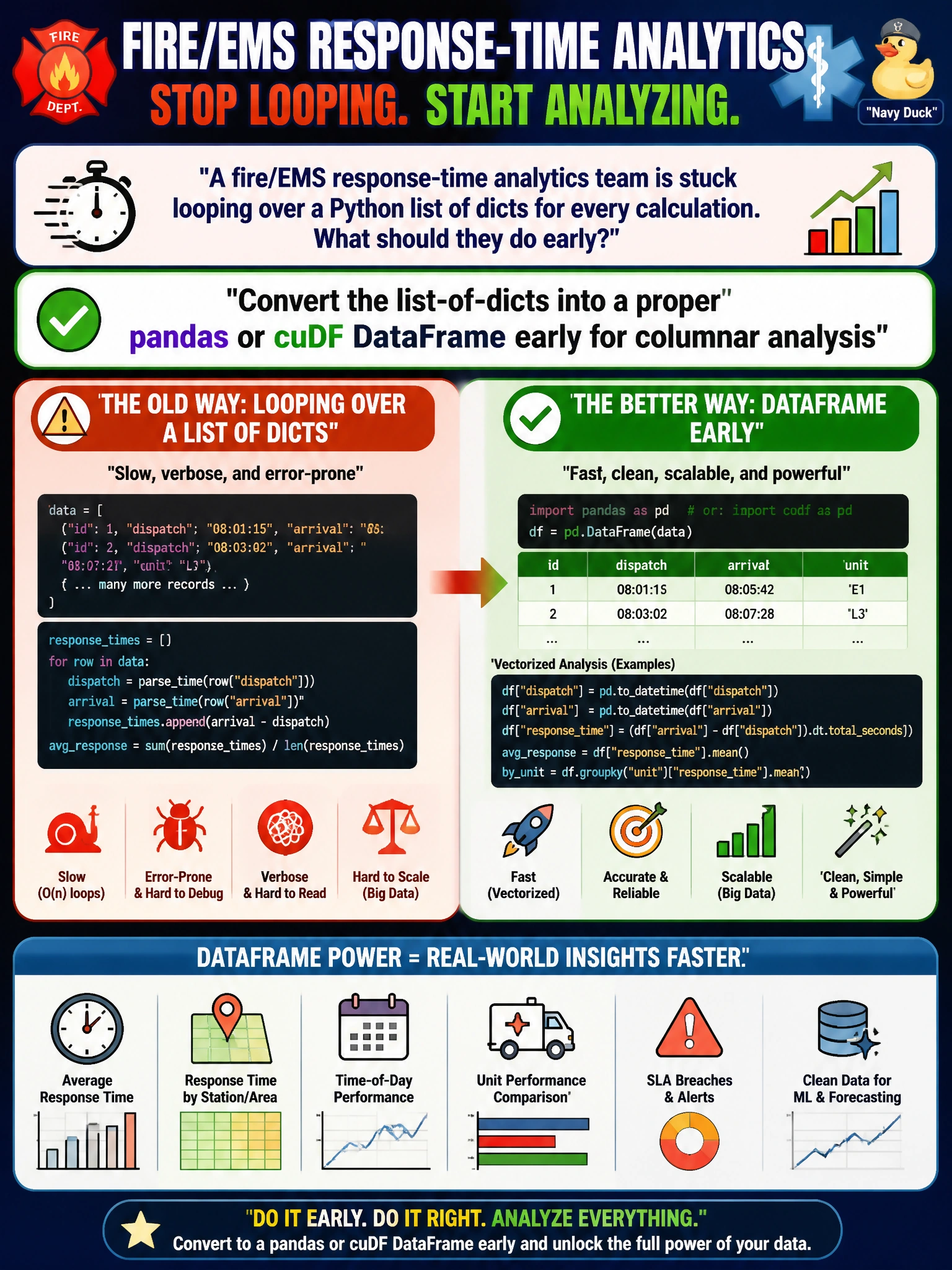
A pile of dicts is a junk drawer—pour it into a DataFrame early so columns can do the math. Fire/EMS timings belong in pandas or cuDF, not endless Python loops or wiki paragraphs. PDFs per row won't save the night.
Full Explanation
Fire/EMS response-time analytics stuck in Python loops over a list of dicts should convert early to a proper pandas or cuDF DataFrame. Columnar frames unlock vectorized filtering, group-bys, and GPU acceleration paths that row-wise dict loops cannot match. Domain 5 foundations treat early DataFrame conversion as the gateway from ad-hoc Python structures to scalable civic analysis.
Keeping the list-of-dicts forever and accepting O(n) Python loops as best practice locks the team into slow interpreter-bound work that will not meet growing call-volume SLAs. Serializing each dict to a separate PDF before any analysis turns structured telemetry into unusable documents for KPI math. Storing response times only as free-text paragraphs in a wiki destroys numeric type and aggregation capability.
Exam caveat: List-of-dicts → DataFrame early is a recurring foundations theme. Acceleration and clean descriptive stats start with columnar tables, not nested dict loops or documents.
Operational check: Parse CAD extracts into a typed DataFrame (timestamps, unit IDs, intervals), replace dict loops with vectorized ops or cuDF equivalents, and benchmark response-time KPIs before and after the conversion.