
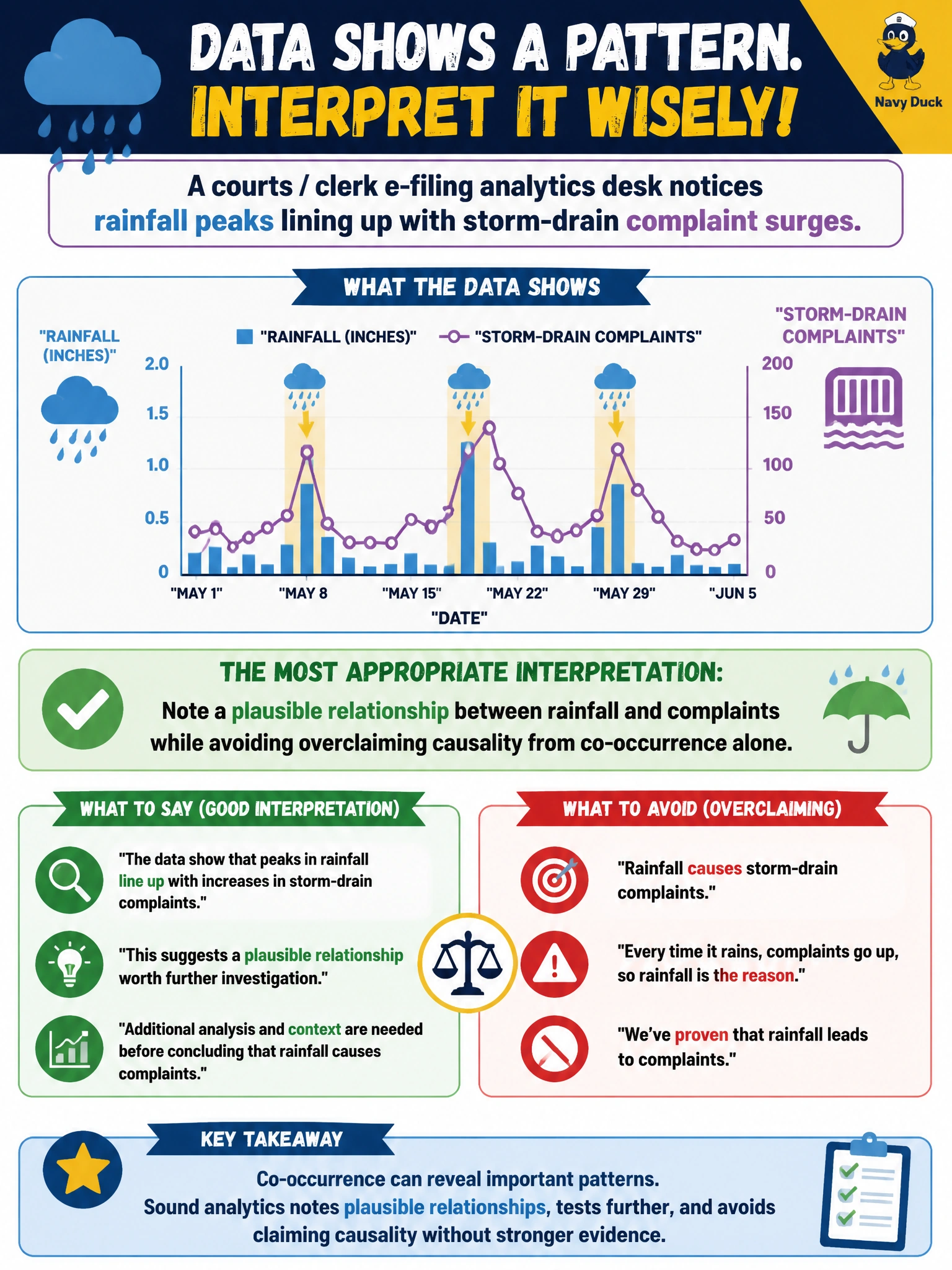
A courts / clerk e-filing analytics desk notices rainfall peaks lining up with storm-drain complaint surges. What interpretation is most appropriate?
Select an answer to reveal the explanation.
Short Explanation
Rain and drain complaints rising together is a clue, not a courtroom verdict. Report the relationship carefully and skip the leap that rain alone legally causes every ticket. Ignoring co-occurrence entirely throws away useful EDA signal.
Full Explanation
When rainfall peaks line up with storm-drain complaint surges, courts/clerk or 311-adjacent analytics should report a plausible operational relationship: wet weather stresses drainage infrastructure and drives resident tickets. That co-occurrence is useful exploratory signal for staffing flood response and prioritizing inspections. The correct interpretation notes the relationship while refusing to overclaim that rainfall is the sole legal cause of every complaint from timing alone—Domain 4 expects careful relationship reading, not courtroom causation from a chart.
Declaring rainfall the sole legal cause of every complaint without further analysis confuses co-occurrence with exclusive causation and skips confounders (clogged inlets, prior deferred maintenance, sensor coverage). Ignoring co-occurrence because 'correlation is never useful' throws away actionable EDA that guides civic ops; correlation can be highly useful without being causal proof. Automatically fining residents whenever rain gauges rise weaponizes a weather signal into punitive policy and has no analytical justification from co-occurrence alone.
Exam caveat: On NCA-ADS pattern items, prefer 'plausible relationship / avoid overclaiming causality' when stems show concurrent civic signals. Co-occurrence supports hypotheses and ops planning; it does not substitute for controlled causal evaluation or legal findings.
Operational check: Overlay rain gauges with complaint timestamps, stratify by basin and known choke points, and phrase the finding as an association with operational implications—then schedule targeted drain inspections after storms rather than issuing automatic fines.