
An emergency-management fusion cell must present a pilot’s effect size to council with more than a bare p-value. Which reporting practice best fits?
Select an answer to reveal the explanation.
Short Explanation
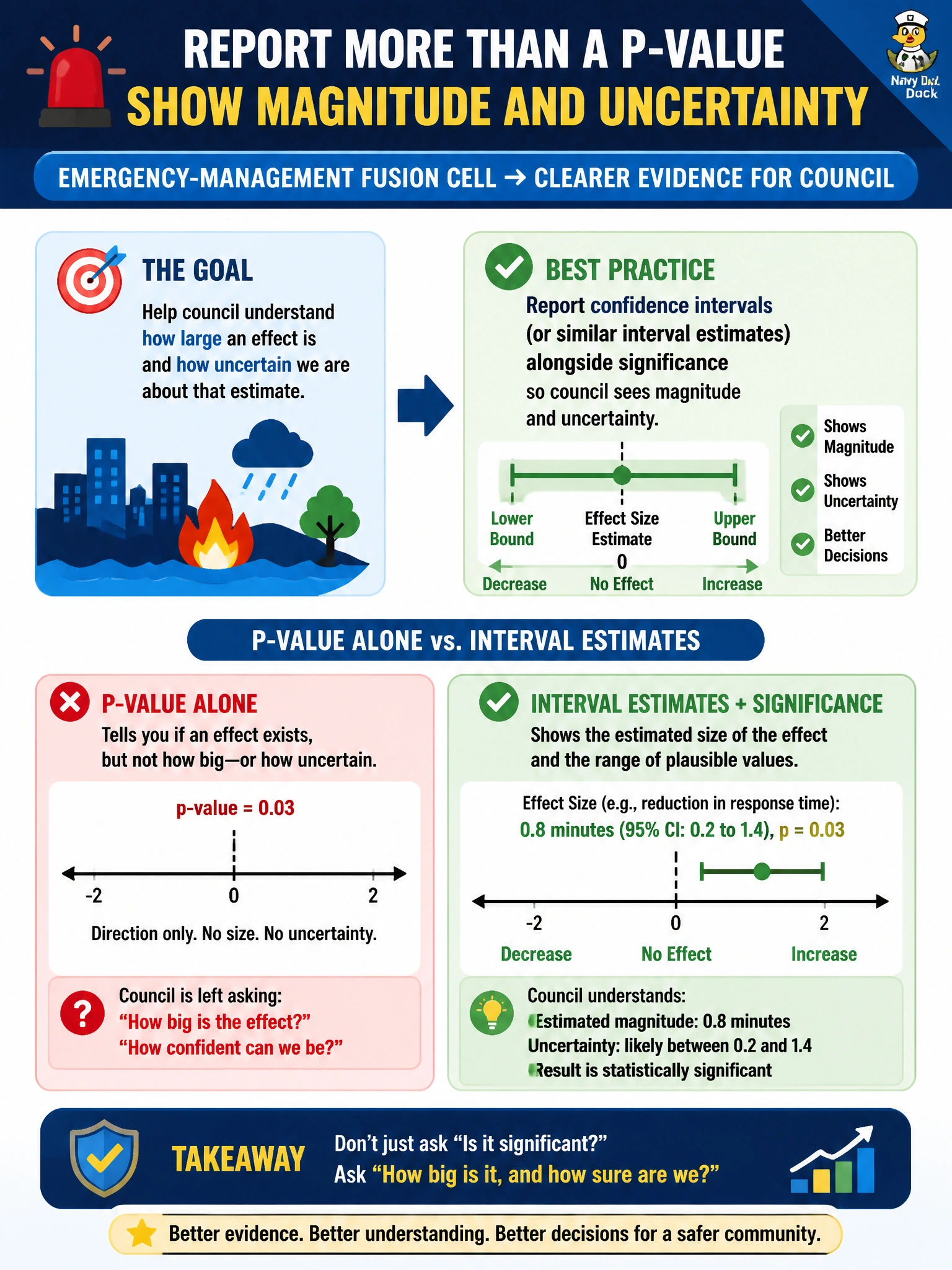
Council hears “significant” and still asks “how big?” Bring confidence intervals (or similar) with the p-value so magnitude and uncertainty show up. A lone asterisk or a stoplight with no numbers leaves emergency managers under-informed.
Full Explanation
Presenting a pilot’s effect to an emergency-management council requires more than a bare significance star: report confidence intervals (or similar interval estimates) alongside significance so magnitude and uncertainty are visible. A p-value answers a narrow null-hypothesis question; intervals communicate how large the estimated change is and how precisely it is known—exactly what council members ask after hearing “significant.” Pairing inferential significance with interval estimates is responsible reporting practice.
Showing only “p < 0.05” with no estimate of how large the change was withholds practical significance and can inflate trivial effects. Replacing all statistics with a single red/green stoplight and no numbers removes magnitude, uncertainty, and auditability. Rounding every result to zero for visual minimalism destroys the quantitative content the fusion cell exists to provide.
Exam caveat: report effect estimates with confidence intervals (or equivalent) plus significance—not p-only or stoplight-only summaries. Operational check: for the pilot metric, publish point estimate, 95% (or pre-set) confidence interval, p-value, sample sizes, and plain-language interpretation of the interval relative to an operationally meaningful threshold before the council slide is finalized.