
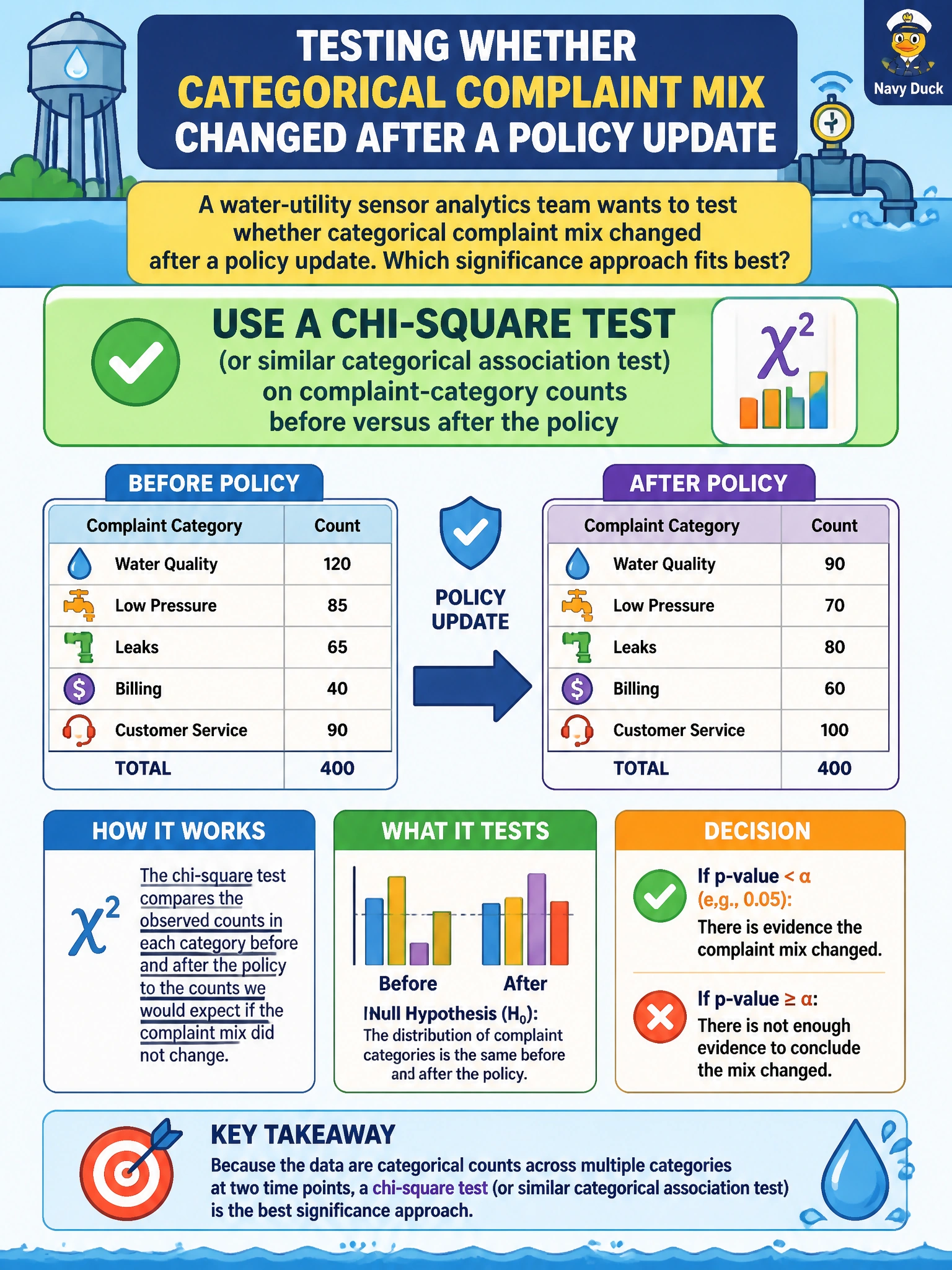
A water-utility sensor analytics team wants to test whether categorical complaint mix changed after a policy update. Which significance approach fits best?
Select an answer to reveal the explanation.
Short Explanation
Complaint mix is categories and counts—chi-square territory, not “t-test the names.” Compare before/after category tables the right way for water-utility policy checks. Pretty legend shifts without a categorical test aren’t significance.
Full Explanation
Testing whether categorical complaint mix changed after a water-utility policy update fits a chi-square test (or similar categorical association / homogeneity test) on complaint-category counts before versus after. The data are category frequencies, not continuous minutes, so the inferential tool must match the measurement scale. Chi-square (or Fisher’s exact when counts are small) evaluates whether the distribution across complaint types shifted with the policy window in a way not easily attributed to chance under the null.
Using a paired t-test on category names treated as if they were continuous minutes commits a scale error: names are not numeric intervals. Skipping testing and assuming any visual legend difference is statistically significant confuses perception with inference. Regressing complaint text through an LLM and treating the essay as a p-value is not a significance procedure and invents false statistical theater.
Exam caveat: categorical count tables → chi-square/homogeneity (or exact tests); do not t-test labels or substitute generative text for p-values. Operational check: build before/after contingency counts for complaint categories, check expected cell frequencies, run chi-square (or exact), inspect standardized residuals for which categories moved, and attach the table plus test summary to the policy evaluation brief.