
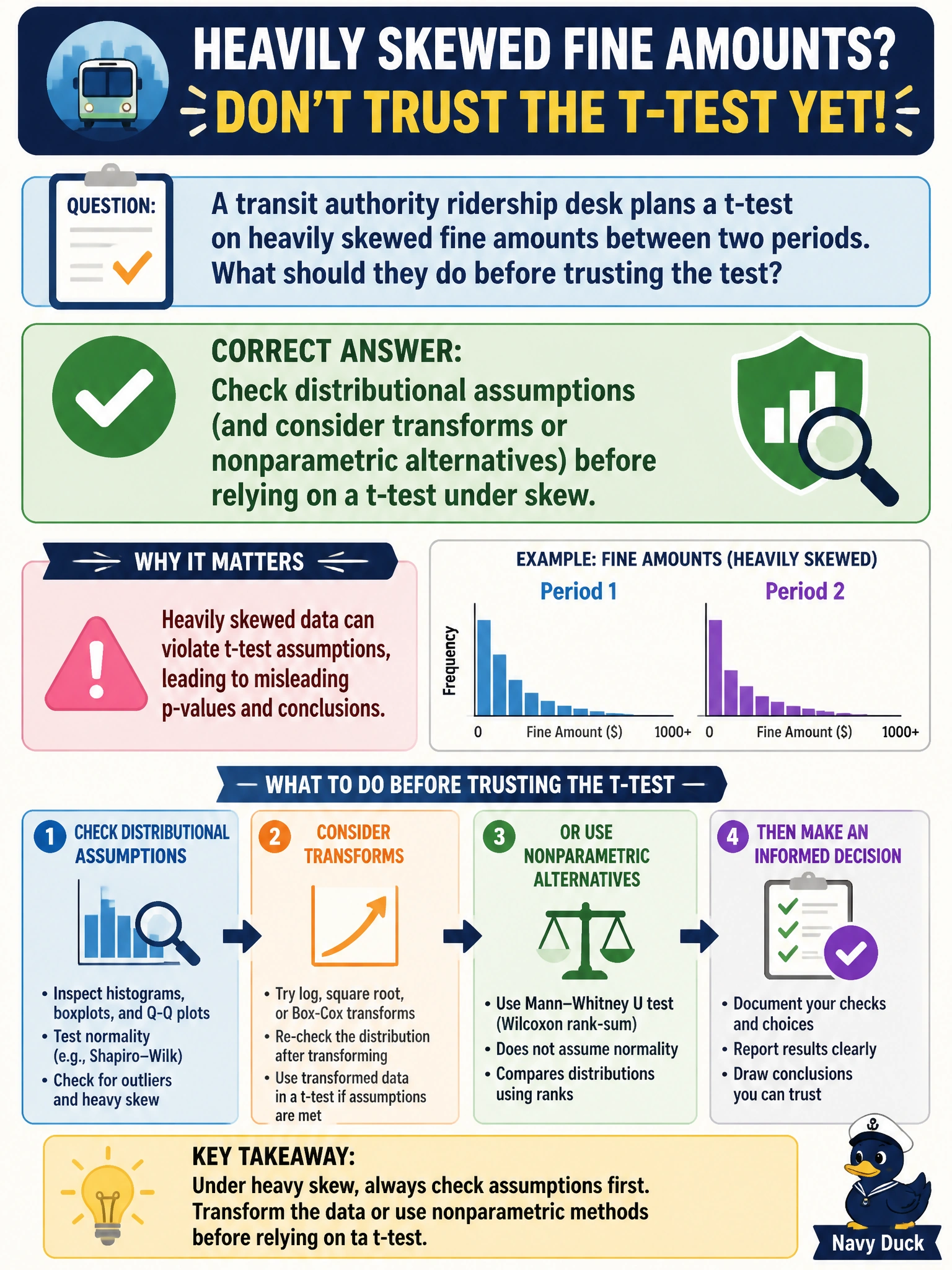
A transit authority ridership desk plans a t-test on heavily skewed fine amounts between two periods. What should they do before trusting the test?
Select an answer to reveal the explanation.
Short Explanation
Skewed fine piles can break the cozy normal-ish world a plain t-test likes. Check assumptions first—or transform / switch tests—before transit leadership trusts the p-value. Blind t-tests on ugly skew are how “significant” becomes “suspicious.”
Full Explanation
Planning a t-test on heavily skewed transit fine amounts between two periods requires checking distributional assumptions first and considering transforms or nonparametric alternatives before trusting the parametric test. Classical t-tests lean on approximate normality of means (and related assumptions); heavy skew and outliers in fine amounts can distort Type I/II behavior in finite samples. Responsible practice inspects histograms/QQ plots, considers log or other transforms, or switches to a Wilcoxon/Mann–Whitney (or bootstrap) approach when assumptions fail.
Running the t-test blindly because “skew never affects parametric assumptions” ignores a core validity condition. Deleting half the fines at random until the histogram looks normal is data mutilation, not assumption repair, and biases the municipal fine population. Reporting only the t-statistic without inspecting distribution shape withholds the diagnostic evidence needed to trust the p-value.
Exam caveat: under skew, validate or adapt (transform/nonparametric)—do not blind-t-test or randomly delete observations to force normality. Operational check: plot fine-amount distributions by period, test sensitivity with a nonparametric alternative, pre-specify the primary analysis in the ridership desk memo, and report both location shift estimate and assumption checks to transit leadership.