
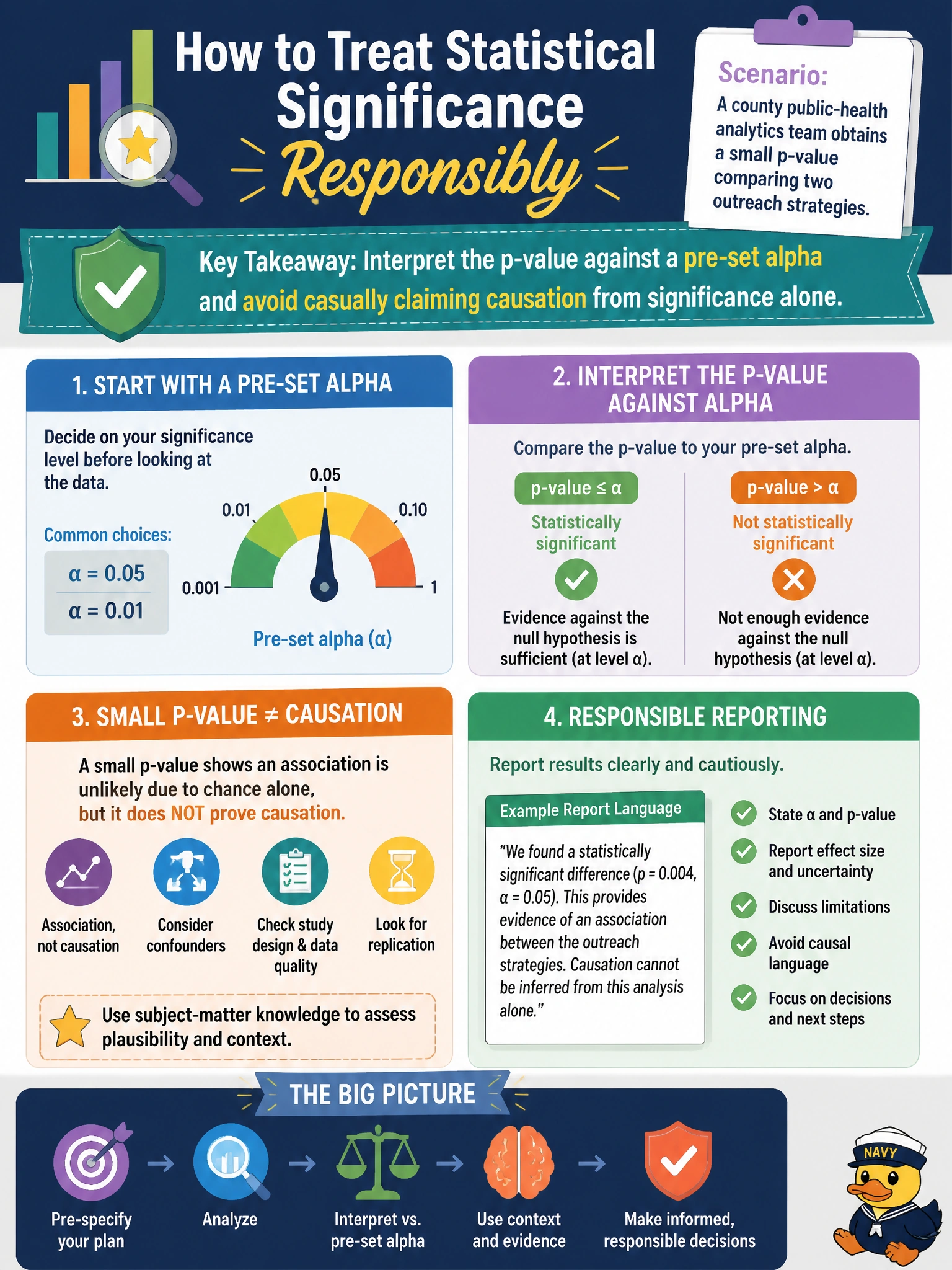
A county public-health analytics team obtains a small p-value comparing two outreach strategies. How should they treat statistical significance responsibly?
Select an answer to reveal the explanation.
Short Explanation
A small p-value means “surprising under the null,” not “we proved the universe’s cause.” Set alpha, interpret honestly, and don’t leap from significance to casual causation in public-health memos. Marketing-only slides skip the science Domain 4 still expects.
Full Explanation
A small p-value in a county public-health comparison of outreach strategies must be interpreted against a pre-set alpha and must not be casually equated with causation. Statistical significance means the observed difference (or a more extreme one) would be unlikely under the null model at the chosen alpha; it does not automatically prove that the outreach caused every downstream health outcome, nor does it replace study design, bias analysis, or practical significance. Responsible Domain 4 practice keeps that boundary clear in leadership memos.
Claiming the outreach caused every health outcome citywide with no caveats overreaches from a significance result to universal causal certainty. Ignoring alpha and treating every nonzero difference as proven policy truth abandons Type I error control and floods decision-making with noise. Hiding the p-value and showing only marketing slogans removes the quantitative evidence trail public-health governance expects.
Exam caveat: interpret p against pre-set alpha; significance ≠ automatic causation. Operational check: state alpha before analysis, report exact p (or bounded), discuss confounding and design limits beside the result, include effect size, and phrase recommendations as evidence-supported—not as metaphysical proof—for the outreach steering committee.