
A water-utility sensor analytics team enables a data flywheel but must stop poisoned or biased new rows from silently entering training. Which safeguard fits best?
Select an answer to reveal the explanation.
Short Explanation
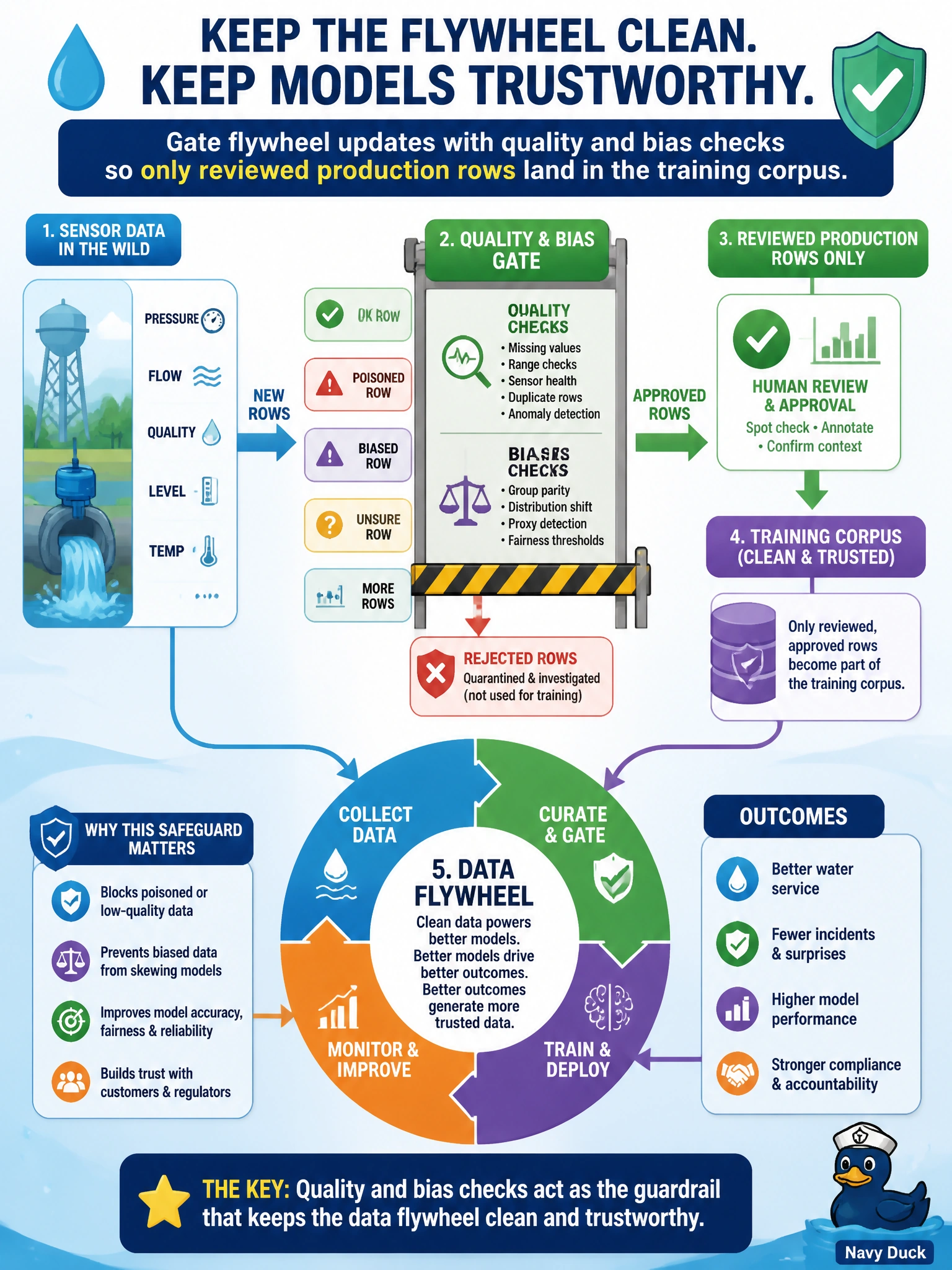
A flywheel without a gate is like pouring every hose reading—glitches and all—straight into the recipe book. Put quality and bias checks in front of training so only reviewed production rows land. Speed that skips those gates just teaches the next model bad water-utility habits.
Full Explanation
A water-utility sensor flywheel that continuously adds production rows to training must gate those updates with quality and bias checks. SCADA and field telemetry often include sensor faults, maintenance windows, biased sampling from easier-to-instrument districts, and schema glitches. Without gates, poisoned or biased rows silently reshape the next model’s notion of “normal” pipe behavior. The correct safeguard admits only reviewed production rows that pass schema, distribution, and fairness/quality screens into the training corpus, preserving the flywheel’s benefit while blocking silent corruption.
Appending every production row immediately with no schema or distribution checks fails by design: it maximizes throughput of bad data and turns the flywheel into a contamination pump. Disabling monitoring so the flywheel “runs faster overnight” removes the detection layer that would catch drift, poisoning, or sudden class imbalance before training. Replacing curated training data with unfiltered SCADA dumps each hour erases carefully labeled history and substitutes raw operational noise for a governed corpus.
Exam caveat: flywheel enablement without quality/bias gates is a trap answer; NCA-ADS expects governed admission of production feedback. Operational check: stage candidate flywheel rows, run null-rate and range checks, compare feature distributions to the approved baseline, flag demographic or district skew if applicable, require analyst sign-off on exceptions, and only then merge into the water-utility training partition used by the next scheduled retrain.