
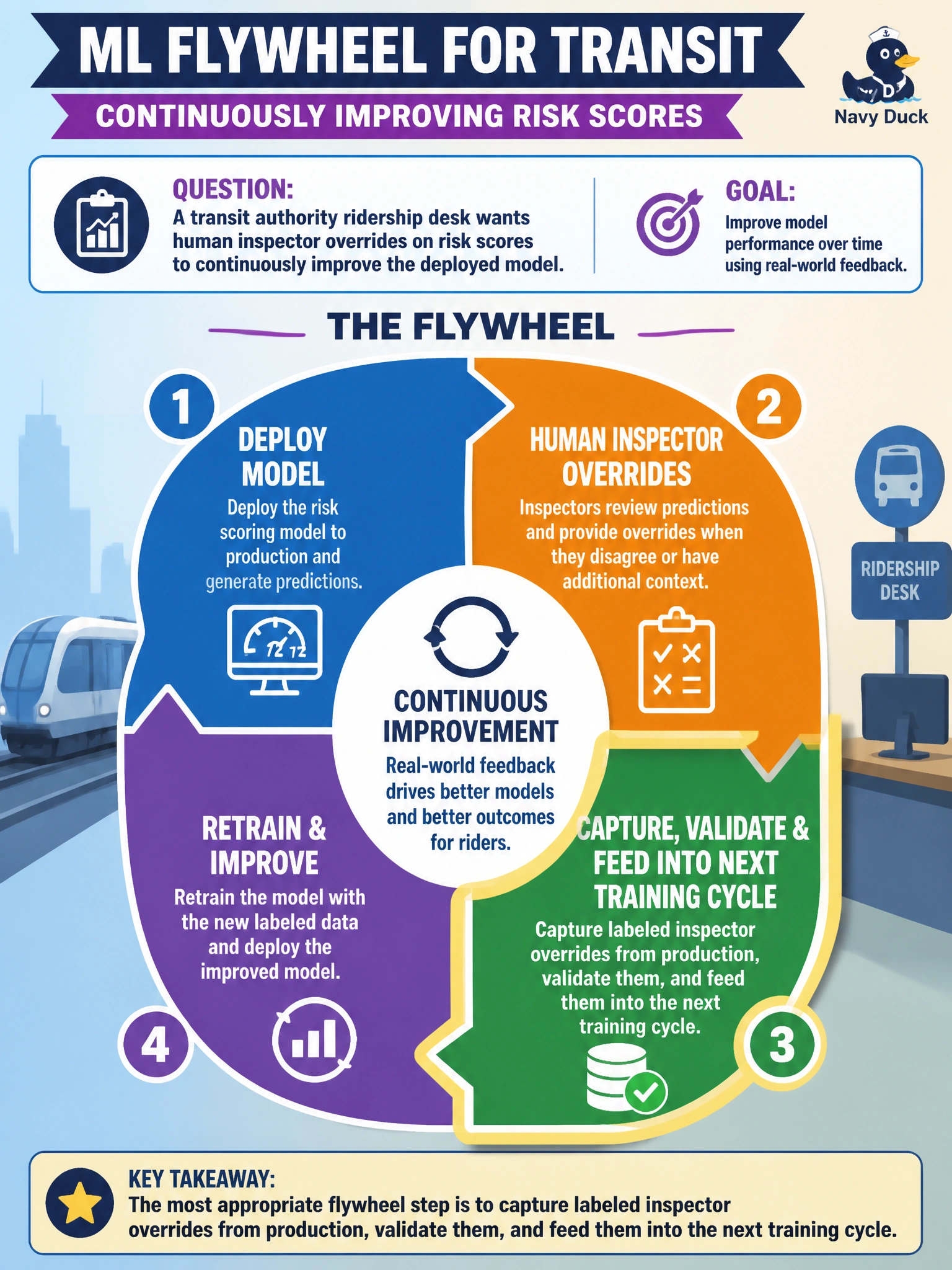
A transit authority ridership desk wants human inspector overrides on risk scores to continuously improve the deployed model. Which flywheel step is most appropriate?
Select an answer to reveal the explanation.
Short Explanation
When an inspector corrects a ridership-risk flag, that correction is gold—if you catch it, check it, and teach the next model. Capture those human-in-the-loop labels from production and fold validated ones into retraining. Throwing them away or blind-trusting every click without a review path breaks the flywheel.
Full Explanation
Human-in-the-loop inspector overrides are a first-class training signal for transit ridership risk models when they are captured, validated, and fed into the next training cycle. When an inspector corrects a model score on the ridership desk—raising risk for a crowded hub or clearing a false alarm—that labeled override documents where the deployed scorer disagreed with operational judgment. Folding validated overrides into retraining continuously improves the model on the exact edge cases the authority actually cares about, instead of treating the human as noise or as infallible automatic truth.
Discarding overrides because humans should never correct model scores rejects the flywheel and wastes paid inspector expertise that exists precisely to catch model blind spots. Treating every override as automatic ground truth without a review queue fails governance: click fatigue, accidental toggles, and inconsistent inspector criteria can poison labels if no validation step exists. Hiding overrides from the data team so the model never sees operational corrections severs the feedback path and guarantees the same mistakes recur in production.
Exam caveat: the tested pattern is capture → validate → retrain, not discard, not blind auto-label, and not hide-from-ML. Operational check: persist override events with inspector ID, timestamp, prior score, and new label; sample for dual review; exclude contested rows; merge approved labels into the next training extract; and monitor lift on the override-prone stations after redeploy.