
A county public-health analytics team wants production prediction errors to continuously improve the next training corpus. Which approach best enables that data flywheel?
Select an answer to reveal the explanation.
Short Explanation
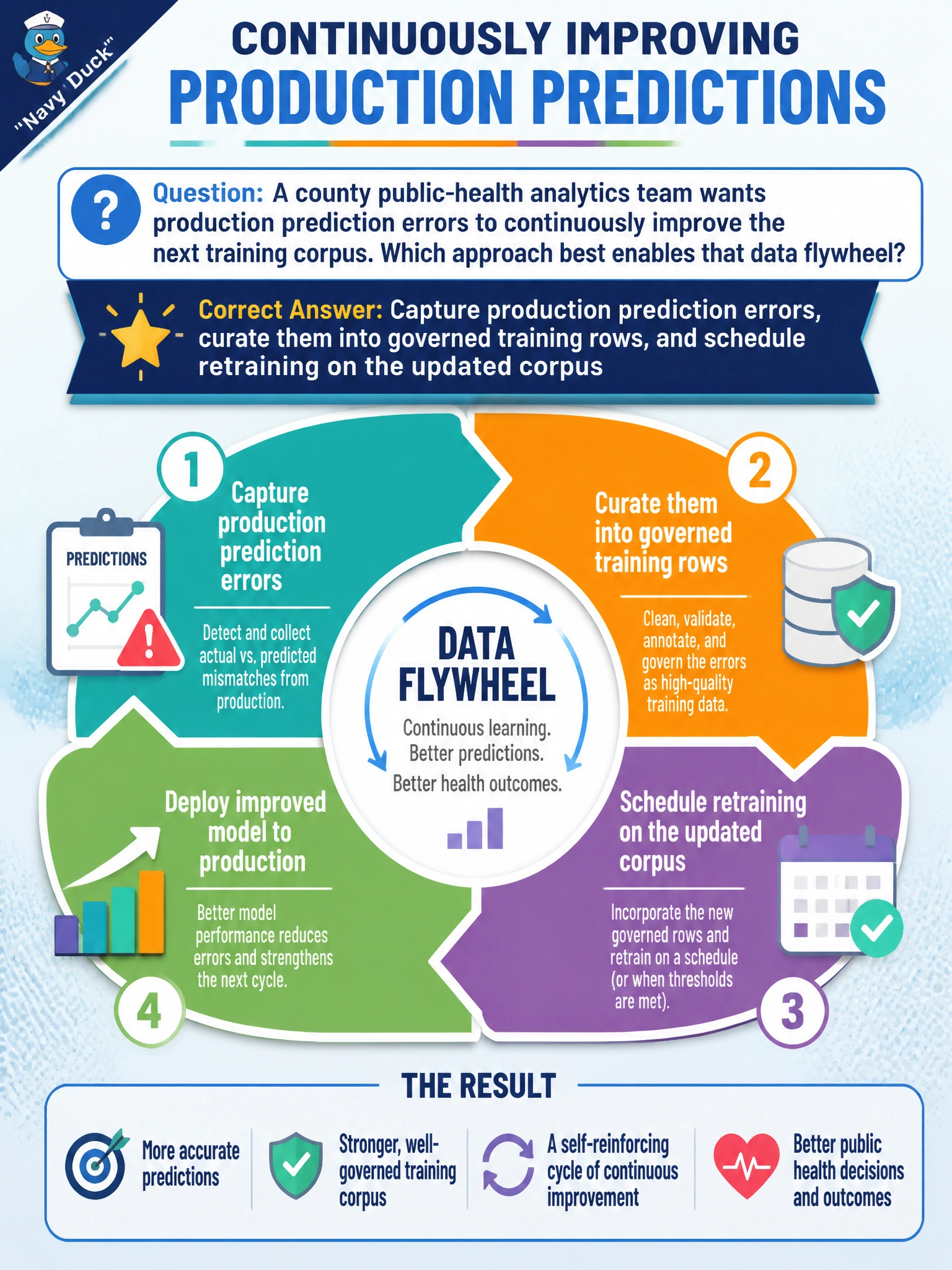
A flywheel is like using last month’s wrong flu-risk calls as study material for next month’s model—only after someone curates them. Capture those production misses, fold them into a governed training set, then retrain on a schedule. Freezing forever or dumping raw errors into the wild skips the improvement loop.
Full Explanation
A county public-health prediction flywheel closes the loop from live model misses back into a governed training corpus. Production prediction errors—cases where risk scores missed outreach targets, false positives that wasted nurse time, or false negatives that delayed intervention—are operational gold only after curation. The sound approach is to capture those errors, review and label them under data-governance rules, append the approved rows to the training set, and schedule retraining so the next model improves on yesterday’s blind spots rather than freezing forever or thrashing weights randomly.
Freezing the training set so production outcomes never touch the model again fails the flywheel concept: without a path from field outcomes into training, drift and novel case patterns accumulate unchecked. Overwriting the live model nightly with random weights sampled from production logs is not learning; it destroys a validated checkpoint and injects noise into clinical decision support. Publishing every raw prediction error to the public open-data portal without review conflates internal model-improvement telemetry with public release, risking privacy leakage, unvalidated labels, and politicized misinterpretation of unfinished curation.
Exam caveat: flywheel questions reward curated, scheduled incorporation of production feedback—not permanent freeze, not random weight overwrite, and not ungated public dumps. Operational check: log prediction-versus-outcome pairs in a restricted store, run schema and PHI screens, route disputed rows to an analyst queue, promote only approved rows into the next training partition, and retrain on a calendar that public-health leads can audit.