
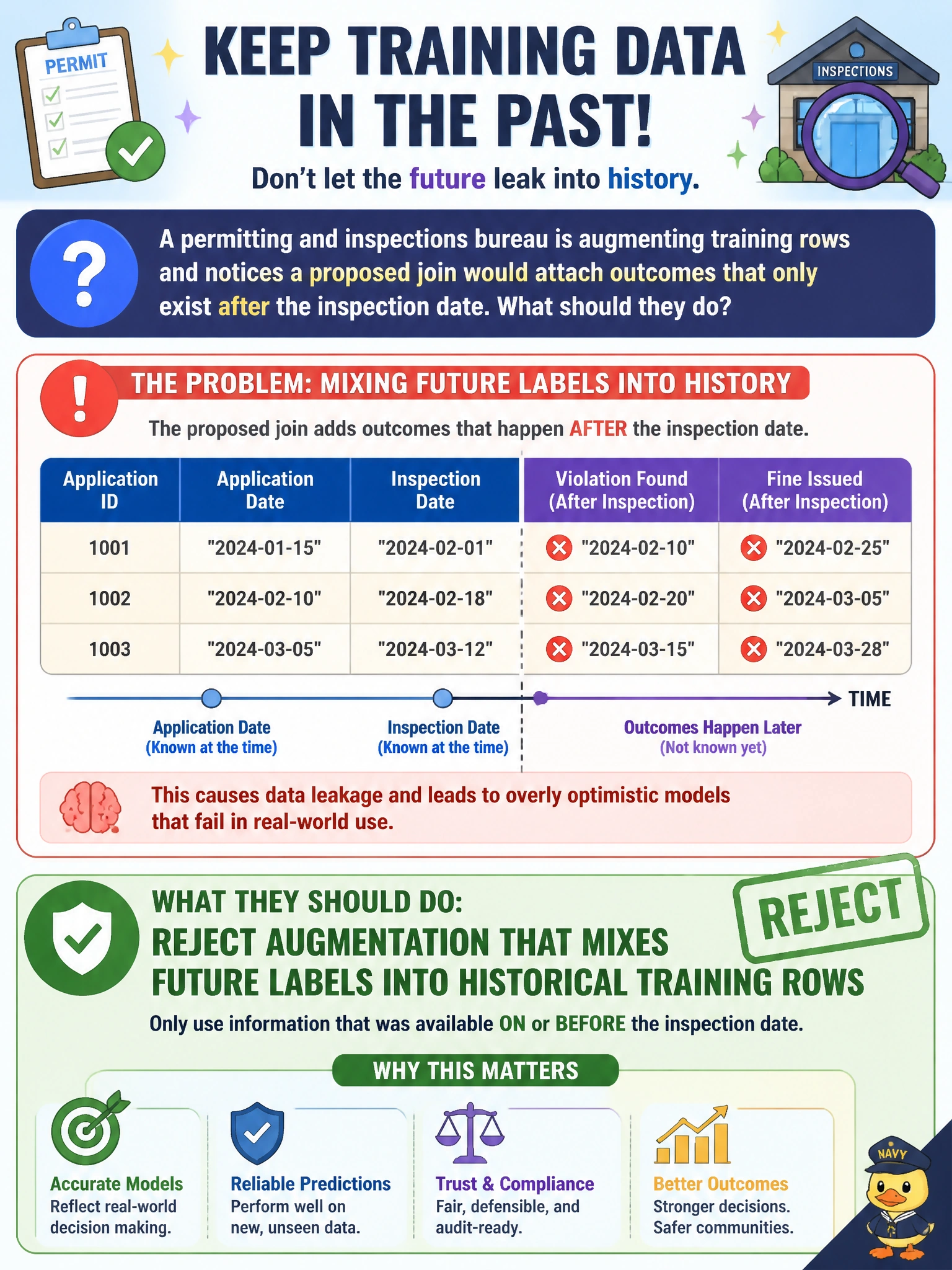
A permitting and inspections bureau is augmenting training rows and notices a proposed join would attach outcomes that only exist after the inspection date. What should they do?
Select an answer to reveal the explanation.
Short Explanation
Don’t staple tomorrow’s inspection result onto yesterday’s row—that’s peeking at the answer key. Reject the leaky join.
Full Explanation
Permitting and inspections augmentation must preserve temporal honesty. A join that attaches outcomes only available after the inspection date mixes future labels into historical training rows—classic leakage that inflates training accuracy and will not exist at score time when inspectors need a prediction. Reject that augmentation rather than chasing a contaminated accuracy bump. Accepting the join because training accuracy rises celebrates metrics that cannot survive honest as-of scoring in the bureau. Backfilling future outcomes into every past row as mandatory features institutionalizes leakage across the entire training set and guarantees brittle production failure. Shuffling timestamps to hide leakage makes detection harder and is unethical engineering, not a remediation of the temporal defect. Exam caveat: any augmentation that adds post-event outcomes to pre-event rows must be rejected on temporal-honesty grounds. Operational check: for each proposed join key, verify as-of timing against inspection date; refuse joins where the attached field’s available-time is after the decision timestamp, and document as-of rules in the permitting feature specification. In municipal practice for this NCA-ADS scenario (item q093), document the decision, retain evidence for auditors, and re-validate holdout civic metrics after any change so operational owners can defend the choice under scrutiny.