
A 311 resident-service analytics team wants better storm-day learning for ridership-adjacent demand models. How should they enhance training data?
Select an answer to reveal the explanation.
Short Explanation
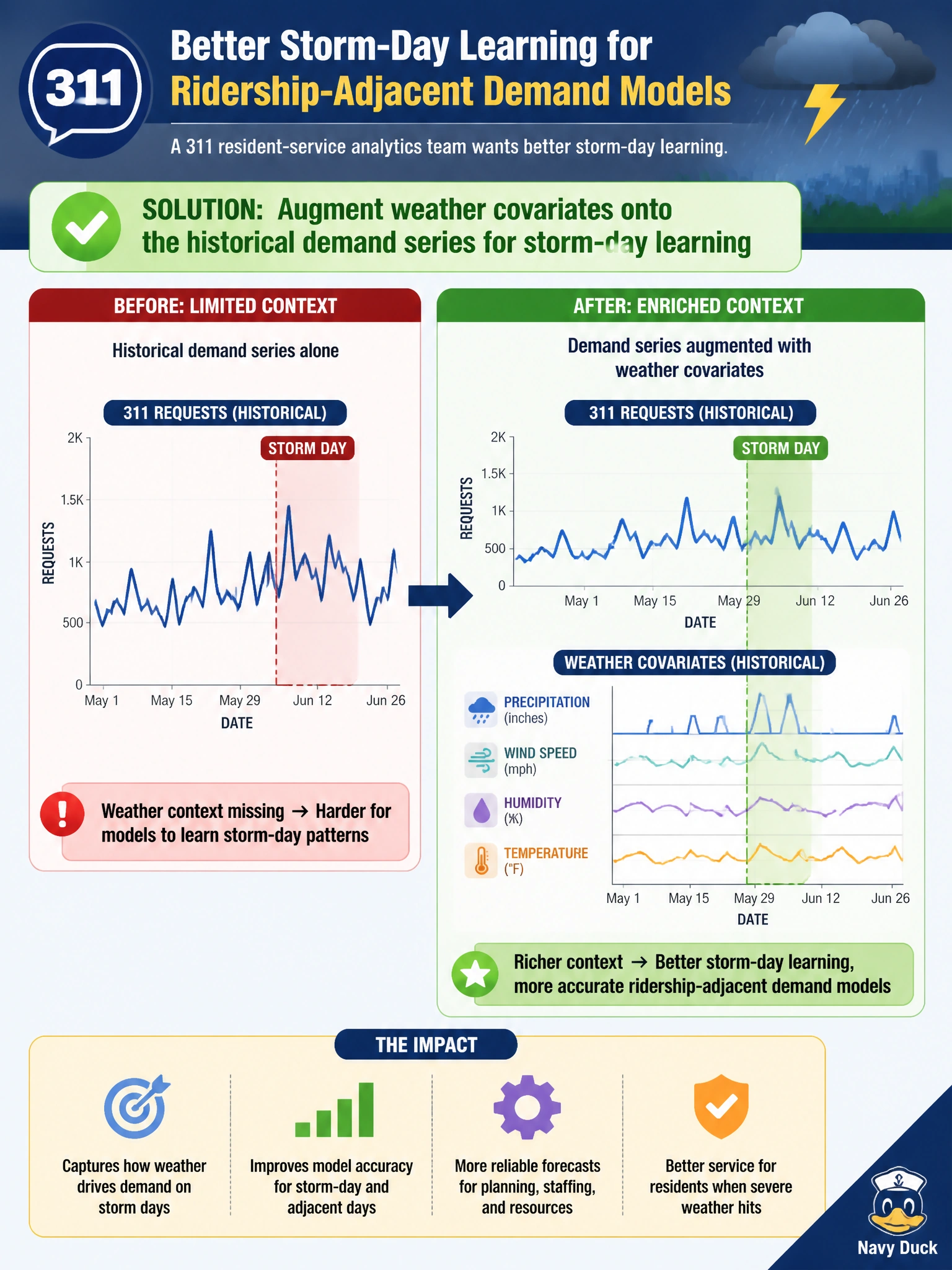
Storm days behave differently—glue weather covariates onto the history so the model can study rainy Mondays, not pretend every day is sunny.
Full Explanation
311 resident-service and ridership-adjacent demand behave differently on storm days. Augmenting weather covariates onto the historical demand series gives the model storm-day context—precipitation, wind, temperature alerts—so learning can condition on civic weather regimes instead of treating every day as clear. Deleting all storm days removes the regime the team wants to improve and guarantees poor performance exactly when resident demand and routing stress spike. Replacing timestamps with unrelated random integers destroys temporal structure needed for demand learning and seasonal civic patterns. Training only on clear-weather weeks and hoping storms generalize fails because storm dynamics are out of distribution relative to clear weeks; hope is not a transfer strategy. Exam caveat: improve storm-day learning by joining weather covariates onto history; do not delete storms or scramble time indexes. Operational check: join quality-checked weather features to the historical 311 or demand series on event time, retrain, and compare storm-day holdout error against a clear-weather-only baseline before expanding the pilot. In municipal practice for this NCA-ADS scenario (item q092), document the decision, retain evidence for auditors, and re-validate holdout civic metrics after any change so operational owners can defend the choice under scrutiny.